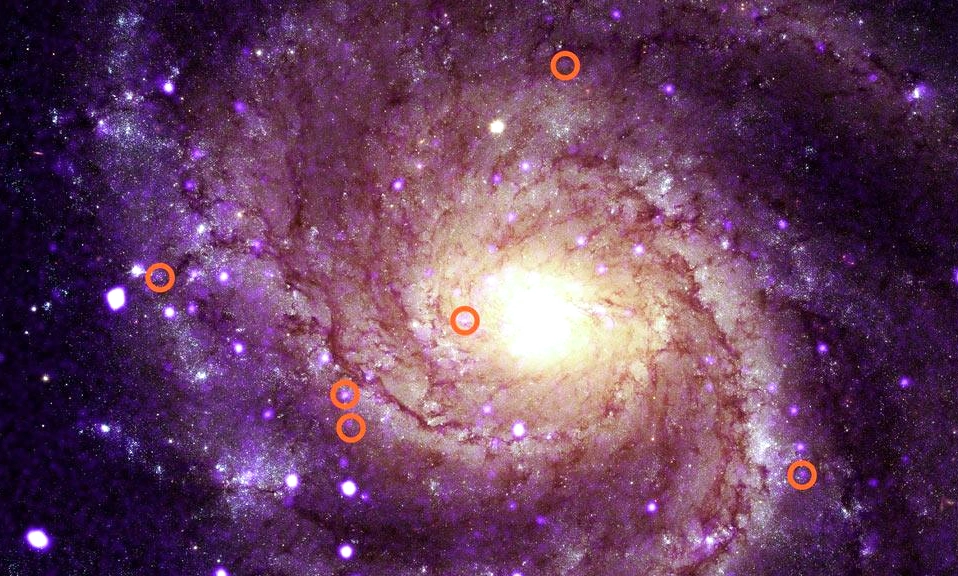
In the vast, silent dark of space, NASA’s Chandra X-ray Observatory has been quietly collecting data for decades. Somewhere in that archive, a signal was hiding—faint, unusual, and dismissed for years as noise. Now, scientists have realized it belongs to a completely new class of objects, and they have no idea what they are.
Using NASA’s Chandra X-ray Observatory, astronomers have discovered 84 mysterious objects spread across six different galaxies that behave unlike anything they’ve seen before. The objects give off unusually low-energy X-rays but intense levels of ultraviolet radiation—a combination that doesn’t match any known type of celestial body.
“We’ve never encountered a group of objects that act like this,” said Mustafa Muhibullah of the University of Alabama, who led the study published in Nature Astronomy. “Of course, the next step was to try to figure out what these things are.”
What Are Hypersoft X-ray Sources?
The researchers have nicknamed these objects “hypersoft X-ray sources” because they emit such low-energy X-rays. The team found them in six galaxies: two spirals, M31 (the Andromeda galaxy) and M101 (the Pinwheel galaxy), and four elliptical galaxies. They appeared in regions of active star formation as well as areas with older stars.
The discovery came from a clever observational technique. The team searched for objects that appeared in Chandra images taken at the lowest X-ray energies but vanished in higher-energy images. This meant these objects give off far more low-energy X-rays than high-energy ones. Because low-energy X-rays border energetic ultraviolet radiation on the electromagnetic spectrum, the researchers determined that these sources must also be producing large amounts of energetic ultraviolet radiation—most of which is absorbed by gas between the stars before it can reach us.
What’s remarkable is that these objects have been hiding in plain sight for decades. “Scientists didn’t even know the objects were there,” said Jimmy Irwin, a professor at the University of Alabama and co-author of the study. “They ignored the very, very lowest-energy channels because they thought they were unimportant.”
What Could They Be?
The exact nature of these objects remains a mystery, but the team has some ideas. They believe the sources most likely involve a black hole, neutron star, or white dwarf pulling material from a companion star. As the material is heated, it produces X-rays before falling onto the compact object. Such binary systems have been seen before—but never with such bright ultraviolet radiation and such low-energy X-rays.
“They must be compact objects that are the remnants of stars,” said Rosanne Di Stefano, a co-author from the Center for Astrophysics | Harvard & Smithsonian. “Either black holes, neutron stars or white dwarfs, that are ripping material from a companion.”
Solving Two Cosmic Mysteries at Once
Perhaps the most exciting aspect of this discovery is its potential to answer two long-standing questions in astrophysics simultaneously.
The first mystery is the origin of Type Ia supernovae. These explosions are critical for measuring the expansion of the universe—they played a key role in the discovery that this expansion is accelerating. Astronomers have been searching for the stars that trigger these supernovae for decades, without success. Some of the hypersoft X-ray sources may be white dwarf systems that will eventually explode as Type Ia supernovae.
“If we could find a way to spot these Type Ia supernova explosions before they go off, that would be really important,” Irwin said. “Right now, we study them after they’ve exploded, and astronomers have struggled to understand what is actually ignited.”
The second mystery is what strips electrons from gas between the stars in some galaxies. This process, called ionization, affects how quickly stars form and influences the life cycles of galaxies. Hot, massive stars play a role, but they don’t fully explain what’s causing the stripping. The intense ultraviolet radiation from these hypersoft X-ray sources could be the missing piece.
“These clandestine X-ray sources are actually among the most energetic objects in galaxies, and they could be solving two cosmic mysteries at once,” Muhibullah said.
Other Strange Objects Defying Classification
The hypersoft X-ray sources aren’t the only cosmic oddballs making headlines. In January 2026, astronomers using NASA’s James Webb Space Telescope identified a small group of objects in the early universe that look like stars but behave like galaxies. They nicknamed them “platypus galaxies,” after the animal with a mix of features that seem like they shouldn’t belong together.
“Each property on its own is familiar to us,” said Haojing Yan, an astronomy professor at the University of Missouri and co-author of the study. “But when added together, they create something we’ve never seen before.”
The platypus galaxies appear as point-like sources—normally a sign of a star or a quasar—but their light spectra show narrow emission lines indicating active star formation, a signature of galaxies. They existed 12 to 12.6 billion years ago, when the universe was still in its infancy.
“This suggests the early universe may have been more flexible and creative than we thought,” Yan said.
Then there’s Cloud-9, a starless, gas-rich cloud of dark matter discovered by the Hubble Space Telescope. Nicknamed a “failed galaxy,” it’s the first confirmed detection of a relic from early galaxy formation that never formed stars. “This is a tale of a failed galaxy,” said Alejandro Benitez-Llambay of the Milano-Bicocca University. “In science, we usually learn more from the failures than from the successes.”
And the “Little Red Dots” discovered by JWST—compact, crimson-colored objects that appear in the early universe and then disappear—continue to baffle astronomers. They’re too small and faint to be typical quasars, yet they exhibit unusual hydrogen spectra that suggest dense, obscured gas.
Why This Matters
Each of these discoveries points to the same conclusion: the universe is stranger and more diverse than our current models can explain. The hypersoft X-ray sources, in particular, suggest that there may be large populations of binary systems with energetic ultraviolet radiation that have been undetected until now. Most of these objects will likely remain hidden from view forever, because the extreme ultraviolet radiation they emit is absorbed by hydrogen and other gas in space before it can reach our telescopes.
“If we had a telescope that was sensitive to extreme ultraviolet and we didn’t have the fog, these sources would be booming bright in these galaxies, and they would not have been missed,” Irwin said.
As astronomers continue to sift through archival data and point new telescopes at the heavens, the next few years promise to be a golden age of discovery. The objects that don’t fit our categories are often the ones that teach us the most about how the universe really works. And right now, the universe is telling us that we’ve only just begun to understand it.