A remarkably complete juvenile skull from South Africa’s Eastern Cape has given paleontologists a new species—and a new window into how the earliest giant dinosaurs grew up. Nyana rooiwalensis was barely out of its toddler years when it died, yet it already weighed as much as a small car and was growing at a rate that hints at the multi-tonne giants its lineage would eventually produce.
The discovery, published this week in Royal Society Open Science, is significant not just because it adds another name to the dinosaur family tree, but because it offers something rare: a near-complete, three-dimensionally preserved skull from a crucial period in dinosaur evolution, from a part of the world where such fossils are exceptionally hard to find.
The Discovery: A Skull That Shouldn’t Exist
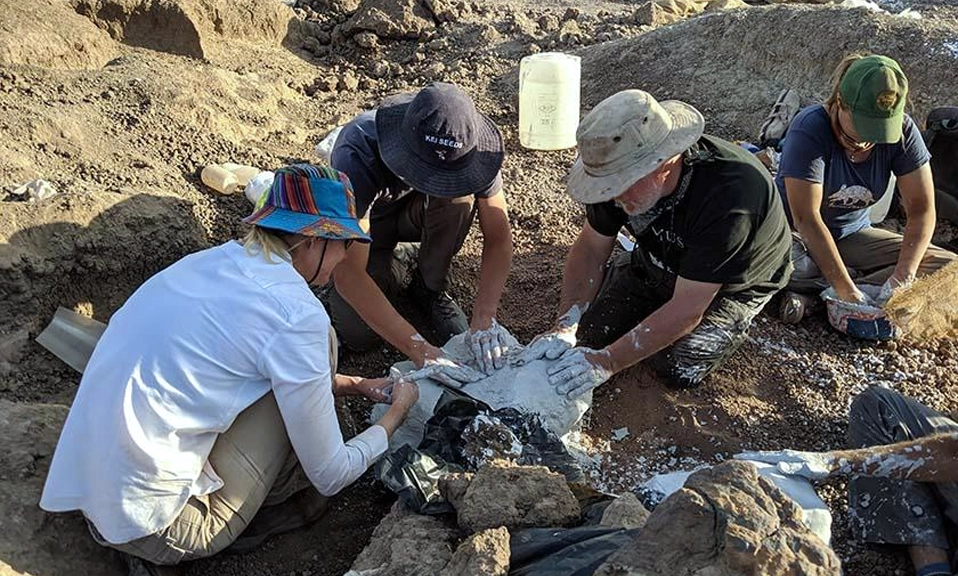
The fossil was collected in 2018 on the outskirts of Qhemegha village in the Eastern Cape province of South Africa. It comes from the lower Elliot Formation, a rock unit that records a 30-million-year slice of the Late Triassic and Early Jurassic periods—roughly 220 million years ago.
What makes the find extraordinary is the skull itself. It measures 21.3 centimetres (8.4 inches) and includes an almost intact braincase, palate, and hyoid—a small bone in the throat. The research team, led by Atashni Moopen at the University of the Witwatersrand, describes it as “the first almost complete and articulated dinosaur skull from the South African Late Triassic” and “one of only a handful of such skulls from this time in the southern continents”.
To study it without risking damage, the team used powerful X-rays at the European Synchrotron Radiation Facility to generate detailed 3D models of the skull, then compared its features with those of other early dinosaurs to place it on the evolutionary family tree.
What Nyana Was: A Heavyweight Juvenile
Nyana rooiwalensis belonged to a group called sauropodomorphs—the “lizard-footed” dinosaurs that were the early relatives of the giant long-necked species like Brachiosaurus and Diplodocus. Unlike their later, four-legged descendants, these early sauropodomorphs were bipedal, walking on two legs, and they were herbivorous.
The individual that was found was a juvenile, estimated to be in its third year of life at the time of death. Microscopic analysis of thin slices from its limb bones revealed growth rings—similar to tree rings—showing two distinct lines of growth, which confirmed its age. Despite its youth, it already weighed an estimated 400–440 kilograms (around 880 pounds).
The most striking finding is how it compared to its peers. Nyana was about four times the size of Massospondylus and Mussaurus, two other sauropodomorphs of comparable age, making it one of the largest juvenile dinosaurs known from that period. And it was not done growing. The growth curves suggest that adult Nyana individuals “may have reached multi-tonne body masses”—several tonnes in weight.
Why It Matters: The Evolution of Giant Growth
The discovery sheds light on a key question in dinosaur evolution: when did the enormous body sizes of sauropods first emerge?
The answer, according to this research, is that rapid growth evolved early. Nyana was already growing at an accelerated rate as a juvenile, long before the true giants of the Jurassic appeared. The researchers suggest that “rapid growth emerged during sauropodomorph evolution, before true giants emerged”. In other words, the biological machinery for getting big was in place before the biggest dinosaurs actually got big. Nyana is a snapshot of that transition—a creature that was already a heavyweight while still a youngster, on an evolutionary trajectory toward the multi-tonne behemoths that would come later.
The skull also provides critical new data on skull morphology in early-diverging sauropodomorphs, a group whose anatomy is still poorly understood because well-preserved skulls are so rare.
A Biogeographical Clue: A Bridge Between Continents?
Phylogenetic analysis—the process of mapping evolutionary relationships—places Nyana as either a close relative of Sarahsaurus, a dinosaur from North America, or of Ngwevu, another South African sauropodomorph.
The Sarahsaurus connection is particularly intriguing. If Nyana is indeed a sister taxon to the North American dinosaur, it would point to a previously unrecognised biogeographical link between southern Africa and western North America during the Early Jurassic. That would suggest that dinosaur populations were moving between these regions at a time when the continents were still relatively close together—a clue to how early dinosaurs spread across the planet.
A Small Skull With a Big Story
Nyana rooiwalensis is not the largest dinosaur ever found. It is not the oldest. But it is a rare and valuable piece of the puzzle of how dinosaurs became the dominant land animals of the Mesozoic. A single, nearly complete skull from a juvenile that died 220 million years ago has revealed that rapid growth was already a feature of early sauropodomorph biology, that these dinosaurs were far larger than their contemporaries at the same age, and that southern Africa may have been connected to North America in ways paleontologists are only beginning to understand.
The fossil was found in 2018. It has taken years of careful preparation, synchrotron scanning, and comparative analysis to bring Nyana into the scientific record. The wait was worth it. This is a dinosaur that was a heavyweight before it was an adult—and a discovery that helps explain how its lineage became the largest animals ever to walk the Earth.