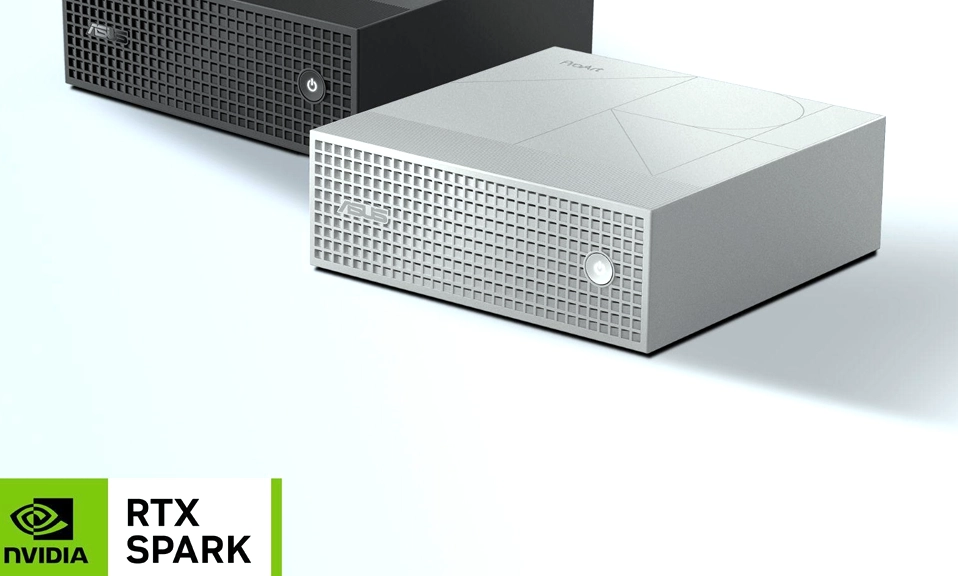
For years, the promise of “local AI” has felt like a compromise. You could run a small, quantised model on your laptop, but the moment you wanted to do anything serious—fine-tune a model, run a capable agent, or work with a 70-billion-parameter system—you had to rent time in the cloud. The hardware simply wasn’t there for the desk.
On November 18, 2026, that compromise came to an end. NVIDIA’s RTX Spark, the Arm-based “superchip” first unveiled at Computex in June, is now shipping in compact desktop systems from ASUS, Dell, and MSI. These are not gaming rigs with a GPU bolted on. They are purpose-built, always-on boxes designed to run AI models and agents locally, with up to 128GB of unified memory and enough compute to handle workloads that would previously have required a data centre. The AI computer has finally arrived on your desk. And it is expensive, ambitious, and genuinely different.
What RTX Spark Actually Is
At the heart of every RTX Spark desktop is a single system-on-chip that NVIDIA calls a “superchip.” The full-fat configuration pairs a 20-core NVIDIA Grace CPU with a Blackwell RTX GPU carrying 6,144 CUDA cores—the same core count as a desktop RTX 5070. That GPU is not an afterthought. It is the point. The CPU handles the operating system and orchestration; the GPU handles the inference, the fine-tuning, and the agentic workloads that define modern AI.
The memory architecture is where RTX Spark diverges from a conventional PC. Instead of separate pools of system RAM and VRAM, the chip uses up to 128GB of unified memory, shared between the CPU and GPU, running at speeds beyond 9,400MT/s with up to 300GB/s of bandwidth through a 256-bit bus. That is not quite the bandwidth of Apple’s M5 Max, which remains the benchmark for unified-memory machines, but it is enough to fit models that would choke a 24GB graphics card. NVIDIA says the desktop can run AI models with 120 billion parameters entirely on-device, with no cloud bills for those tasks.
The headline performance figure is up to 1 petaflop of AI performance, though NVIDIA is careful to call this a ceiling rather than a sustained measurement. The launch material does not specify which precision or workload produces that number, so it is best treated as a marketing peak until independent reviewers publish measured results on real models.
The Desktop Advantage: More Power, More Cooling, More Performance
The first RTX Spark devices to market were laptops, starting at $2,599 in October. The desktops are a different proposition. Early reviews of the ASUS ProArt GR1X found graphics performance up to 22% higher than the laptop chip, thanks to more power headroom and better cooling, though processor speed improved by only about 5%. The desktop form factor is not a dramatic leap in CPU performance. It is a modest but meaningful boost in sustained GPU performance—the kind that matters when you are running an agent for hours rather than benchmarking for minutes.
The real appeal of the desktop is its role as an always-on AI appliance. NVIDIA is pitching these machines as boxes that can keep AI agents running around the clock, the same role that drove record demand for the Mac mini earlier in the year. An agent running on-device is effectively unmetered. NVIDIA’s own briefing used the example of Claude Sonnet 5.5 Medium: running 61 million output tokens a month through the API would cost $1,200 in fees, whereas pushing the same volume through a local model on RTX Spark costs nothing beyond electricity. For developers, researchers, or small teams running continuous agentic workloads, that math is compelling.
The Benchmarks: Local AI That Genuinely Competes
Independent testing has begun to validate NVIDIA’s claims. On Artificial Analysis’s AgentPerf-Local workload—a 168-turn, 172-tool-call agentic simulation—the RTX Spark laptop completed the task in 18.7 minutes, compared to 17.3 minutes for the DGX Spark and 4.9 minutes for a GeForce RTX 5090 with 32GB of VRAM. The RTX Spark is not faster than a dedicated desktop GPU with adequate memory, but it is in the same league as NVIDIA’s own DGX Spark, a machine that costs significantly more.
Against Apple, the picture is more nuanced. In a test running the 70-billion-parameter DeepSeek R1 distilled model at Q4, the RTX Spark N1X was 8% slower than an M5 Pro but 60% faster than an HP ZBook Ultra with the same 128GB of memory. On Qwen 3.8, a 27-billion-parameter model, the RTX Spark delivered twice the speed of AMD’s Ryzen AI Halo and was “notably faster” than a MacBook Pro with the M5 Max chip. In Geekbench 6.5, the 20-core chip scored 3,085 single-core and 19,313 multi-core.
The pattern is clear: RTX Spark is not the fastest machine for every AI task, and it is not designed to be. It is the fastest Windows machine for local AI, and it brings the CUDA software ecosystem—the tooling that most AI developers already know—to a compact, power-efficient desktop. For anyone who has wanted to escape Apple’s walled garden or AMD’s less mature ROCm stack without sacrificing local AI capability, that is a meaningful differentiator.
Pricing, Availability, and the Value Question
The RTX Spark desktop is not cheap. The MSI EdgeMesa N AI+ starts at $4,399 for 64GB of memory** and rises to **$7,499 for 128GB. The ASUS ProArt GR1X starts at $4,499. Dell has a system available, but its pricing has not been confirmed. Acer, GIGABYTE, and HP have announced systems, and Microsoft is preparing a Surface RTX Spark Dev Box, but none of those have confirmed prices or ship dates yet.
The value comparison depends entirely on what you are replacing. Against a Mac Studio with an M5 Max and 128GB of memory, which costs $5,399** with a 1TB SSD, the RTX Spark desktop is competitive but not cheaper. Against the DGX Spark, NVIDIA’s Linux-based personal AI computer, which lists at **$6,950 for the 128GB Founders Edition, the RTX Spark is the more affordable way to get CUDA and 128GB of unified memory in a Windows environment. And against the cloud, the math is entirely different: if you are spending hundreds or thousands of dollars a month on API fees for agentic workloads, the RTX Spark pays for itself over time.
The software story is maturing quickly. Adobe’s Illustrator and InDesign now run natively on RTX Spark’s Arm chip, and Blender 5.3 has added NVIDIA’s DLSS ray-tracing technology to its preview window. The ecosystem is not perfect—reviews note that gaming and translation ecosystems remain incomplete, and Windows on Arm still has rough edges—but the trajectory is unmistakable.
A New Category of Computer
The RTX Spark mini desktop is not for everyone. At $4,399 and up, it is a specialist tool for a specific audience: AI developers, researchers, creative professionals, and small teams who need to run capable models and agents locally, without metered cloud costs and without leaving the CUDA ecosystem they already know.
What makes it significant is not any single specification. It is the fact that NVIDIA has built a machine that does two jobs genuinely well: it games far better than an integrated GPU has any right to, and it runs serious AI models locally at speeds that were previously the preserve of data-centre hardware. As one reviewer put it, RTX Spark is “a different species of computer that has arrived early”—a statement of intent about where computing is going, trading raw benchmarking crowns for the ability to carry a self-rewriting, fully autonomous, CUDA-accelerated digital brain on your desk.
The AI computer is no longer a concept. It is a box you can buy, plug in, and leave running. And for the first time, it feels like the future has arrived on schedule.