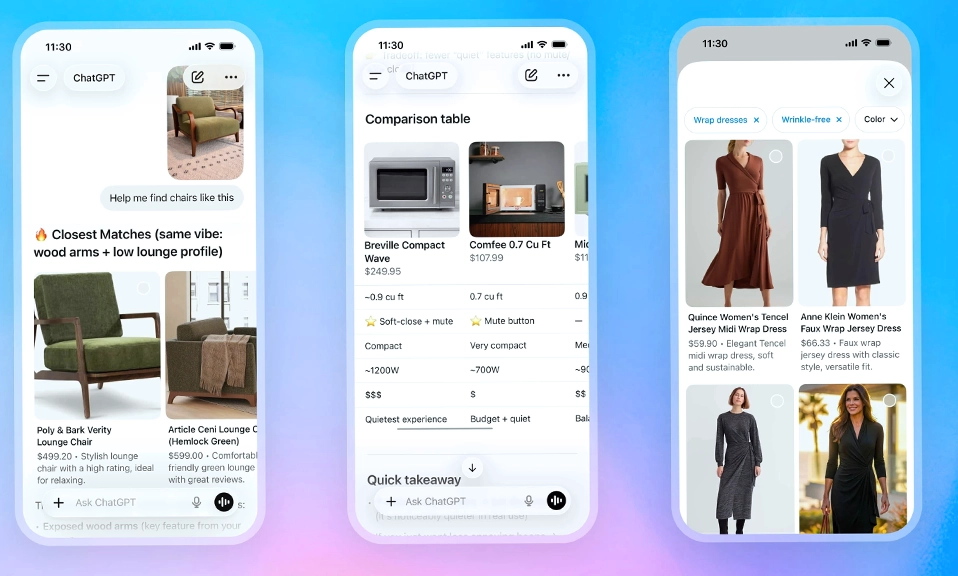
OpenAI just turned ChatGPT into a storefront, and it did it without ever asking you to open a new tab. On November 10, 2026, the company launched a beta suite of business tools that lets companies claim verified profiles inside ChatGPT and deploy their own AI agents to talk to customers. The headline feature, “Business Agents,” is a direct line between you and a brand’s representative—an AI that answers questions about products, compares options, and helps you make a decision without leaving the chat. It is a quiet but significant step toward a future where the shopping assistant and the store are the same thing.
What Are Verified Business Agents?
A Business Agent is an AI representative that a company creates and controls, published inside ChatGPT. When ChatGPT surfaces a business in a response—say, you ask it to compare running shoes—you can click on that business’s profile and start a separate conversation with its agent. The agent can answer follow-up questions, explain differences between two products, and pull from the business’s own product feeds, pricing, and stock information.
The key word is verified. To prevent impersonation and ensure you are talking to the actual brand, companies must claim their organization through a new tool called Business Hub. Verification methods vary by business—a phone number, email, website domain, or a Shopify account—and once approved, the company receives a blue check that appears on its profile. It is a trust signal, a way of saying: this agent really does represent the business it claims to.
How the Shopping Experience Changes
The experience is designed to feel like a natural extension of the conversation you are already having. You might start by asking ChatGPT to recommend a laptop for video editing. ChatGPT returns a list of options. One of those options includes a link to the brand’s Business Agent. You click it, and a new chat window opens—clearly labeled as a conversation with that specific business, separate from your main ChatGPT thread.
Inside that window, you can ask the agent the kind of questions you would ask a salesperson: Does this model support dual external monitors? What is the return policy on sale items? Is the upgraded RAM worth the price difference? The agent answers using the information and guidelines the business has supplied, and it can reference live product data if the company has connected a feed or linked its Shopify store.
Crucially, the agent does not complete the purchase. For now, buyers are sent to the brand’s own website to check out. OpenAI is building agent payment capabilities with Visa, but that is not part of this beta. The current iteration is about discovery and decision-making, not transaction processing.
What Businesses Get Out of It
For brands, the appeal is twofold: a direct channel to customers inside the world’s most-used AI assistant, and a set of analytics that shows whether that channel is working.
Through Business Hub, companies can see how often ChatGPT mentions them, how many people click through to their website from those mentions, and what “discovery topics” are driving the most engagement. They can update their business details, prices, and stock, ensuring that the information ChatGPT presents to users is accurate and current. And they can build, test, and publish a Business Agent—free at launch, though OpenAI has left the door open to charging in the future.
OpenAI is careful to stress that claiming a profile does not guarantee better placement in ChatGPT’s recommendations. The company says it will continue to make independent suggestions, and that paying for an agent does not change how often a business is recommended. The value is in the conversation, not in the ranking.
The Ad Connection
The Business Agent is not just a customer service tool. It is also an advertising product. OpenAI is selling the same agent as the landing spot for ChatGPT Ads, building on the Sponsored Agents it began testing in September 2026. A business can sponsor its agent to appear more prominently when relevant queries arise, turning the agent into a destination that a shopper can enter and explore.
This is part of a broader monetization push. OpenAI’s advertising business passed a $1 billion annual run rate in August 2026 and now has 100,000 advertisers. The Business Agent gives those advertisers a way to do more than display a sponsored link. It gives them a conversational storefront—a space where a customer can ask questions, compare features, and build confidence before clicking through to buy.
The Limits and the Open Questions
For all its ambition, the current beta is deliberately narrow.
It is US-only, for now. Eligible e-commerce and online service businesses in the United States are the first to get access to Business Agents. Local stores and restaurants can claim existing U.S. listings, but the full agent-publishing capability is limited to a narrower set of online businesses.
It does not handle payments. The agent helps you decide, not transact. Checkout still happens on the brand’s website.
Businesses do not see your chats. OpenAI says it does not share users’ conversations with businesses, and the agent chats are kept separate from your main ChatGPT history. The analytics businesses receive are aggregated, not individual-level transcripts.
The trust model is still being tested. Verification methods vary, and OpenAI is not disclosing the specifics because different businesses require different approaches. The blue check is a useful signal, but it is not a guarantee of quality or reliability. Users will still need to exercise judgment.
OpenAI’s Verified Business
Agents are not the final form of AI shopping. They are the foundation of it. The company describes the launch as “an early step in bringing businesses more deeply into ChatGPT,” starting with “accurate business information, useful insights, and conversations that help people make informed decisions”.
That is a modest framing for a move that could reshape how we discover and evaluate products. If ChatGPT becomes the place where shopping begins—where you compare options, ask questions, and narrow your choices—then the Business Agent is the store’s representative in that conversation. It is a salesperson who never sleeps, never pressures, and always has the product manual at hand.
The question is whether shoppers will trust it. The blue check helps. The separation of chats helps. The ability to click through to the brand’s own site helps. But trust in AI-mediated commerce is still being built, one conversation at a time. OpenAI has built the infrastructure. Now it has to earn the confidence of the people who use it—and the businesses that depend on it.