Imagine this.
You are hiking in the mountains. No bars. No Wi-Fi. No signal at all.
You pull out your normal phone, the one you already have in your pocket, and you send a text. Not to a satellite phone. Not with a bulky antenna. Just your phone.
It goes through. From space.
That is not science fiction anymore. In 2026, it is real, it is on sale, and millions of people have already used it.
But will we soon have mobile network coverage everywhere? The short answer is no, not yet, and the gap between what satellite-to-phone service can do today and what travelers actually need on a trip is bigger than the marketing suggests.
Let me explain how it actually works, who is winning, and when you can throw away the phrase “no signal.”
What Is Satellite-to-Phone, Or Direct-to-Cell?
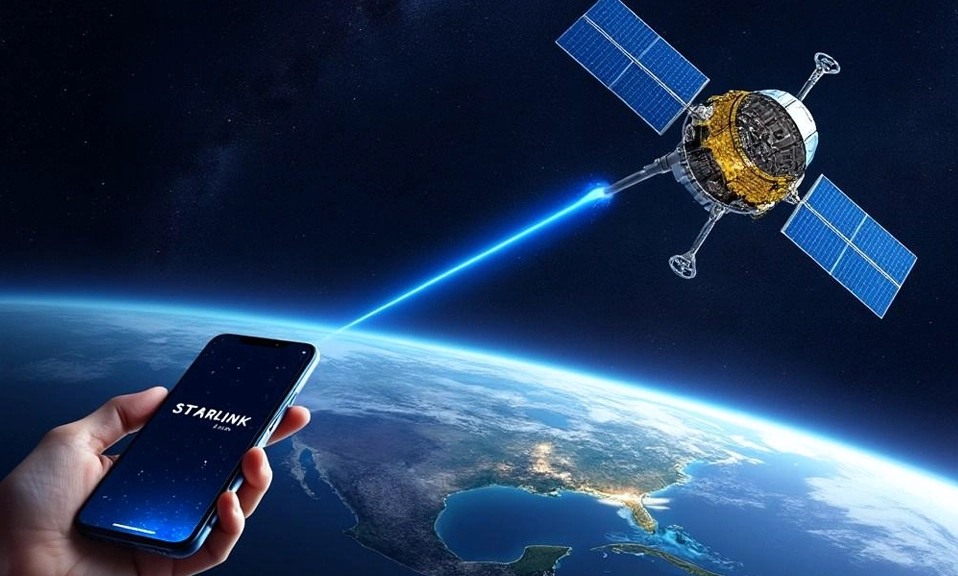
Starlink direct to cell lets an ordinary, unmodified smartphone connect straight to SpaceX’s satellites when there’s no ground-based cell signal, without any special hardware or app.
No new phone. No SIM swap. No dish on your roof.
Your phone thinks it is talking to a cell tower. In reality, it is talking to a satellite 550 km above Earth that is acting as a cell tower in space.
Starlink Direct to Cell puts a mobile phone tower on a satellite. More than 650 of these satellites talk to ordinary 4G phones using a slice of partner operators’ spectrum, starting with T-Mobile’s T-Satellite service in the US.
In 2026, an ordinary smartphone can increasingly communicate directly with satellites in low Earth orbit using cellular spectrum and technology designed to make the spacecraft act like a tower.
That is the magic. Your phone does not need to know it is in space. It just connects.
The 3 Different Types Of Satellite Phone Tech
People confuse these three. They are not the same.
1. Emergency SOS via Satellite, Apple / Huawei
Apple launched Emergency SOS via satellite on the iPhone 14 series in late 2022 using Globalstar’s LEO network.
Apple has offered emergency satellite messaging on iPhone s since 2022. Every iPhone 14 or later model supports Emergency SOS via satellite and Messages via satellite. That includes iPhone 14 and all later models, including iPhone 16e, 17e, and iPhone Air.
Emergency SOS via satellite texts emergency services through orbiting satellites when every terrestrial network is gone. It is not a phone call and it is not fast, but it works where nothing else does.
Huawei Mate 60 Pro, 2023, added two-way satellite texting and satellite voice calling via BeiDou’s Tiantong GEO network, requiring careful skyward pointing and delivering low bandwidth.
The company launched Emergency SOS via satellite in 2022, giving iPhone users a lifeline to contact emergency services when cellular networks weren’t available, but this used narrowband communication at roughly 0.1 Mbps, barely enough for compressed text messages.
2. Direct-to-Cell, Starlink / AST SpaceMobile
This is the new one. This is the one that will change everything. Your normal phone connects to a satellite for regular texting, and soon, voice and data.
3. Old Satellite Phones, Iridium / Inmarsat
Classic satellite phones offer voice calling, SMS, and very low-bandwidth data globally, but with noticeable latency, especially on GEO networks, about 36,000 km away.
Those are the bulky phones journalists and soldiers used to carry. They still work, but they are expensive, slow, and you have to point them at the sky.
Direct-to-cell is trying to kill them.
Who Is Winning In 2026? The Three-Way Race
1. Starlink + T-Mobile: First To Market
T-Mobile launched T-Satellite commercially on July 23, 2025, and as of mid-2026, the service has been used by millions of people across the United States. AT&T is preparing its own satellite service through AST SpaceMobile.
T-Mobile launched its T-Satellite service commercially on July 23, 2025, in partnership with SpaceX’s Starlink.
T-Satellite, Starlink, T-Mobile, any carrier eligible, Live since July 2025, Texting, location, select apps, $10 a month or included with premium plans.
T-Mobile sells access to it in the US under the name T-Satellite, a $10 a month add-on.
As of early 2026, over 650 Direct to Cell satellites are operational, covering 500,000 square miles of the U.S. that terrestrial networks cannot reach.
As of early 2026, the Starlink D2C constellation has become the largest 4G network on the planet when measured by geographic coverage area.
But here is the catch: Starlink now has about 650 direct-to-cell satellites in orbit, and native voice calling is still not available.
Right now, Starlink is mostly texting, location sharing, and a few compressed apps. Not YouTube. Not Zoom.
Starlink, LEO, smaller aperture, high density, T-Mobile licensed plus EchoStar owned, T-Mobile primary, VEON, Kyivstar, Commercial SMS live, voice and data in rollout.
In May 2026 the FCC approved SpaceX’s $17 billion purchase of EchoStar’s AWS-4 and H-block frequencies. That gives Starlink more spectrum to do voice and data faster.
2. AST SpaceMobile + AT&T / Verizon: The Broadband Bet
AST SpaceMobile, which has investments and agreements with AT&T, Verizon, Vodafone, and Google, is building a competing system with a fundamentally different architecture.
While Starlink Direct-to-Cell provides basic text messaging services through T-Mobile in the United States, AST SpaceMobile is building a fundamentally different network architecture, one designed to deliver actual 4G/5G broadband.
Instead of 650 small satellites, AST SpaceMobile uses a few enormous ones. Its BlueBird 6 unfolds a 2,400 sq ft, about 223 m², antenna and is designed for peak speeds of 120 Mbps.
That antenna is bigger than a house. It is the largest commercial antenna ever put in space. Because it is so big, it can talk to your phone with much more power, which means faster speeds and real broadband.
Meanwhile AST SpaceMobile is flying a different bet: fewer, enormous satellites built for broadband speeds, not just texts, holding an FCC authorization for a network of up to 248 of them.
AST SpaceMobile, LEO, large aperture BlueBird, MNO partner licensed spectrum, AT&T, Verizon, Vodafone, stc, 50+ total.
AST SpaceMobile’s promise is not just texts. It is calls, video, messaging, apps and data to ordinary smartphones.
The downside? Fewer satellites means less coverage right now. AST SpaceMobile is still in beta in 2026, while Starlink is already live.
3. China’s Spacesail / Qianfan: The Surprise Contender
On June 20, 2026, Chinese satellite internet operator Spacesail, Shanghai Stack Satellites Technology, SSST, announced a milestone achievement: completing a voice call using an unmodified standard commercial smartphone, connected through its Qianfan, “Thousand Sails”, constellation.
That is a voice call, not just a text. On a normal phone. That is ahead of Starlink in one way.
China is building its own system for its own market, but it shows the race is global, not just American.
And the stakes increased further in the United States on October 1, 2026, when AT&T, T-Mobile and Verizon announced a joint venture aimed at expanding satellite-enabled mobile coverage in underserved areas.
Even the carriers that compete with each other are teaming up on satellite, because no one carrier can cover everywhere alone.
How Does It Actually Work? The Simple Version
- You are in a dead zone. No cell tower. No Wi-Fi.
- Your phone searches for a signal and finds a satellite instead of a tower.
- The satellite has a special antenna that can speak your phone’s language, 4G LTE.
- The satellite relays your message down to a ground station on Earth.
- The ground station connects to T-Mobile’s network, and your text goes through like normal.
Your phone does not know the difference. It just sees a very far away, very fast-moving tower.
SpaceX Starlink Direct to Cell uses T-Mobile’s mid-band PCS spectrum with modified satellites, V2 Mini and V3, carrying custom antenna arrays.
That spectrum part is key. Starlink is not using satellite spectrum. It is using cell phone spectrum, borrowed from T-Mobile. That is why your normal phone can hear it.
Why Is It So Slow Right Now? The 3 Limitations
If this is so amazing, why can you not watch Netflix from the middle of the Sahara yet?
1. Speed and Latency
T-Satellite is not fast. Messages can take anywhere from a few seconds to several minutes to send, depending on satellite position and network load. App data is heavily compressed.
Satellite communication involves inherent latency and bandwidth limitations since satellites orbit hundreds of miles above Earth and move rapidly. Messages sent in clear conditions with an unobstructed sky view take approximately 30 seconds to transmit, while obstacles such as dense forest cover can extend transmission time to over a minute or prevent connection entirely.
Current satellite messaging has significant limitations. Under ideal conditions with clear sky visibility, sending a single message can take around 30 seconds.
Expect 30 seconds to a few minutes per message, and only with a clear view of the sky.
Why? Because a satellite is moving at 27,000 km/h. It is only above you for a few minutes. Your phone has to catch it, send your message, and the satellite has to catch the next ground station.
2. You Need A Clear Sky
The satellite option shows only with zero cellular and Wi-Fi. In normal coverage you will never see it, that is by design.
And you need to be outside, with a clear view of the sky. In a building, in a car with a metal roof, under dense trees, it will struggle or fail.
3. Battery Drain
Battery drain accelerates noticeably during satellite operations. The radio module works harder to maintain connection with an orbital asset rather than a nearby ground tower, consuming power more rapidly.
Your phone has to shout to space. Shouting uses battery. If you are at 15% battery, you might only get a few messages out.
How Much Does It Cost?
Right now, it is cheap because carriers want you to try it.
As of August 2026, satellite SOS remains free for emergency use on most major carriers, though non-emergency satellite texting now typically requires a $4.99 a month add-on or a premium data tier.
T-Mobile’s T-Satellite is $10 a month, or included in premium plans.
Apple’s Emergency SOS was free for 2 years, then extended. It is still free for emergency use in most places.
But that will not last forever. Once voice and data go live, expect carriers to charge $10 to $20 a month for satellite data, or bundle it into premium plans.
The real cost is not money. It is that satellite will be an add-on, not a replacement, for years.
Will We Soon Have Coverage Everywhere?
Here is my honest timeline.
2026, Now: Texting in dead zones in the US, New Zealand, and parts of Europe. Emergency SOS everywhere on iPhone. Voice calls in tests in China. No real data yet.
Direct-to-cell, ordinary phones talking to satellites instead of towers, crossed from demo to retail in 2026. T-Mobile’s T-Satellite with Starlink.
2027 to 2028: Voice calling starts on Starlink and AST SpaceMobile. You will be able to make a real phone call from a mountain, but it will be low quality and expensive.
2029 to 2030: Slow data. Think 1 to 5 Mbps. Enough for WhatsApp, maps, email, and browsing, but not for HD video. Coverage expands to most of the world, including Africa, South America, and Southeast Asia.
2030+: Real broadband from space. AST SpaceMobile’s 120 Mbps promise, if it works, means you could watch video from anywhere. That is when “no signal” truly dies.
So will we have coverage everywhere soon? Yes for texting. Not yet for everything.
For a hiker who needs to text “I’m lost, send help,” we are already there.
For a farmer in rural Uganda who wants to watch YouTube in 4K from a field with no tower, we are still 4 to 5 years away.
What Does This Mean For You?
If you live in a city: Nothing changes yet. Satellite is slower than your 5G. Your phone will never use it when you have a tower.
If you travel, hike, or live in rural areas: This is life-changing. You can already get T-Satellite for $10 a month if you are in the US. If you have an iPhone 14 or later, you already have Emergency SOS for free.
If you run a business in a remote area: Do not cancel your Starlink dish yet. Direct-to-cell is not a replacement for broadband. It is a safety net.
If you are in Africa, Asia, or Latin America: Watch AST SpaceMobile and Spacesail. Starlink is US-first. The global expansion will come from AST SpaceMobile’s 50+ carrier partners.
Satellite-to-phone
technology is not a gimmick. It is the biggest change in mobile since 4G.
Your phone can now talk to space. No new hardware. No new phone. Just software and satellites.
But it is still in its texting phase. Voice and data are coming, but they are not here yet.
In 2026, the dead zone is shrinking. In 2030, it might be gone.
The next time you see “No Service” on your phone, remember: That message is on borrowed time. Soon, there will be no place on Earth where your phone cannot reach someone.