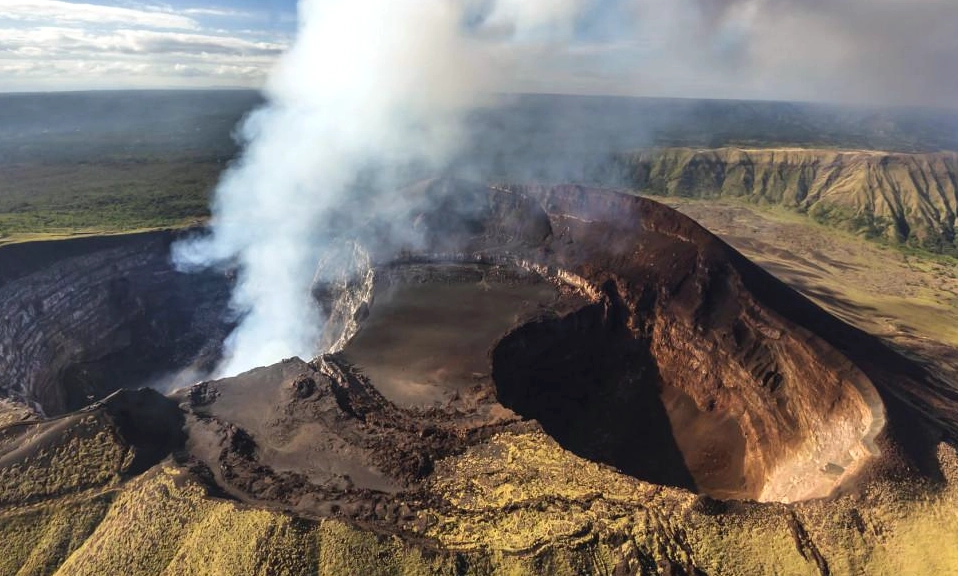
Something strange is happening beneath one of Central America’s most active volcanoes. Scientists have discovered that Nicaragua’s Masaya volcano—a popular tourist destination with a glowing lava lake—is not fed by a single magma chamber, but by two distinct, active reservoirs. The finding, published in Geophysical Research Letters, reveals a far more complex and dynamic underground system than previously understood, with significant implications for the roughly 2 million people living within 20 kilometres of its crater.
The discovery came from a painstaking analysis of six years of satellite data, collected between 2018 and 2024 by the Sentinel-1 satellite. A team at Penn State used a remote sensing technique called interferometric synthetic aperture radar (InSAR) to track incredibly subtle changes in the ground’s elevation around the volcano. Because InSAR uses long-wavelength microwave radiation, it can penetrate the tropical cloud cover that often obscures Masaya, allowing for continuous monitoring.
The Two Chambers: One Rising, One Sinking
The satellite data revealed a striking pattern of ground deformation. The researchers observed a period where a broad area of the volcano’s caldera initially sank, before beginning to rise again. They interpreted this uplift as the inflation of a deep, main magma reservoir, potentially being fed by a new source of fresh magma from below. Lead author Lizzie Johnson explained the significance: “When it’s subsiding, that means that there’s probably magma draining away from the volcano, but once the ground starts uplifting again, that can mean that there’s potentially new magma moving in”.
At the same time, the ground immediately surrounding Masaya’s active Santiago crater—the site of its famous, incandescent lava lake—was steadily sinking throughout the entire study period. This subsidence suggests the presence of a separate, shallower magma reservoir that was slowly losing volume, even as the deeper system was being replenished. The two systems were behaving independently, painting a picture of a “complex plumbing system” that had previously gone unrecognised.
Why This Matters for 2 Million People
The immediate takeaway is not that an eruption is imminent. The researchers were careful to stress that their observations indicate no immediate danger. However, the discovery is critical for improving how scientists monitor and forecast the volcano’s behaviour, which is a serious concern given the scale of the population at risk.
Masaya is located just 20 kilometres (about 12 miles) from Nicaragua’s capital, Managua, and sits within a national park that attracts tourists from around the world. While its modern activity has been mostly passive—characterised by persistent degassing, lava lake formation, and vent-clearing explosions—the volcano has a violent history. It has produced at least four caldera-forming “Plinian” eruptions in its past, and its last major lava flow, in 1772, was mostly confined within its caldera. Earlier eruptions, around 30,000 and 6,500 years ago, were far more dramatic, with the latter being one of the largest anywhere on Earth in the last 10,000 years.
Even without a major eruption, Masaya poses a persistent hazard. Its chronic release of sulphur dioxide regularly pushes local air quality beyond World Health Organization standards, creating an insidious public health risk for surrounding communities. Understanding the volcano’s baseline behaviour—how magma moves and accumulates beneath it—is essential for distinguishing normal activity from changes that could signal a period of heightened unrest.
A New Tool for Volcano Monitoring
The study also demonstrates the power of continuous, satellite-based monitoring. Co-author Young Cheol Kim emphasised the importance of this approach: “Continuous monitoring allows us to understand the baseline activity and identify if things are changing”. By establishing what “normal” looks like for Masaya’s ground deformation, scientists can more quickly recognise anomalies that might precede an eruption, giving authorities the crucial lead time needed to warn nearby communities.
The discovery of two magma reservoirs beneath Masaya does not change the volcano’s current threat level. But it does change our understanding of the engine driving it. For the 2 million people who live in its shadow, that knowledge is the first step toward being better prepared for whatever the “Mouth of Hell” does next.