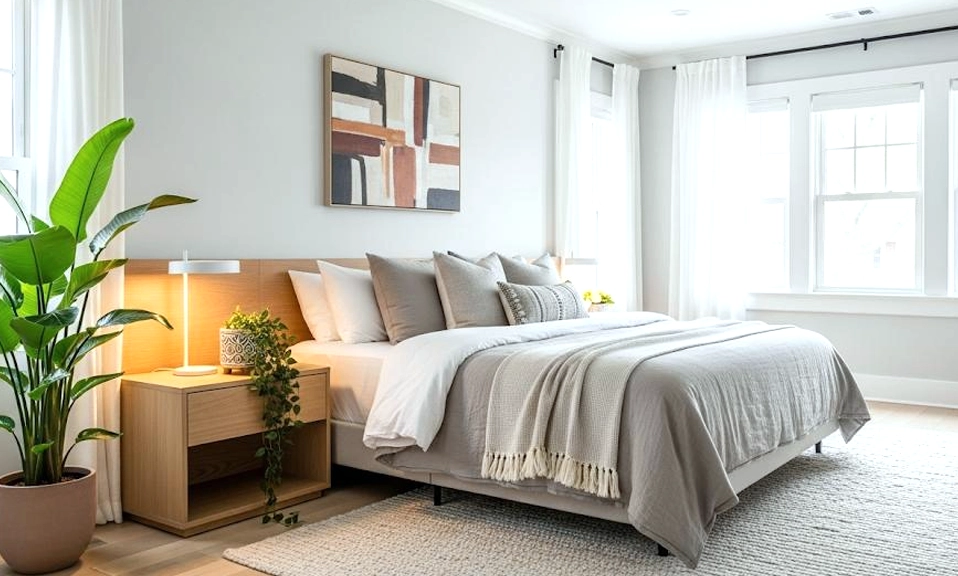
You wake up feeling groggy. You drag yourself through your workday, surviving on caffeine. You finally get home, sink into your couch, and think, “I should feel relaxed right now.”
But you don’t. You just feel… tired.
We tend to blame our fatigue on our schedules, our diets, or our screen time. But we rarely consider the physical space we are living in. Your home is supposed to be your sanctuary—a place that recharges your batteries. But if it’s subtly working against your biology, your home might actually be draining your energy.
The good news? You don’t need a massive renovation to fix it. Here are 7 small, science-backed changes you can make today to stop your home from making you tired.
💡 1. Fix Your “Circadian Mismatch” (The Lighting Trap)
The Problem: You are bathing your home in the wrong light at the wrong times. The Science: Your body’s internal clock (circadian rhythm) relies heavily on light cues. Bright, cool-toned LED lights (often found in modern kitchens and bathrooms) mimic daylight. If you’re exposed to them after sunset, your brain suppresses melatonin production, tricking your body into thinking it’s noon. This destroys your sleep quality, leaving you exhausted the next day. The Small Change:
- Morning: Open the blinds immediately upon waking to get natural sunlight in your eyes.
- Evening: Swap out the bulbs in your bedroom and living room lamps for warm white (2700K or lower). Dim the lights an hour before bed to signal to your brain that it’s time to wind down.
🌬️ 2. Clear the “Stuffy Room” Brain Fog (CO2 Buildup)
The Problem: You’re suffocating your own brain with carbon dioxide. The Science: When you keep your windows and doors tightly sealed for energy efficiency, the CO2 levels in your home can spike dramatically, especially overnight. Studies show that high indoor CO2 levels directly cause drowsiness, brain fog, and poor concentration. You aren’t just tired; you’re literally缺氧 (lacking optimal oxygen exchange). The Small Change:
- Practice cross-ventilation. Open windows on opposite sides of your home for just 10 to 15 minutes every morning. It completely flushes out the stale, CO2-heavy air and replaces it with fresh oxygen, instantly sharpening your mind.
📦 3. Silence the “Visual Noise” (Cognitive Drain)
The Problem: Your messy countertops are exhausting your brain. The Science: Clutter isn’t just an aesthetic issue; it’s a neurological one. When your environment is filled with random objects (mail, keys, cups, chargers), your brain’s visual cortex is constantly processing that information. This creates a low-level, continuous cognitive load that leads to “decision fatigue” and mental exhaustion. The Small Change:
- Clear your flat surfaces. Make a rule that your kitchen counters, coffee table, and nightstands must be 90% clear at the end of every day. You don’t have to deep clean the whole house; just clearing the horizontal surfaces gives your brain a visual “resting place.”
🔊 4. Soothe the “Invisible Hum” (Acoustic Stress)
The Problem: Low-level, chronic noise is keeping your nervous system on edge. The Science: You might not consciously notice the hum of the refrigerator, the dripping faucet, or the muffled traffic outside, but your brain does. Chronic, low-level noise keeps your body in a state of mild arousal, subtly elevating your cortisol (stress hormone) levels and preventing deep relaxation. The Small Change:
- Softening the space: Hard surfaces bounce sound around, amplifying the noise. Add a thick area rug, heavy curtains, or some fabric wall art to absorb the echo.
- Masking the hum: If you can’t fix the fridge hum or the street noise, use a white noise machine or a small indoor water fountain to create a soothing, consistent background sound that masks the jarring spikes.
🌡️ 5. Drop the Thermostat (Thermal Sleep Sabotage)
The Problem: Your bedroom is too warm, and it’s ruining your deep sleep. The Science: To enter and stay in the restorative “deep sleep” and REM stages, your core body temperature needs to drop by about 2 to 3 degrees. If your bedroom is warm, your body has to work overtime to cool itself down, which fragments your sleep and leaves you feeling unrefreshed. The Small Change:
- Set your bedroom thermostat between 65°F and 68°F (18°C – 20°C). If you can’t control the central heating, use a fan, switch to breathable cotton or linen sheets, or even just stick one foot out from under the covers to act as a thermal radiator!
🛋️ 6. Fix Your “Resting” Posture (Ergonomic Micro-Stresses)
The Problem: Your couch is causing physical fatigue. The Science: You sit on your sofa to relax, but if the cushions are sunken or the back is unsupportive, your muscles are actually working hard to keep you upright. These “micro-stresses” in your neck, shoulders, and lower back cause physical tension, which your body interprets as fatigue. The Small Change:
- Don’t just buy a new couch. Hack your current one. Add a firm lumbar pillow to support your lower back. If the seat is too deep, put a firm cushion behind your knees to take the pressure off your lower spine. Change your physical angle to relieve the micro-tensions.
🌿 7. Cure Your “Biophilic Deficit” (Nature Starvation)
The Problem: You are staring at too many screens and blank walls. The Science: Environmental psychologists talk about “Attention Restoration Theory.” Staring at screens and indoor geometry requires “directed attention,” which depletes your mental energy. Nature, however, provides “soft fascination.” Looking at organic shapes, plants, and natural light effortlessly engages your brain, allowing your directed attention to recharge. The Small Change:
- Bring the outside in. You don’t need a green thumb. Buy three low-maintenance houseplants (like a Pothos, Snake Plant, or ZZ plant) and place them in the rooms you spend the most time in. If you can’t keep plants alive, simply rearrange your seating so you have a direct line of sight to a window and the sky.
Your Home is Your Third Body
We often think of our home as just a box we live inside. But in reality, your home is an extension of your physical body. It regulates your temperature, filters your air, dictates your light exposure, and influences your stress levels.
If you’re feeling chronically tired, don’t just drink another cup of coffee. Take a walk through your house with fresh eyes. Swap a lightbulb, open a window, clear a counter, and bring in a plant.
By making your home work with your biology instead of against it, you’ll stop just surviving in your space, and start actually thriving in it.