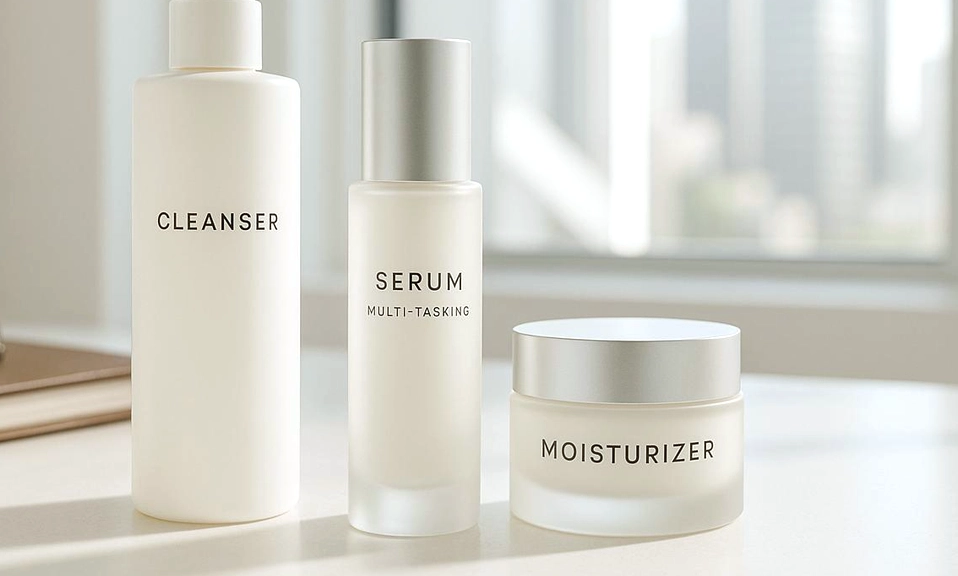
For years, the beauty industry sold us the idea that more is better. More steps. More products. More ingredients. The ten-step routine. The double cleanse. The essence, the ampoule, the serum, the moisturizer, the overnight mask. Somewhere along the way, skincare stopped being self-care and became a second job.
In 2026, the pendulum is swinging back. Skinimalism — the practice of using fewer, more intentional products — has moved from niche trend to mainstream movement. Searches for “simplified skincare routine” are up, dermatologists are singing its praises, and even the legacy brands that built their empires on multi-step routines are launching “minimalist” lines.
But is skinimalism just a backlash against overconsumption, or is there real science behind it? The answer is: both. And for many people, a simpler routine isn’t just easier — it’s actually better for their skin.
What Is Skinimalism, Exactly?
Skinimalism isn’t about doing nothing. It’s about doing what matters.
At its core, skinimalism is the practice of paring your skincare routine down to the essentials — the products that genuinely serve your skin’s needs — and eliminating everything that’s redundant, irritating, or simply unnecessary. Think of it as the KonMari method applied to your bathroom shelf: keep only what sparks joy (and results), and let the rest go.
A skinimalist routine typically includes:
A gentle cleanser
A moisturizer (or a moisturizing sunscreen for daytime)
A broad-spectrum sunscreen (every morning, no exceptions)
One or two targeted treatments (if needed), such as a retinoid for anti-aging or an acid for acne-prone skin.
That’s it. No double cleansing. No essence. No toner unless your skin specifically needs it. No ten-step ritual. Just the products that actually do something.
Why Skinimalism Is Taking Off
Several forces are driving the shift.
The Skincare Fatigue Is Real
The average skincare routine has ballooned over the past decade. Influencers promote twelve-step routines. Brands launch new “essential” steps every year. Consumers are overwhelmed. A 2026 survey found that nearly 60% of skincare users feel “confused” by the number of products they’re told they need — and more than a third say they’ve simplified their routines in the past year.
“The multi-step routine became a status symbol,” says Dr. Shereene Idriss, a dermatologist and founder of PillowtalkDerm. “But people are realizing that more steps don’t equal better skin. They equal more time, more money, and more chances for irritation.”
The Barrier Function Is Having a Moment
The science of skin barrier health has entered the mainstream. Dermatologists now talk about the stratum corneum — the outermost layer of skin — as a delicate ecosystem that needs to be protected, not stripped. Over-cleansing, over-exfoliating, and layering too many actives can damage that barrier, leading to redness, sensitivity, and inflammation.
Skinimalism is, at its heart, a barrier-first approach. By using fewer products, you reduce the risk of irritation and give your skin a chance to repair itself.
The Cost-of-Living Crisis Made Us Rethink
Skincare is expensive. A full multi-step routine can easily cost hundreds of dollars a month. In an era of rising costs, consumers are looking for ways to save — and they’re realizing that many of those products were never essential in the first place. A gentle cleanser, a good moisturizer, and a sunscreen can cost less than $60 total — and they’ll do more for your skin than a shelf full of serums.
The Rise of “Skin Streaming” and “Skin Cycling”
Even the trend-forecasting world has noticed. “Skin streaming” — the practice of using fewer products but applying them more consistently — is one of the most searched skincare terms of 2026. “Skin cycling” — alternating active ingredients over several days rather than layering them all at once — has become a mainstream strategy for people who want results without irritation.
These are all variations on the same theme: less, but better.
The Benefits: What the Science Says
Skinimalism isn’t just a philosophy. It has measurable benefits for your skin.
Less Irritation, Fewer Reactions
Every product you apply is a potential irritant. The more products you use, the more chances there are for a reaction — whether it’s contact dermatitis, breakouts, or a damaged barrier. A simpler routine reduces the number of variables. If something goes wrong, it’s easier to identify the culprit.
A 2026 study in the Journal of Cosmetic Dermatology found that participants who simplified their routines to three to five products reported fewer episodes of redness, stinging, and sensitivity over a 12-week period compared to those who maintained a multi-step routine.
Better Barrier Function
When you stop over-cleansing and over-exfoliating, your skin barrier has a chance to recover. The stratum corneum can rebuild its lipid matrix, retain moisture more effectively, and protect against environmental stressors. For people with sensitive or reactive skin, this can be transformative.
“Many of the patients I see with ‘sensitive skin’ are actually dealing with ‘over-treated skin’,” says Dr. Idriss. “When they simplify their routine, the sensitivity often resolves on its own.”
Cost Savings
This one is obvious, but worth stating: fewer products means less money spent. A minimalist routine can cost a fraction of a multi-step one, and the savings add up over months and years. For people who were buying products they didn’t need, skinimalism is a financial relief.
Less Waste, More Sustainability
The beauty industry generates an enormous amount of packaging waste. Multi-step routines mean more bottles, more jars, more plastic. A simplified routine reduces that waste — and many skinimalist brands are now prioritizing refillable packaging and recyclable materials.
More Consistency
Here’s the paradox of the multi-step routine: the more steps you have, the less likely you are to do them consistently. A twelve-step routine is impressive on the first night. By the third week, most people have abandoned half the steps. A simple routine is one you’ll actually stick to — and consistency is the single most important factor in skincare results.
How to Transition to a Simpler Routine
Ready to try skinimalism? Here’s how to do it without sacrificing results.
1. Audit Your Routine
Write down every product you use. For each one, ask: Does this actually do something for my skin? If you can’t explain what the product does or why you’re using it, it’s a candidate for elimination.
2. Identify Your Essentials
At a minimum, you need:
A gentle cleanser (one that doesn’t leave your skin feeling tight or stripped)
A moisturizer (or a moisturizing sunscreen for daytime)
A sunscreen (SPF 30 or higher, every morning).
If you have specific concerns — acne, rosacea, hyperpigmentation — you may need one targeted treatment. But most people don’t need more than that.
3. Eliminate Redundant Steps
Toners, essences, ampoules, and sheet masks are often redundant. They can be pleasant, but they’re rarely essential. If you love them and they don’t irritate your skin, keep them. If you’re using them because you feel you should, let them go.
4. Introduce Actives Slowly
If you’re using retinoids, exfoliating acids, or vitamin C, don’t layer them all at once. Introduce one active at a time, use it consistently for a few weeks, and see how your skin responds. Skin cycling — alternating actives over several days — is a good strategy for people who want results without irritation.
5. Give It Time
Your skin may go through an adjustment period when you simplify. If you’ve been over-cleansing, your skin may initially feel oilier as it recalibrates. If you’ve been over-exfoliating, it may feel smoother and calmer within a few weeks. Give it at least a month before you judge the results.
The Caveats: Skinimalism Isn’t for Everyone
Skinimalism is a useful framework, but it’s not a one-size-fits-all prescription.
Some people need more. If you have a specific skin condition — severe acne, rosacea, melasma — you may need a more targeted routine prescribed by a dermatologist. Skinimalism doesn’t mean abandoning treatment; it means being intentional about what you use.
Some ingredients are worth the extra step. If you have a well-formulated vitamin C serum that brightens your skin, or a gentle exfoliant that keeps your pores clear, those products are doing real work. Keep them.
“Simple” doesn’t mean “lazy.” A minimal routine still requires consistency. The point isn’t to do less for the sake of doing less — it’s to do what matters, and do it well.
Skinimalism isn’t a rejection
of skincare. It’s a refinement. It’s the realization that your skin doesn’t need twelve steps. It needs a few good products, used consistently, that support its natural function rather than fighting against it.
The beauty industry spent years convincing us that more is better. In 2026, we’re finally asking: more what? More products? More steps? More money spent? Or more results?
For many people, the answer is clear. Less is more. And their skin is thanking them for it.