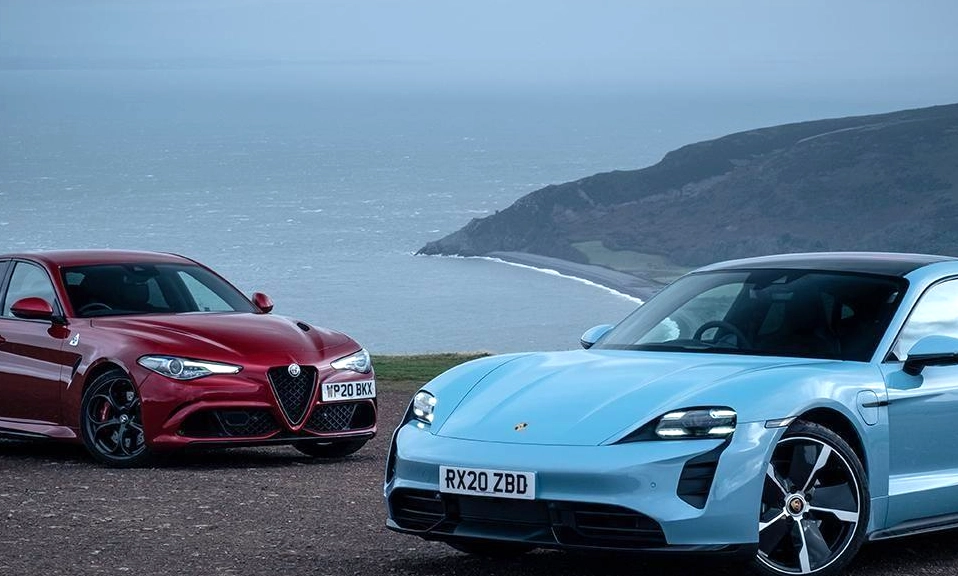
The answer in 2026 is no longer a simple “yes” or “no.” It depends on where you live, how you charge, how long you keep the car, and—more than ever—what happens after you drive it off the lot. The purchase price gap is narrowing. The fuel savings are real. But depreciation and insurance are pulling in the opposite direction, and in some markets, the math now favors the petrol car for the first time in years.
Here is what the 2026 numbers actually say.
The Purchase Price: Still Higher, But Closing
The first hurdle is the sticker price. In most markets, a new EV still costs more than a comparable petrol car—but the gap is no longer the chasm it once was. JATO Dynamics found that battery electric vehicles were 53% more expensive than combustion cars in 2018, but “just” 22% more expensive by 2024. Electric prices fell 15% over that stretch while combustion prices rose 7%.
In the US, the average transaction price for a new EV was $55,300** in February 2026, compared with **$48,800 for a new gas-powered car—a difference of about $6,500.
The wildcard is incentives. In the US, the $7,500 federal tax credit expired in September 2025, and federal funding for EV purchase incentives has largely expired, though some states still offer subsidies. In China, the purchase tax exemption for new energy vehicles was halved to 50% starting in 2026, with a cap of ¥15,000 (about €1,880) per vehicle. In Japan, purchase subsidies for BEVs increased to ¥1.3 million (about €7,100) in 2026.
The takeaway: In markets with strong incentives, the purchase gap can be meaningfully reduced. In markets without them—like the US post-2025—the EV premium is still substantial, and it is the first number you have to overcome.
Fuel and Charging: The EV’s Biggest Advantage
Once you’re on the road, the EV’s cost advantage is dramatic—if you can charge at home.
AAA’s 2026 Your Driving Costs study, based on regular gas at $4.152 per gallon** and electricity at **$0.18 per kilowatt-hour, found that charging an EV cost up to 70% less than fueling with gas. In Europe, the numbers are similar. At an EU average household electricity price, an electric car costs about €6.08 per 100 km to refuel, compared with €15.27 per 100 km for petrol—a savings of roughly 60%.
In the US, at an average electricity cost of 17.5 cents per kWh, an EV costs about 4.5 cents per mile to charge. For a 38-mpg petrol car to match that, fuel would need to be $1.70 per gallon—far below recent prices.
The catch: Public fast charging can cost roughly the same as petrol, or even more in some markets. The EV’s fuel advantage depends heavily on home charging. If you can’t charge at home, the savings shrink—and in some cases disappear.
Maintenance: Real Savings, But Smaller Than You Think
The EV maintenance pitch is familiar: no oil changes, no spark plugs, no timing belts, fewer moving parts. The savings are real, but AAA’s 2026 study put a number on them—and it’s smaller than most shoppers assume.
Averaged across the four vehicle categories where all three powertrains were compared, electric models spent $248 a year less than their gas counterparts on maintenance, repair, and tires**—about **$20 a month. Over five years and 75,000 miles, that’s roughly $1,240.
The spread varies by category. In compact SUVs, the electric advantage is $552 a year**—meaningful. In medium SUVs, it’s just **$45—less than four dollars a month. And in pickups, the hybrid was actually cheaper to maintain than the electric model.
The reason is that EVs still have tires (which wear faster because of weight and instant torque), alignments, cabin filters, suspension work, and battery thermal systems. The savings land on items that were already getting cheaper and less frequent on modern petrol cars.
The takeaway: EVs are cheaper to maintain, but the savings won’t transform your budget. They’re a modest tailwind, not a game-changer.
Depreciation: The EV’s Achilles’ Heel
This is where the math gets uncomfortable for EVs.
iSeeCars’ 2026 depreciation study found that five-year-old EVs had lost an average of 57.2% of their value, compared with 41.8% for all vehicles and 35.4% for hybrids. EVs made up half of the 10 fastest-depreciating models and none of the 25 slowest.
The Ayvens 2026 Car Cost Index confirmed the pattern: depreciation accounts for 42% of the total cost of ownership of a BEV, compared with 32% for a petrol car.
There are signs of stabilization. A 2026 machine learning study found that EVs retain approximately 30.3% of their total value compared with 33.9% for ICE vehicles—a 3.6% disadvantage, narrower than the iSeeCars figure. Fleet News reported that EVs under 12 months old declined by just 5% between 2025 and 2026, suggesting the curve may be flattening at the top end. And in China, the three-year residual value of pure electric vehicles rose to 45.7% in September 2026, a second consecutive month of gains.
The takeaway: Depreciation is still the EV’s biggest financial weakness. If you buy new and sell after three to five years, the value loss can wipe out years of fuel savings. If you lease, or if you keep the car for a decade, the impact is smaller.
Insurance: The Hidden Cost Nobody Talks About
Insurance is the cost that often gets overlooked—and it’s a significant one.
A 2026 report from Insurify, analyzing more than 235 million insurance rates, found that electric vehicles cost an average of 42% more to insure than comparable gas-powered vehicles. Nationally, full coverage on an EV averages $3,159 per year**, compared with **$2,218 for a similar internal-combustion vehicle—nearly $1,000 more annually.
The gap is narrowing for newer models. For 2024 model-year EVs and newer, the difference drops to 18%, or about $501 per year. But across all vehicles, the 42% gap remains.
The reasons are structural: EV battery packs are expensive, many electric vehicles use highly integrated structures that make collision repairs more complicated, and there is a shortage of certified EV repair technicians, which raises labor costs.
The takeaway: Insurance is a real and persistent EV cost penalty. For a new EV, it can add $500–$1,000 a year to your ownership bill—enough to erase a meaningful chunk of your fuel savings.
Total Cost of Ownership: The Verdict Depends on Where You Live
When you add it all up, the picture is not uniform. It depends on geography, driving patterns, and charging access.
In Europe, the Ayvens 2026 Car Cost Index found that BEVs have “moved beyond a niche choice to become a dominant cost-competitor.” In Western and Northern Europe, leasing a battery-electric car is typically cheaper than leasing a petrol or diesel model. In the compact segment, BEVs have a lower TCO in 19 out of 30 countries; in the premium segment, the electric BMW i4 has a lower TCO than the petrol BMW 3 Series in 20 out of 30 countries. In France, the TCO for electric vehicles is approximately 30% lower than for combustion or hybrid vehicles in some comparisons.
In the United States, the picture is more mixed. AAA’s 2026 study found that hybrids posted the lowest cost per mile in all four vehicle classes it examined. In the medium SUV class, the EV came in below the gas model per mile. But in the other three classes, gas cost less per mile than electric. A separate AAA comparison found that a medium electric sedan came in about $3,080 per year above a comparable gas model, largely because its value fell faster.
The difference is largely driven by fuel prices and incentives. Europe has higher petrol prices, stronger EV subsidies, and more aggressive emissions regulations—all of which tilt the math toward electric. The US has lower fuel prices (even at $4.15/gallon), no federal EV tax credit, and a market where hybrids are increasingly the value proposition.
Which Is Actually Cheaper?
In Europe, with home charging and strong incentives, the EV is often the cheaper option over the full ownership period—especially if you lease or keep the car for many years.
In the United States, without the federal tax credit and with higher insurance and depreciation, the petrol car—or, increasingly, the hybrid—is often the cheaper option on a total cost of ownership basis, particularly for shorter ownership windows.
The EV’s fuel savings are real and substantial. The maintenance savings are modest but genuine. But depreciation and insurance are powerful counterweights, and in some markets they tip the balance back toward combustion.
The most honest answer is that there is no universal answer. The cost comparison depends on:
Where you live (fuel prices, electricity prices, incentives)
How you charge (home charging vs. public fast charging)
How long you keep the car (depreciation hits hardest in the first three to five years)
What you’re comparing (a compact EV vs. a compact petrol car is a different calculation than a premium EV vs. a premium petrol car)
The good news is that the gap is narrowing. The purchase price premium is shrinking. Depreciation appears to be stabilizing. Insurance gaps are smaller for newer models. And as charging infrastructure improves and battery costs fall, the EV’s case will only get stronger.
But in 2026, the answer to “which is cheaper?” is still: it depends. And the only way to know for sure is to run the numbers for your own situation—your mileage, your electricity rate, your insurance quote, and your ownership timeline.