The middleweight adventure segment has been a one-horse race for years. The Kawasaki Versys 650, the Suzuki V-Strom 650, and the Yamaha Ténéré 700 have divided the spoils between them, each offering a subtly different flavour of two-wheeled utility. But a new challenger is emerging from the most unlikely of places: Kawasaki’s own stable. The KLE 650, a nameplate dormant for over a decade, is being resurrected, and early indications suggest it is coming for the Versys’ crown—and everyone else’s.
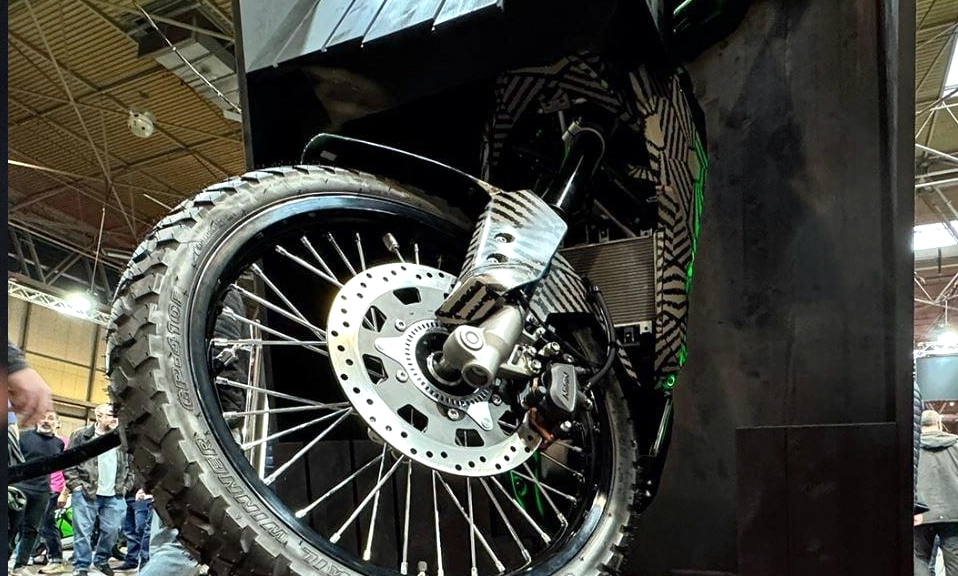
The evidence is mounting. An Australian type-approval filing dated October 16, 2026, lists a Kawasaki “LE650L” carrying the model name KLE 650 (SE). A cryptic 19-second teaser video has been released, showing a tubular frame, a new clutch cover, and a dual-disc front brake setup—details that point to a machine more serious about off-road capability than the road-biased Versys. And the industry’s gaze is already turning toward EICMA 2026 in Milan, where the bike is expected to make its global debut.
So, the question is not whether the KLE 650 is coming. It is whether it can genuinely challenge the established order. Based on what we know so far, the answer is a qualified yes—but the qualifications are significant.
What We Know So Far: A Versys in Off-Road Clothing
The KLE 650’s most likely heart is Kawasaki’s proven 649cc liquid-cooled parallel-twin, the same engine that powers the Versys 650 and Ninja 650. In Versys tune, it produces around 68 PS (67 hp) and 64 Nm of torque. This is a smart, low-risk choice. The engine is renowned for its durability, smooth power delivery, and broad torque curve—qualities that matter far more in an adventure context than peak horsepower.
Where the KLE diverges from the Versys is in its chassis and intent. The teaser confirms a dual-disc front brake setup, a clear upgrade over the single disc found on the smaller KLE 500 and a necessity for a heavier, more capable machine. More importantly, the KLE 650 is expected to adopt a 21-inch front wire-spoke wheel and long-travel suspension, a combination that transforms it from a road-going tourer into a genuine dual-sport machine. The Versys 650, by contrast, rolls on 17-inch cast wheels and is unapologetically road-focused.
This is the crux of the KLE 650’s appeal. It is not simply a Versys with a bigger engine. It is a reinterpretation of the middleweight ADV formula with a genuine off-road bias, filling a gap that Kawasaki has left open while the Ténéré 700 has cleaned up in the more dirt-oriented end of the segment.
The Rivals: Where the KLE 650 Fits
To understand whether the KLE 650 can challenge the best, it helps to map the battlefield.
| Model | Engine | Front Wheel | Power (approx.) | Character |
|---|---|---|---|---|
| Kawasaki Versys 650 | 649cc parallel-twin | 17-inch cast | 68 PS | Road-biased sport-tourer |
| Suzuki V-Strom 650 | 645cc V-twin | 19-inch cast | 70 PS | Versatile all-rounder, road-leaning |
| Yamaha Ténéré 700 | 689cc parallel-twin | 21-inch spoked | 72 PS | Hard-edged, off-road focused |
| Kawasaki KLE 650 (expected) | 649cc parallel-twin | 21-inch spoked | ~68 PS | Dual-sport, off-road capable |
The KLE 650 slots neatly between the Versys and the Ténéré. It offers more off-road capability than the Versys and V-Strom, but likely with a lower seat height and more road-friendly ergonomics than the rally-inspired Ténéré. For riders who want to explore fire roads and gravel trails without sacrificing highway comfort, this is a compelling proposition.
The pricing is the great unknown. Estimates suggest the KLE 650 could land under €10,000, with the Versys 650 serving as a reference point at around €9,070 in Germany. If Kawasaki can deliver the KLE 650 at or near that price point, it will undercut the Ténéré 700 and position itself as the value choice for genuine dual-sport adventure.
The Challenges: Weight, Suspension, and the Shadow of the Versys
For all its promise, the KLE 650 faces several hurdles.
Weight is the first. The Versys 650 tips the scales at around 206 kg (wet) , and adding off-road hardware—a 21-inch spoked wheel, longer-travel suspension, and protective bars—will likely push the KLE’s weight higher. In the dirt, weight is the enemy. The Ténéré 700, for all its capability, is no featherweight, but it has been engineered from the ground up as an off-road machine. The KLE 650, if it is indeed built around a modified Versys platform, may struggle to match the Ténéré’s agility when the going gets loose.
Suspension quality is the second. Long travel is only half the battle; the quality of the damping and the adjustability of the forks and shock will determine whether the KLE 650 is a genuine off-road tool or merely an adventure-styled road bike. Kawasaki has not released details, but the teaser suggests a serious approach. Whether it matches the spec of the Ténéré’s fully adjustable units remains to be seen.
The Versys problem is the third, and perhaps the most delicate. The KLE 650 risks cannibalising sales of the Versys 650. Kawasaki will need to differentiate the two clearly: the Versys as the road-focused tourer, the KLE as the dual-sport adventurer. If the KLE is too road-biased, it will be redundant. If it is too off-road-focused, it will alienate the Versys’ core audience. Finding the middle ground is the challenge.
A Genuine Contender, With Caveats
Can the Kawasaki KLE 650 challenge the best in its class? On paper, yes. It brings a proven engine, a genuine off-road chassis, and the might of Kawasaki’s dealer network and reliability record. It fills a gap in the market that the Versys has left open and the Ténéré has exploited. If the pricing is right and the suspension is up to scratch, it could become the default choice for riders who want a do-it-all middleweight with a real appetite for dirt.
But it will not dethrone the Ténéré 700 as the hardcore off-roader’s choice, and it will not replace the Versys 650 as the pure road-tourer. Its success depends on a narrow but valuable slice of the market: the rider who wants one bike that can do almost everything, with a slight bias toward the unpaved. That rider exists, and they have been underserved for years.
The KLE 650 is not a revolution. It is a recalibration—a recognition that the middleweight ADV class is not a monolith, and that there is room for a machine that sits between the road and the trail. If Kawasaki gets it right, it could be the most interesting bike in the segment. And in a class defined by compromise, that is no small achievement.