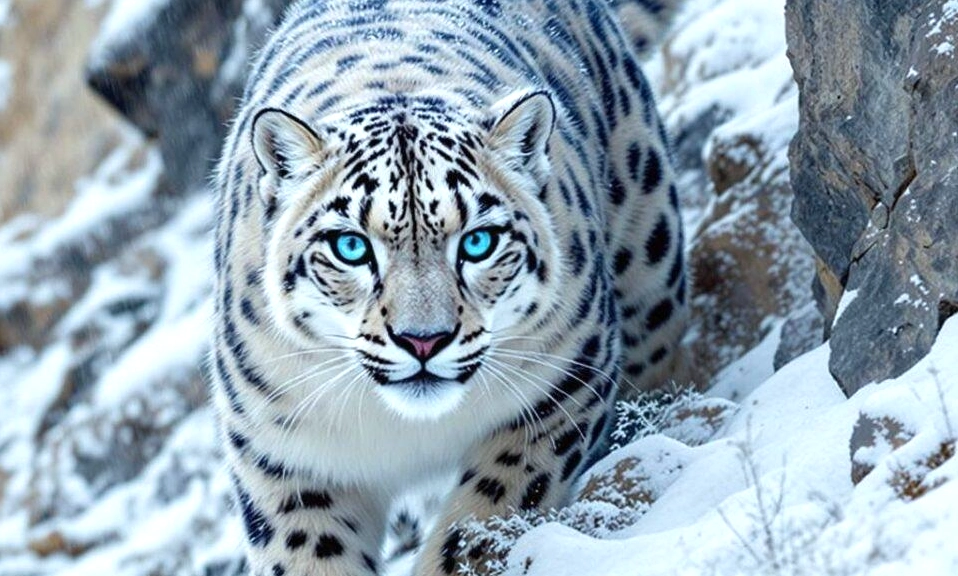
There is a ghost in the mountains of Central Asia. It has no supernatural powers, no ethereal glow. It is simply a cat—but a cat so perfectly adapted to its unforgiving world, so silent, so elusive, that even the people who live alongside it almost never see it. Its tracks appear in the snow and then vanish. Its kill is found, picked clean, with no sign of the predator that made it. For decades, it was easier to believe in the ghost than to prove the animal existed.
That animal is the snow leopard (Panthera uncia). And the “ghost of the mountains” is one of the most extraordinary big cats on Earth—a creature capable of leaping 50 feet through the air, surviving in temperatures that would kill a human in hours, and living an entire life without ever being seen.
The 50-Foot Leap: A Physics Defying Escape
The snow leopard’s most famous talent is its jump. It can leap as far as 50 feet (15 metres) horizontally and up to 20 feet (6 metres) straight up. To put that in perspective, 50 feet is the length of a semi-truck trailer, a school bus, or roughly three car lengths.
What makes this possible is a body built for explosive power. Snow leopards have short forelimbs and long hind limbs, a combination that gives them extraordinary agility and the leverage to launch themselves into the air. Their powerful chest muscles provide the force, and their long, flexible tail acts as a rudder, keeping them balanced as they sail between narrow rocky ledges.
This is not a party trick. It is a survival mechanism. In the steep, broken terrain of the Himalayas and the Tibetan Plateau, a snow leopard often has to leap across ravines or up cliff faces to reach prey, escape danger, or simply move through its territory.
The Ghost: Why You Will Never See One
The snow leopard’s elusiveness is legendary. It is a solitary, crepuscular animal—most active at dawn and dusk—and it lives in some of the most remote, inaccessible mountains on the planet, often above 3,000 metres and up to 5,500 metres.
But even if you were in the right place at the right time, you would likely still miss it. Its smoky-grey fur, marked with dark rosettes, is the perfect camouflage against the rocky, snowy landscape it inhabits. Its thick, fur-covered paws allow it to walk silently across the snow, leaving almost no trace. And its temperament is famously non-confrontational.
“They’re not confident or aggressive,” says scientist and conservationist Dr Kulbhushansingh Suryawanshi, who has studied snow leopards for 20 years. “They will give up their kill if you were to walk by. They are not confrontational, not with other snow leopards, not with other animals, not with humans”.
Suryawanshi reckons around half of his trips to see snow leopards are unsuccessful. The cats were only filmed for the first time in 2006. And there is no collective noun for a group of snow leopards, because it is so rare to see two together.
They do not even roar. Unlike the other big cats, snow leopards make a soft, non-threatening puffing sound called a “chuff” —a vocalisation that seems to say, “I am here, and I mean you no harm”.
The Body of a High-Altitude Specialist
Every part of the snow leopard is adapted to its world.
Its long, bushy tail is almost as long as its body—up to one metre—and serves two vital functions. It acts as a counterbalance when the cat is leaping across rocks or running down steep slopes, and it can be wrapped around the face and body like a scarf to conserve heat in the bitter mountain cold.
Its large, furry paws work like natural snowshoes, distributing the cat’s weight so it does not sink into deep snow, while also providing traction on sharp, unstable rocks. Its enlarged nasal cavity warms the freezing air before it reaches the lungs, and its thick, long fur—up to 12 centimetres on the belly—insulates it against temperatures that can plunge below -35°C.
It is, as one description put it, “purr-fectly adapted” to the mountains it calls home.
The Solitary Wanderer
Snow leopards live alone, patrolling enormous home ranges that can stretch from 100 to over 1,000 square kilometres. A single male may need an area the size of 80 square miles—larger than three Manhattans—to find enough prey.
They are opportunistic predators, hunting whatever is available: blue sheep (bharal), ibex, marmots, hares, game birds, and occasionally domestic livestock. They are capable of killing animals three times their own weight, but they will also eat carrion and small prey when the opportunity arises.
Their territories overlap significantly with other snow leopards, but they avoid each other through a complex system of scent marking, scrapes, and vocalisations. It is a solitary life, but not an unsociable one—a “social” network written in scent and sound rather than physical contact.
The Threats: A Ghost on the Edge
The snow leopard is listed as Vulnerable on the IUCN Red List. The most recent population estimate places the global total at 7,446 to 7,996 individuals, with only 2,710 to 3,386 mature individuals.
The threats are relentless. Poaching for their beautiful fur and bones, retaliatory killings by herders whose livestock are preyed upon, habitat loss and fragmentation, declining prey populations, and climate change are all pushing the species toward the brink.
Climate change is a particularly insidious threat. As the planet warms, the alpine zone—the snow leopard’s habitat—is shrinking. Melting glaciers and shifting vegetation zones are squeezing the cats into ever-smaller patches of suitable terrain, and the herders who live alongside them are being forced to move higher and higher in search of pasture, bringing them into closer conflict with the cats.
The Hope: A Population That Is Growing
But there is good news, and it comes from the country that holds the largest share of the world’s snow leopards: China.
On International Snow Leopard Day, October 23, 2026, China’s National Forestry and Grassland Administration announced that the country’s snow leopard population has doubled from approximately 2,500 in 2013 to approximately 5,000 today. The species’ habitat in China now covers approximately 2.08 million square kilometres, accounting for more than 60% of the global total.
The recovery is the result of systematic conservation efforts: two national parks and 78 important protected areas have been established in the snow leopard’s core range, bringing more than 800,000 square kilometres of habitat under strict protection. Prey populations—blue sheep, ibex, argali—have been restored, rebuilding the food chain that the snow leopards depend on.
And in a world first, China has successfully reintroduced snow leopards to the Helan Mountains, where they had been locally extinct for decades. In 2026, the project achieved a complete cycle of wild release, natural pairing, wild birth, and successful rearing—the first such breakthrough in global snow leopard reintroduction.
The snow leopard
is a ghost because it has to be. In a world of shrinking mountains and growing human pressure, invisibility is its greatest survival strategy. It leaps 50 feet not for show, but to cross the un-crossable. It wraps its tail around its face not for comfort, but to survive the cold. It chuffs instead of roaring because aggression is a luxury it cannot afford.
And yet, for all its elusiveness, it is still here. In the high mountains of Central Asia, the ghost is still walking. Its tracks are still appearing in the snow. Its kills are still being found, picked clean. And thanks to the people working to protect it—scientists, rangers, herders, governments—its population is growing.
The snow leopard does not need us to see it. But it does need us to protect it. And in the silence of the mountains, that is the only sound that matters.