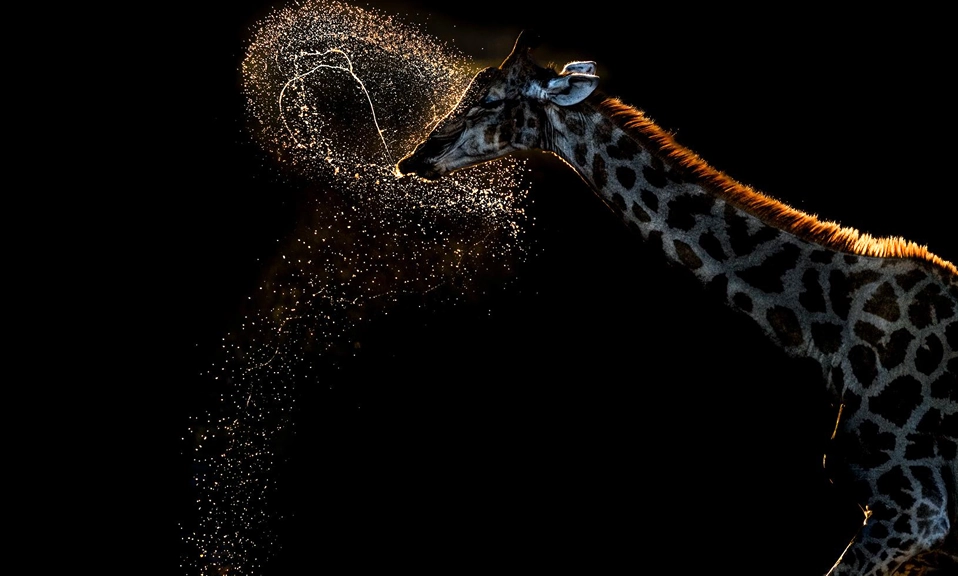
A giraffe lowers its head to drink, then lifts it with a sudden swish. The water doesn’t just splash—it arcs into the air and, for a fraction of a second, forms a near-perfect circle, suspended like a halo in the golden light of a Botswana sunset. It is a moment of pure, accidental geometry, and it has become one of the most celebrated wildlife photographs of the year.
The image, titled “Water Ballet,” was captured by Vaidehi Chandrasekar, a 72-year-old amateur photographer from Singapore. In late February 2026, it won gold in the Behaviour – Mammals category at the World Nature Photography Awards, chosen from thousands of entries across 51 countries and six continents.
This is the story behind the shot that stopped the world.
The Moment: A “Gift from the Setting Sun”
Chandrasekar was on a safari in Makgadikgadi Pans National Park in Botswana, a vast, dry landscape of salt pans and grasslands. She and her husband were camping—a demanding experience, she later admitted—but they had come for moments like this.
When a lone giraffe approached the water’s edge, Chandrasekar held her breath. She had photographed giraffes before, but she knew something was different. The giraffe bent its long legs, lowered its neck, and drank. Then it lifted its head and swished, sending a stream of water into an arc that shimmered in the fading sunlight.
“The droplets danced in the air, forming a near-perfect circle before falling back to the earth,” the awards website later described. “With the animal’s outline enhanced by the rim lighting, golden reflections sparkled off the airborne water”.
Chandrasekar called it “a moment of magic.” She wanted to capture “the interplay of the golden light and the motion of the swishing of the water”.
The Photographer: A Retirement Passion Project
What makes the image even more remarkable is the story of the person behind the lens.
Vaidehi Chandrasekar is not a career wildlife photographer. She retired in 2019 from a job in systems design support, and it was only then that she began to take photography seriously. She and her husband, also in his seventies, learned through YouTube videos and trial and error—no formal training, no expensive mentors, just curiosity and persistence.
Since then, they have travelled to photograph leopards, polar bears, and migratory birds in Singapore. They have a long list of places and animals they still hope to see, including orangutans in Indonesia and penguins in Antarctica. The Botswana safari was not a glamorous assignment—it involved camping in a remote national park—but it produced a photograph that has now been seen around the world.
When she found out she had won gold on February 20, she was “totally overwhelmed”. She was the only winner from Singapore in the entire competition.
The Technical Craft Behind the “Magic”
The image may look like a lucky accident, but capturing it required precision.
According to Digital Camera World, Chandrasekar used a Nikon Z9 mirrorless camera with a 400mm lens. The shot was taken at a shutter speed of 1/1,000 second, an aperture of f/5.6, and ISO 400.
That fast shutter speed was essential. It froze the water droplets in mid-air, preserving the shape of the arc that formed the circle. A slower shutter speed would have blurred the droplets into a streak, and the perfect circle would have been lost. The low sun did the rest, illuminating the water from behind and creating the rim-lit outline that makes the image so striking.
Chandrasekar herself credited “good fortune” as much as technique. She had photographed giraffes before, but she had rarely seen one expel so much water after drinking. The moment was brief—it required her to be ready the instant the giraffe finished drinking and raised its head.
Why the Image Resonates
“Water Ballet” is more than a beautiful photograph. It captures something that is increasingly rare in a world saturated with images: a genuine moment of wonder.
The giraffe is not performing. It is not posed. It is simply doing what giraffes do—drinking, lifting its head, swishing the water from its mouth. The circle is not designed. It is a byproduct of physics and timing, a fleeting accident of fluid dynamics that happened to align with the setting sun and a photographer who was ready.
That is what makes wildlife photography so powerful. It does not create moments. It waits for them. And occasionally, it captures something that feels almost too perfect to be real.
Chandrasekar believes photography can make a difference for conservation. “It’s not just taking a picture,” she said. “By looking at it, a lot of others can learn from it. They learn about the animals and how they must be left alone in their habitats”.
The competition itself partnered with Ecologi, a British environmental organisation, to plant a tree for every entry—a detail that drew Chandrasekar to the awards in the first place.
A 72-year-old retiree,
a camera she learned to use through YouTube, and a giraffe in a remote corner of Botswana. Those are the ingredients of a photograph that has captured the world.
“Water Ballet” is a reminder that magic doesn’t require a studio or a budget. It requires patience, preparation, and the willingness to be present when the world offers you something extraordinary. Chandrasekar was there. She was ready. And she captured a circle of water that will be remembered for a long time.
“I got very lucky,” she said.
Maybe. But luck, as the saying goes, is what happens when preparation meets opportunity. And Chandrasekar was prepared.