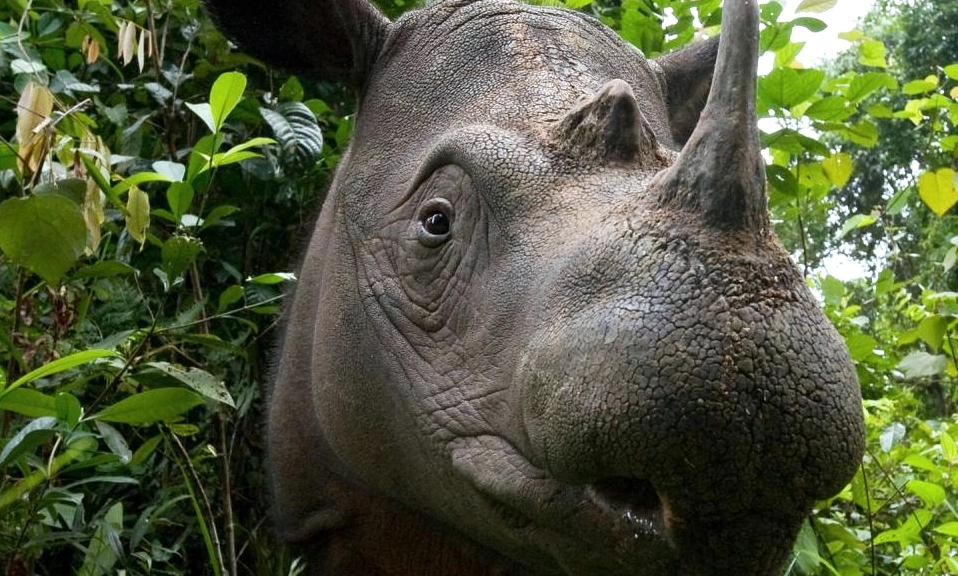
Ratu means “queen” in Indonesian. At the Sumatran Rhino Sanctuary in Way Kambas National Park, she has earned the name. The critically endangered rhino is 238 days pregnant with her fourth calf — nearly halfway through a gestation period that will end, if all goes well, in May 2027.
Her daughter, Delilah, is pregnant too. More than 250 days into her second pregnancy, Delilah is due around the same time. Mother and daughter, carrying the next generation of a species that numbers fewer than 80 individuals in the wild, and perhaps as few as 34 to 47 mature adults according to the IUCN SSC Asian Rhino Specialist Group.
The pregnancies, announced by Indonesia’s Ministry of Forestry on October 4, 2026, are being described as a milestone. “The pregnancies of these two Sumatran rhinos are not only good news for Indonesia, but also for the world,” said Ahmad Munawir, the ministry’s director of species and genetic conservation.
They are also a reminder of how narrow the margin has become.
A Sanctuary Built for a Species on the Brink
The Sumatran rhino is the smallest and hairiest of the world’s five rhino species, and the closest living relative of the extinct woolly rhinoceros. It is the only Asian rhino with two horns, and the only living rhino with a conspicuous coat of reddish-brown hair. It once ranged from the foothills of the Himalaya through mainland Southeast Asia to Sumatra and Borneo. Today, it survives only in Indonesia, in fragmented pockets of forest in North Sumatra, Lampung, Bengkulu, and East Kalimantan.
The species’ decline has been driven by habitat loss, historical poaching, and — increasingly — reproductive failure. Sumatran rhino females are induced ovulators, meaning they need to breed to maintain reproductive health. Prolonged periods without breeding are associated with cysts and fibroids that can render a female permanently infertile. In a population scattered across isolated forest fragments, where animals struggle to find each other, isolation itself becomes a cause of extinction.
The sanctuary at Way Kambas exists to break that cycle. It is a semi-in-situ breeding facility — rhinos live in their natural habitat with minimal human interaction, while receiving medical care and intensive reproductive monitoring. It is managed jointly by the Way Kambas National Park Office and the Indonesian Rhino Foundation (YABI), with financial support from the International Rhino Foundation (IRF), Taman Safari Indonesia, and TFCA Sumatera.
Since the breeding program began, five Sumatran rhinos have been born at Way Kambas: Andatu (2012), Delilah (2016), Sedah Mirah (2022), Anggi (2023), and Indra (2023). Ratu herself was captured in the wild in 2005 and has been the foundation of the program ever since.
Now she is carrying her fourth calf, fathered by Andalas — a male born at the Cincinnati Zoo in 2001, one of two brothers who form the genetic backbone of the captive breeding effort.
Delilah: The Second Generation
Delilah’s pregnancy is significant for a different reason.
She is Ratu’s daughter, born at Way Kambas in 2016. In 2023, she gave birth to a calf named Indra — making her the first Sumatran rhino born in captivity to herself successfully give birth. Now she is pregnant with her second calf, fathered by Harapan — Andalas’s full brother.
That detail matters, and not in a simple way.
Harapan is Delilah’s paternal uncle. He is also the paternal uncle of the calf she is carrying. The pairing was not chosen for genetic diversity. It was chosen because the alternative was worse.
The Inbreeding Problem: “The Immediate Need Outweighs the Concerns”
Indonesia’s captive breeding program holds 11 Sumatran rhinos — the only captive members of the species anywhere in the world. All of its males are related.
Sanctuary experts try to pair the least-related males and females possible, said Nina Fascione, executive director of the International Rhino Foundation. They also consider factors like body size differences. But with so few animals to work with, their options are severely limited.
“The immediate need to sustain the species outweighs genetic-diversity concerns,” Fascione said.
That sentence captures the brutal arithmetic of Sumatran rhino conservation. In an ideal world, you would pair genetically distant individuals to maximise the health and resilience of the population. In the real world, you pair the animals you have, because the alternative is no calves at all. A calf with an uncle for a father is better than no calf. A population with limited genetic diversity is better than a population that no longer exists.
The problem is not solved. It is being managed — one pregnancy at a time, with the full knowledge that each calf carries both hope and a genetic compromise.
The Broader Picture: A Species on a Knife’s Edge
The Sumatran rhino is not the only Indonesian rhino in crisis. The Javan rhino, with fewer than 50 individuals, is even closer to the edge. Together, the two species number fewer than 100 animals — a fraction of the hundreds of thousands that once roamed Southeast Asia.
The threats are layered. Fragmentation means wild populations are too small and too isolated to sustain themselves; population viability analysis indicates that pockets below about 15 individuals face acute demographic, environmental, and genetic risk, and no single wild pocket is currently self-sustaining. Reproductive pathology means that even where rhinos survive, they may not be able to breed. Historical poaching and snaring drove the long decline that produced today’s fragmentation, and snares remain a hazard in occupied forest. Habitat loss reduced a once-extensive range to a handful of forest blocks.
Against that backdrop, two pregnancies in a semi-in-situ sanctuary are not a solution. They are a lifeline.
“Ratu and Delilah’s pregnancies represent two more individuals that can help bring Sumatran rhinos back from the brink of extinction,” Fascione said.
Two more individuals. In a population of fewer than 80, that is not a rounding error. It is everything.
What Comes Next
The medical team, keepers, and sanctuary management at Way Kambas are monitoring both pregnancies closely. The calves are due in May 2027. If both arrive safely, the captive population will grow from 11 to 13. The wild population will remain unchanged — still fewer than 80, still fragmented, still vulnerable.
The pregnancies will not reverse the species’ decline on their own. They will not solve the inbreeding problem, halt habitat loss, or reconnect isolated populations. Those challenges require decades of work, sustained funding, and a level of international commitment that has often been lacking.
But they do offer something that has been in short supply for the Sumatran rhino: evidence that the species can still reproduce. That the biological machinery of renewal, however strained, is still functioning. That the queen of Way Kambas, and her daughter, are still carrying the future inside them.
Ratu means “queen.” In May, if all goes well, she will have another calf to prove it.