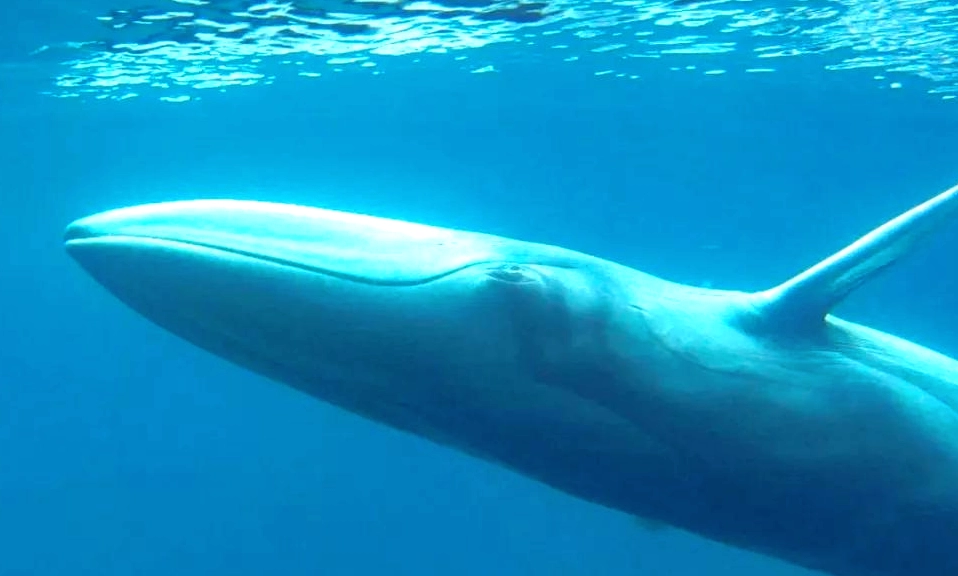
It was first described from a handful of dead specimens in a Japanese research facility. It wasn’t seen alive in the wild until a decade later. It is a 39-foot baleen whale that scientists still can’t reliably find, count, or track. And yet, off the coast of Western Australia, its song has been playing for years—a low, rhythmic pulse that researchers have only just begun to decode.
The Omura’s whale (Balaenoptera omurai) is one of the most enigmatic large animals on the planet. It was formally recognised as a species in 2003, based on genetic analysis of specimens collected by Japanese research whaling vessels in the 1970s. Before that, it had been mistaken for a Bryde’s whale—a close relative that looks almost identical to the untrained eye. The species was named after Hideo Omura, a prominent Japanese cetologist.
For years, the only evidence of its existence came from bones, strandings, and a handful of dead animals. It wasn’t until 2015 that a team led by Dr. Salvatore Cerchio confirmed the first living Omura’s whales off the coast of Madagascar—a population that had been hiding in plain sight.
Even now, sightings are so rare that the International Union for Conservation of Nature (IUCN) lists the species as Data Deficient—meaning there isn’t enough information to even assess its risk of extinction. “Omura’s whales are notoriously difficult to study because visual sightings are rare,” says Ciara Browne, a PhD student at Curtin University’s Centre for Marine Science and Technology. “Listening for their calls provides an important way of understanding where they occur”.
The Song: A Low, Rhythmic Pulse
The Omura’s whale’s song is not designed for human ears. It is a low-frequency sound, with energy concentrated between 15 and 50 Hz—below the range of most human hearing, which bottoms out around 20 Hz. The most common vocalisation is a two-unit “doublet,” which peaks at around 25.5 Hz and lasts for approximately 15 seconds. A one-unit “singlet” is also produced in some regions, with a slightly different frequency profile.
These sounds are not random. They are rhythmically repeated for extended periods, in the typical structure of baleen whale song. Researchers believe the song is a male breeding display, the same function as the humpback’s famous melodies—just pitched too low for us to hear without specialised equipment.
The scale of the singing is remarkable. Omura’s whales have been recorded singing for up to 12 hours without pause, with as many as five or six individuals audible on a single hydrophone at the same time. The song is not a fleeting call. It is a sustained, overlapping chorus.
Recent research has added nuance to the picture. A 2026 study analysing years of acoustic data from northwest Australia found that the song is not tied to the time of day or the lunar cycle. When the whales sing, they sing continuously for hours or days. The researchers suggest this means reproductive signalling may occur continuously rather than being restricted to specific light conditions or prey migrations.
The song is also geographically variable. In northern Australian waters, the doublet is the dominant vocalisation. In the lower-latitude locations off the northwest coast, the singlet is more common. And in the Great Barrier Reef, similar doublets have been detected, pointing to a possible population in the Southwest Pacific.
The Mystery: Why We Know So Little
The Omura’s whale is not just rare. It is difficult to find in a way that frustrates even the scientists who study it.
It inhabits tropical and warm-temperate waters, primarily in the Indo-Pacific, with confirmed records from Australia, Indonesia, the Philippines, Malaysia, Thailand, Vietnam, and as far afield as Singapore and the western Indian Ocean. It tends to prefer coastal and neritic habitats—relatively shallow waters near shore—though there are also pelagic records.
This preference for coastal waters is both a clue and a problem. It makes the species easier to study in some ways, because researchers know where to look. But it also puts the whales directly in the path of human activity: ship strikes, fisheries bycatch, entanglement, local hunting, seismic surveys, and coastal industrial development are all documented threats.
There is another, quieter concern: low genetic diversity. Studies across the species’ global range have found remarkably little genetic variation, suggesting that local populations may be small and isolated. If that’s true, the species may be particularly vulnerable to regional impacts—a single oil spill, a new shipping lane, a fishing gear entanglement—that would be manageable for a larger, more connected population.
And yet, the more researchers look, the more they find. Since 2015, reports of Omura’s whales have increased precipitously, from a handful of locations to 161 accounts from 95 locales across 21 range states. The species is now known from every ocean basin except the central and eastern Pacific. It wasn’t rare. It was simply overlooked.
What the Song Reveals
The recent acoustic research off Western Australia, published in Marine Mammal Science in October 2026, offers a glimpse of what the future of Omura’s whale research might look like.
Using archival recordings from 72 deployments across 35 sites between 2005 and 2023, Browne’s team detected the whales’ calls year-round. The presence of the song was driven by environmental variables associated with high productivity and warmer waters—specifically, areas with high chlorophyll levels.
This matters for conservation. If researchers can predict where the whales are likely to be based on oceanographic conditions, they can focus their monitoring efforts—and their protective measures—on the right places. The song becomes a proxy for presence, a way of tracking a species that is almost impossible to see.
“By understanding the distribution and predictors of Omura’s whale acoustic presence, we have a foundation for future research, conservation, and management plans for the species,” the study concluded.
The Omura’s whale
is a ghost in the ocean—a 39-foot baleen whale that was misidentified for decades, that wasn’t seen alive until 2015, and that remains so poorly understood that we don’t even know how many exist.
But it is not silent. Its song, a low-frequency pulse that repeats for hours and carries for miles, is a thread that researchers can follow. It tells them where the whales are, when they are there, and what conditions they prefer. It is, for now, the most reliable way to study a species that refuses to be seen.
“Listening for their calls provides an important way of understanding where they occur,” Browne says.
The Omura’s whale does not need us to see it. But it does need us to listen. And for the first time, we are starting to hear what it has been saying all along.