Some destinations are beautiful. Others are beautiful in a way that makes you look over your shoulder. The gothic getaways in this list belong to the second category—places where the fog clings to the stones, the architecture seems designed to unsettle, and the line between history and legend is pleasantly blurred. These are not haunted houses at a theme park. They are real places with real pasts, where the atmosphere is so thick you can almost taste it. Here are six mysterious destinations that feel like stepping into a dark fairytale.
1. Bran Castle, Romania: The Home of the Vampire Myth
Perched on a rocky outcrop in the Carpathian Mountains, Bran Castle is the place most often associated with Bram Stoker’s Dracula—though the real history is more complicated and, in some ways, more interesting than the fiction.
The castle was built in the 13th century by the Teutonic Knights and later became a royal residence. Its association with Vlad the Impaler—the brutal Wallachian ruler who inspired Stoker’s Count—is tenuous; Vlad may have passed through, but he never lived there. That hasn’t stopped Bran from becoming the unofficial “Dracula’s Castle” of popular imagination, drawing visitors from around the world to its narrow corridors, secret staircases, and shadowy courtyards.
What makes Bran genuinely atmospheric is not the vampire lore but the architecture itself: the heavy stone walls, the creaking wooden floors, the small windows that let in only slivers of light. On a foggy autumn day, with the mountains disappearing into the mist, it is easy to understand why the castle has captured the imagination for centuries.
Why go: The castle is open year-round, but autumn—when the leaves turn and the tourists thin out—is when it feels most like a fairytale. The nearby town of Brașov, with its own gothic Black Church and medieval squares, is a worthy companion destination.
2. Glencoe, Scotland: The Weeping Valley
Glencoe is not a building or a ruin. It is a landscape—a deep, dramatic valley in the Scottish Highlands that has been the site of one of the most infamous massacres in Scottish history.
In 1692, the MacDonalds of Glencoe were slaughtered by government troops who had been billeted in their homes, in an act of betrayal that has echoed through Scottish culture for centuries. The valley itself is hauntingly beautiful: steep, dark mountains rising on either side, waterfalls cascading down rock faces, and a pervasive mist that seems to cling to the ground even on sunny days.
Visitors often describe a feeling of heaviness in Glencoe, a sense that the land remembers. Whether that is the result of the massacre, the sheer scale of the landscape, or simply the Scottish weather is impossible to say. What is certain is that Glencoe feels like a place where stories are still being told—and some of them are not happy ones.
Why go: The Glencoe Visitor Centre offers context on the massacre and the geology of the area. The best experience, though, is simply to walk. The Lost Valley hike, a hidden glen where the MacDonalds once hid stolen cattle, is a favorite. Go in late autumn or early spring for maximum atmosphere and minimum crowds.
3. Burg Eltz, Germany: The Fairytale That Never Fell
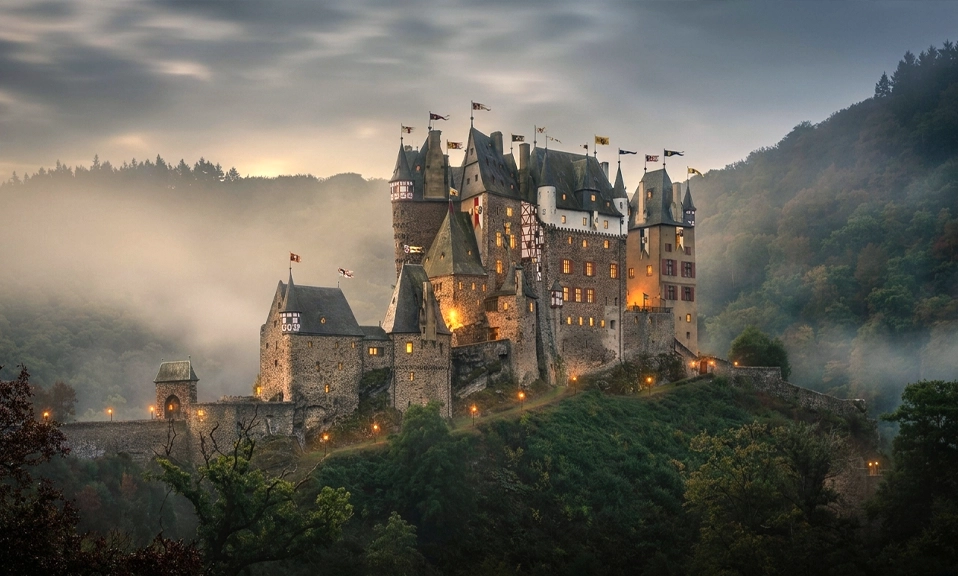
Burg Eltz is the rare medieval castle that has never been destroyed. Sitting in a valley in the Rhineland-Palatinate region, surrounded by forest, it has been owned by the same family for over 850 years—33 generations of the Eltz family—and it looks exactly like the castles in the storybooks.
That is precisely what makes it feel like stepping into a fairytale. The castle’s towers and turrets rise from the trees, the walls are covered in ivy, and the interior is a labyrinth of rooms furnished with original medieval and Renaissance pieces. Unlike so many castles that are essentially empty shells, Burg Eltz feels lived-in—because it is.
The surrounding Eltz Forest is a protected nature reserve, with hiking trails that wind through ancient beech and oak woods. The combination of the castle and the forest creates an atmosphere that is both enchanting and slightly eerie—the kind of place where you half-expect to see a figure in a cloak disappear around a corner.
Why go: The castle is open from April to November. It is best reached on foot from the nearby village of Wierschem, a 20-minute walk through the forest that adds to the sense of arrival. The Treasury and Armory are worth the extra ticket.
4. Predjama Castle, Slovenia: The Castle in the Cave
Predjama Castle is one of the most unusual castles in the world. It is built into the mouth of a cave, its walls merging with the rock face, its lower levels disappearing into the darkness of the cavern behind it. It looks less like a building and more like something that grew out of the mountain.
The castle was home to Erasmus of Lueg, a 15th-century knight and robber baron who defied the Habsburgs for over a year, using a secret tunnel through the cave to smuggle in supplies while under siege. The story goes that he was eventually betrayed by a servant and killed by a cannonball while using the castle’s outdoor privy—a detail that is both tragic and faintly absurd, and very much in keeping with the gothic spirit of the place.
The cave system behind the castle is vast, with passages that extend for kilometers into the mountain. Tours take visitors through the castle’s rooms and into the cave, where the temperature drops and the light fades, and the sense of stepping into another world becomes almost overwhelming.
Why go: Predjama is a short drive from Postojna Cave, one of Slovenia’s most famous attractions. Combining the two makes for a full day of subterranean exploration. Go in spring or autumn when the crowds are lighter and the cave’s atmosphere is at its most dramatic.
5. Charleville Castle, Ireland: The Haunted Grandeur
Charleville Castle in County Offaly is widely considered one of the most haunted castles in Ireland—a claim that is helped by its appearance. The castle is a massive gothic revival structure, designed by Francis Johnston in the early 19th century, with towers, turrets, and a facade that seems to loom out of the surrounding oak forest.
The castle fell into disrepair in the 20th century and is now being restored by a volunteer trust. Its interiors are partially restored, partially decaying, and the effect is deeply atmospheric: peeling wallpaper, grand staircases, and long corridors that seem to stretch into shadow.
Charleville is said to be haunted by the ghost of Harriet Bury, a young girl who died in a fall down the main staircase in the 19th century. Visitors have reported hearing children’s laughter, seeing apparitions, and feeling sudden drops in temperature. Whether you believe in ghosts or not, the castle’s combination of gothic architecture and genuine decay makes it one of the most evocative places on this list.
Why go: The castle offers guided tours and is available for events and overnight stays. It is a favorite destination for paranormal investigators and history enthusiasts alike. The surrounding forest, with its ancient oaks, adds to the sense of stepping into another time.
6. Bomarzo Monster Park, Italy: The Garden of Nightmares
Not all gothic fairytales are set in castles. The Sacro Bosco of Bomarzo, also known as the Park of the Monsters, is a 16th-century garden in Lazio, Italy, filled with enormous stone sculptures of grotesque and fantastical creatures.
The garden was created by Pier Francesco Orsini, a Renaissance nobleman who retreated to Bomarzo after the death of his wife. The sculptures—a giant face with an open mouth, a war elephant, a dragon, a harpy, and a leaning house—are carved from the volcanic rock of the region and have a raw, almost surreal quality. There is no obvious narrative or order to the garden; the sculptures are scattered among the trees, appearing suddenly as you walk the paths.
The effect is disorienting and deeply strange. Bomarzo is not a beautiful garden in the conventional sense. It is a place that feels like a dream—or a nightmare—and it has inspired artists and writers for centuries, including Salvador Dalí and Manuel Mujica Láinez, whose novel Bomarzo brought the garden to a wider audience.
Why go: Bomarzo is about an hour and a half north of Rome, making it an easy day trip. It is best visited in the late afternoon, when the light is low and the shadows are long. The garden is open year-round, but spring and autumn are the most comfortable seasons.
Gothic getaways are not
for everyone. They require a tolerance for ambiguity, a willingness to be unsettled, and an appreciation for places that are beautiful in a way that is not always comfortable. But for those who are drawn to the darker side of travel, these six destinations offer something increasingly rare: the feeling of stepping into a story.
Each of them has its own character. Bran Castle has its vampire myth. Glencoe has its massacre. Burg Eltz has its fairytale perfection. Predjama has its cave. Charleville has its ghosts. Bomarzo has its monsters. What they share is an atmosphere—a sense that the past is not entirely past, and that the world is a little stranger than we usually allow ourselves to admit.