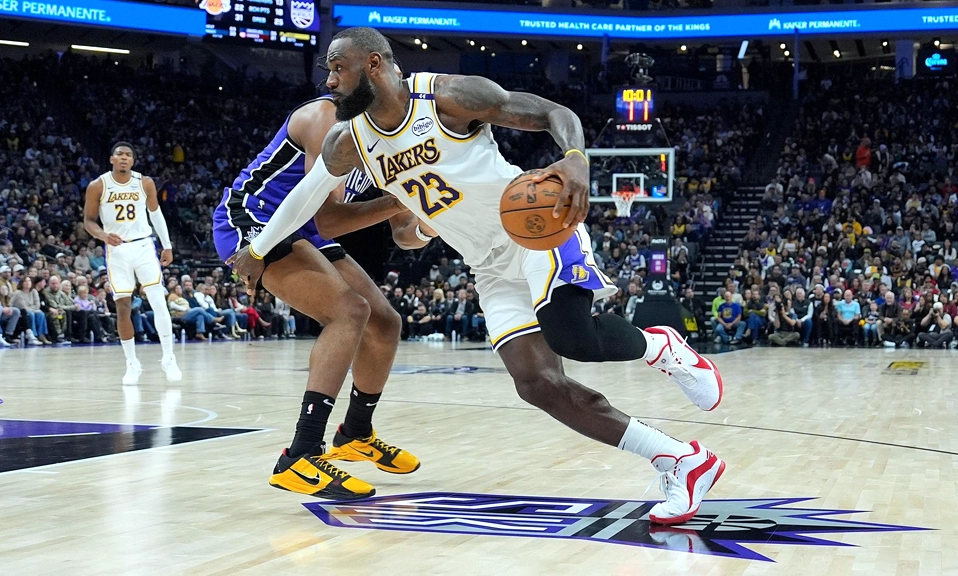
He turned 41 in December. He is entering his record 24th NBA season. He has played more minutes and more games than any player in league history. And yet, the question that follows LeBron James into every arena is no longer whether he can still play—it is how much longer the greatest longevity story in basketball can possibly last.
The answer, as the 2026-27 season begins, is more complicated than it has ever been. James is no longer a Laker. He is a Philadelphia 76er, having signed a two-year, $8 million deal with a player option for 2027-28 after informing Los Angeles he would not return. He is managing two chronic conditions—arthritis in his left foot and sciatica in his lower back—that have already forced the 76ers onto a maintenance plan before the season is a month old. And for the first time in his career, he is not the first option, not the second option, and not even the primary ball-handler on a team with championship ambitions.
That combination—diminished role, persistent pain, and a roster built to win now—is what makes this season the most fascinating test of James’s career. The end is closer than it has ever been. But “closer” is not the same as “now.”
A New Chapter in Philadelphia
James’s decision to leave Los Angeles was not a farewell. It was a recalibration. After the Lakers were swept out of the playoffs in May, James admitted he was “pretty sure” he had played his last NBA game. Those close to him indicated retirement was a real possibility. But instead of walking away, he chose a situation that could extend his career rather than end it.
Philadelphia offers something Los Angeles no longer could: a roster where James does not have to carry the burden of being “the guy” every night. The 76ers return Tyrese Maxey, Joel Embiid, and VJ Edgecombe, and they added Jaylen Brown via trade this offseason. James can slide into a role that maximizes his remaining strengths—vision, passing, situational scoring—while minimizing the physical toll of being a primary creator. “Philadelphia’s going to energize him,” his agent, Rich Paul, told ESPN. “Maybe we get two [seasons]. Maybe we get four”.
That “maybe four” is the most optimistic projection anyone around James has offered. It would take him to the 2029-30 season, at age 45. It sounds far-fetched. But James has made a career of making far-fetched things look routine.
The Physical Reality
The optimism is tempered by the body. James enters Year 24 with two conditions that are not going away.
Chronic arthritis in his left foot has been a recurring issue since his final seasons with the Lakers. It is not an acute injury that heals; it is a degenerative condition that requires constant management. Sciatica in his lower back caused him to miss the first month of the 2025-26 season, and it remains a source of concern heading into this year. Before the season began, ESPN reported that the 76ers were already paying “special attention” to both areas.
The result is a maintenance plan that will keep James in and out of the lineup. He missed the 76ers’ game against Milwaukee on October 25 for sciatica and lower back injury management—the front end of a back-to-back. He is averaging 15.5 points, 9.5 rebounds, and 6.0 assists in his first two games, efficient numbers that reflect a player who is no longer asked to score 30 a night but can still impact winning in multiple ways.
The question is not whether James can play at a high level in any given game. He can. The question is how many games his body will allow him to play, and whether the cumulative toll of managing two chronic conditions will eventually make the daily grind unbearable.
The Records and the Motivation
James has said he is not playing for money. He is estimated to be a billionaire. He is not playing for legacy; that was secured long ago. He is not playing for records; he already owns nearly every meaningful one.
But the records keep coming anyway.
He enters the season 560 points away from 44,000 regular-season points and 1,560 away from becoming the first player to reach 45,000. He needs 76 assists to pass Jason Kidd for third on the all-time assists list and 537 to pass Chris Paul for second. He is 29 steals away from passing Gary Payton for fifth all-time and 27 regular-season wins away from passing Kareem Abdul-Jabbar for the most in NBA history.
Those milestones are not the reason he is still playing. But they are a reminder of the scale of what he has built—and of how much he has already accomplished. The one thing he has not done is win a championship with a fourth franchise. He has won with Cleveland, Miami, and Los Angeles. Adding Philadelphia would be “quite the capper” to a career that has already redefined what a basketball career can be.
The Support System
The 76ers are not asking James to be the engine. They are asking him to be a component. That is a significant shift for a player who has been the center of gravity for every team he has played on since high school.
Coach Nick Nurse will be James’s 11th head coach—a number that reflects both the length of his career and the instability that has often surrounded him. But the roster around him is the most balanced he has had in years. Maxey provides speed and shot creation. Embiid, when healthy, is a dominant interior force. Brown adds wing scoring and defensive versatility. James’s role is to connect the pieces—to be the veteran mind who sees the play before it happens, who makes the extra pass, who stabilizes the second unit, and who can still take over a quarter when the situation demands it.
“I have a lot of experience in this game,” James said. “I hope that I can bring that experience, bring that knowledge, bring the blueprint to guys that are trying to accomplish some things that they haven’t done in their career”.
That is the pitch. The reality is that the blueprint only works if the body holds up.
How Long Can He Keep Going?
The honest answer is: nobody knows. Not James, not his agent, not the 76ers, not the doctors.
The optimistic case is that the reduced workload and the support of a deep roster allow James to play two or three more seasons at a diminished but still impactful level. Rich Paul’s “maybe four” is the outer limit of that scenario. James would be 45 at the end of a four-year extension. He would have played 27 seasons. He would have rewritten every longevity record in the sport.
The realistic case is that this season is a bridge year—a chance to compete for a championship with a team that does not need him to be Superman, followed by a decision at the end of the season about whether the daily maintenance is still worth it. The player option for 2027-28 gives him an exit ramp. If the body says no, he can take it.
The pessimistic case is that the chronic conditions accelerate. Arthritis does not reverse. Sciatica does not disappear. A 41-year-old body that is already on a maintenance plan in October is a body that will be tested by the 82-game grind. The 76ers will manage his minutes. They will hold him out of back-to-backs. They will do everything they can to keep him available for the games that matter. But they cannot stop time.
James has said he does not want a farewell tour. He reportedly plans to step away “without much fanfare,” a departure from the pomp and circumstance he has typically sought throughout his career. That suggests he has thought about the end—not in a way that hastens it, but in a way that accepts its inevitability.
LeBron James at 41
is not the player he was at 31, or even at 37. The athleticism has diminished. The jumper is less consistent. The body requires more care and produces more pain. But the mind is still there, the vision is still there, and the competitive fire—the thing that has driven him for two decades—is still there.
How long can he keep going? The answer depends on factors that no one can control: the progression of arthritis, the stability of his back, the fortune of avoiding a serious injury, and the willingness of a proud athlete to accept a diminished role for the sake of one more run at a championship.
He will not play forever. But he is not done yet. The 2026-27 season is not a farewell tour. It is a test—of the body, of the will, and of the limits of what a 41-year-old athlete can still do in a league that has never seen anyone quite like him. The record books say he has nothing left to prove. The man himself seems to disagree.