Sixteen titles in five years. Simultaneous men’s and women’s World Cup champions. A 38-match unbeaten run that is the longest in the history of European and South American football. This isn’t a golden generation. It’s a system.
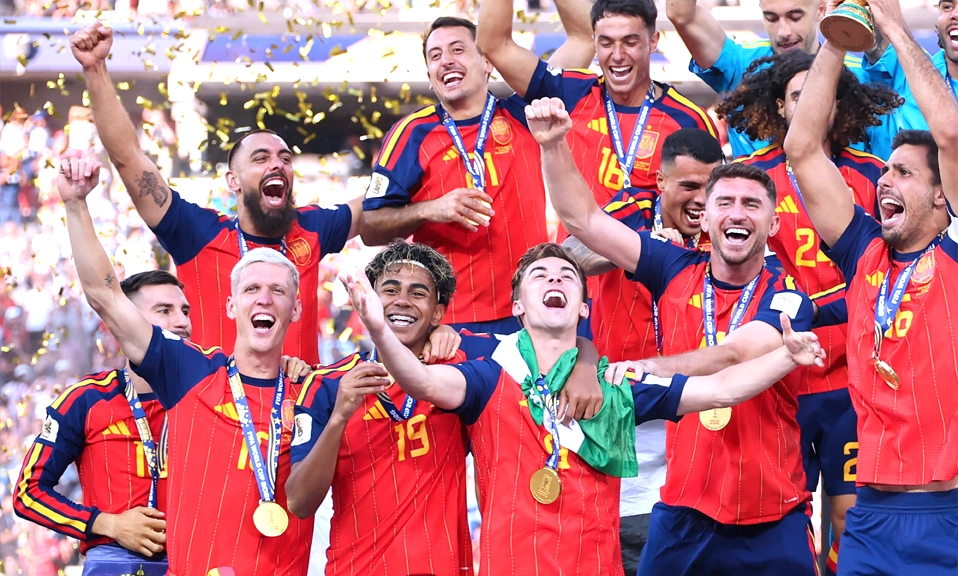
On July 19, 2026, Spain beat Argentina 1-0 after extra time to win the FIFA World Cup for the second time in their history. Two years earlier, they had won Euro 2024. Sixteen years earlier, they had done exactly the same thing — a European crown followed by a world crown. But this time feels different. This time, it doesn’t feel like a peak. It feels like a platform.
Here’s how Spain built the most dominant footballing nation on Earth — and why they might be just getting started.
The Numbers That Defy Belief
Let’s start with the raw facts, because they’re genuinely staggering.
In the last five years, Spain have won 16 world and European titles across men’s and women’s football, from under-17 level all the way to the senior teams. They are the first nation in history to hold the men’s and women’s World Cup titles simultaneously. They sit at the top of both FIFA world rankings.
The men’s team is unbeaten in their last 38 matches in all competitions — the longest run by any European or South American team in history. At the 2026 World Cup, they conceded just one goal across the entire tournament, a record for the expanded format.
And they didn’t just win. They won convincingly. Their 2-0 semi-final dismantling of France — a team many considered the tournament favourites — was described by analysts as one of the most one-sided matches between elite sides in World Cup history.
The Factory: Why La Masia Matters More Than Ever
The foundation of Spain’s dominance isn’t a single player, a single coach, or a single tactical innovation. It’s an ecosystem — and at the heart of that ecosystem sits a youth academy that has quietly become the most important institution in world football.
FC Barcelona’s La Masia produced eight members of Spain’s 2026 World Cup squad: Lamine Yamal, Pau Cubarsí, Gavi, Pedri, Dani Olmo, Eric García, Ferran Torres, and Joan García. In the World Cup final itself, nine La Masia graduates took the pitch — eight for Spain and one for Argentina, a certain Lionel Messi.
But La Masia isn’t just producing good players. It’s producing players who understand the game at a level that sets them apart.
Pau Cubarsí, who was named Young Player of the Tournament at the 2026 World Cup, made his Barcelona debut days before turning 17. By 19, he was marshalling Spain’s defence against Kylian Mbappé in a World Cup semi-final. Lamine Yamal, his batchmate at La Masia, broke into Barcelona’s senior team at 16 and is already a European and World Cup winner at 19.
The reason, according to those who study the system, isn’t just technical skill. It’s cognitive development. Players are taught from a very young age not just how to play, but how to think about the game.
The Philosophy: Everyone Speaks the Same Language
Spain’s success isn’t just about one academy. It’s about a nationwide footballing identity that runs from under-8s to the senior national team.
David Gutiérrez, Director of the National School of Coaches at the Spanish Football Association (RFEF), traces the modern era back to one man and one year: Luis Aragonés in 2008. Aragonés recognised that Spain’s clubs were producing a specific type of player — technically gifted, tactically intelligent, but not necessarily the fastest or strongest — and built a national team around that profile.
From that moment, the RFEF began formalising a methodology. Coaching courses were built around possession-based drills and teaching players to interpret the game collectively, not just individually.
“I always say that Spanish footballers are the best in the world at interpreting the game,” said current RFEF sporting director Aitor Karanka. “They understand both phases — attack and defence — and they understand space.”
The result is a national team where every player — whether they came through Barcelona, Real Madrid, or a smaller club — speaks the same tactical language. When they put on the Spain shirt, they don’t have to learn a new system. They already know it.
The Tactical Evolution: Beyond Tiki-Taka
For nearly two decades, “Spain” and “tiki-taka” were synonymous. Endless possession. Short passing triangles. Patience bordering on suffocation. It won Euro 2008, the 2010 World Cup, and Euro 2012. Then it became predictable. Spain exited the 2014 World Cup in the group stage and the next two World Cups in the round of 16.
Luis de la Fuente, appointed in December 2022, didn’t abandon tiki-taka. He evolved it.
The data tells the story. At the 2018 and 2022 World Cups, Spain’s share of progressive passes was below the tournament average — 0.82 and 0.76 times the field average, respectively. At Euro 2024, which Spain won, it rose to 1.08 times the average. At the 2026 World Cup, it was 1.09.
In plain English: Spain are still a possession team. But they’re now a vertical one. They still control the ball, but they use it to attack with speed and intent.
“They further developed tiki-taka in the last 10 or 12 years,” said former Germany goalkeeper Oliver Kahn. “Luis de la Fuente has made some adaptations. They are playing more vertically and much more aggressively, with both full-backs always attacking. This is a totally different Spain than it was 10 years ago”.
“They are still a possession-based team,” said former England striker Robbie Fowler, “but what I love is it’s possession in the right way, it’s possession in the right spaces. There’s a purpose to how they play”.
The Coach: The Quiet Architect
Luis de la Fuente is not a charismatic figure. He doesn’t give rousing speeches or cultivate a public persona. He spent 15 years coaching in Spain’s lower leagues and youth setups before being handed the senior job — a decision that many at the time considered risky.
But De la Fuente knew something the critics didn’t. He had coached most of these players before. He had watched them grow up in Spain’s youth teams. He understood what they were capable of, and he trusted them to deliver.
His philosophy is simple: stay true to the idea. “We always try to be faithful to our idea, our model,” he said. “And we know that the closer we are to that idea, the closer we’ll be to winning”.
His players describe him as a master of man-management. “He understands how players tick, he knows how to guide them, and he senses who should start each match,” said one FIFA profile of the coach.
De la Fuente’s greatest achievement isn’t just the trophies. It’s that he built a team that could win without its best players. At the 2026 World Cup, Spain lost Lamine Yamal and Nico Williams — their two most explosive wingers — to hamstring injuries early in the tournament. Rather than panic, De la Fuente shifted the focus back to Spain’s midfield, relying on the bread and butter of the Spanish game: control, patience, and collective intelligence.
It worked. Spain won the World Cup conceding just one goal.
The Women’s Game: Not an Afterthought
Spain’s dominance isn’t limited to the men’s side. The women’s national team won the 2023 World Cup and has since added two UEFA Women’s Nations League titles. In the 2025 Women’s Euro, they finished as runners-up.
The RFEF’s youth system isn’t gendered. The same philosophy, the same coaching methodology, the same emphasis on technical excellence and collective understanding applies across both programmes. When Alexia Putellas talks about the Spanish style, she’s describing the same principles that Lamine Yamal and Pedri learn.
The women’s side will defend their World Cup crown in Brazil in 2027. And given the pipeline of talent flowing through Spain’s youth ranks, they might be favourites to do it.
The Coaching Pipeline: Spain’s Secret Weapon
One of the most overlooked reasons for Spain’s dominance is its coaching education system.
At least a quarter of the managers who started the 2026-27 Premier League season are Spanish. Spanish coaches are in demand across Europe because they understand the game at a level that sets them apart.
The RFEF’s coaching courses emphasise game understanding over rigid systems. Coaches are taught to give players the freedom to find solutions without confining them to overly structured frameworks. The goal is to produce players who can think — not just execute.
This approach extends beyond Spain’s borders. Spanish coaches are exporting the methodology to other countries, spreading the influence of Spanish football even further. When you watch a well-coached team anywhere in the world, there’s a decent chance a Spanish coach had something to do with it.
The Future: Why Spain’s Reign Is Just Beginning
Spain’s 2026 World Cup triumph echoes 2010. But there’s a crucial difference. The 2010 team was the culmination of a golden generation — Xavi, Iniesta, Casillas, Puyol. When they aged out, Spain struggled. The system that produced them wasn’t yet mature enough to replace them.
This time is different. The 2026 team was built on a system, not a generation. And that system is producing talent at every age level.
Spain won the Under-19 European Championship in 2026. They won it in 2025, 2024, 2023, and 2022. The pipeline isn’t just producing replacements. It’s producing a conveyor belt.
In four years, Spain will co-host the 2028 European Championship with Portugal and Morocco — meaning they will be defending their continental crown on home soil. Before that, Euro 2028 in the UK gives them a chance to complete another Euro-World Cup double.
“We’re facing a unique and exceptional generation,” De la Fuente said.
He might be understating it. This isn’t a generation. It’s a machine.
Spain didn’t
become football’s new powerhouse by accident. They didn’t stumble into a golden generation. They built one — deliberately, systematically, over two decades.
They built an academy that produces thinking players, not just talented ones. They built a coaching philosophy that runs from grassroots to the senior team. They built a tactical identity that evolves without abandoning its core principles. And they built a federation infrastructure that ensures continuity, so that when one coach leaves, the next one already knows the system.
The result is a national team that can lose its best players and still win the World Cup. A women’s team that dominates its sport. A coaching pipeline that exports talent around the globe. And a youth system that keeps producing the next Lamine Yamal, the next Pedri, the next Cubarsí.
Sixteen titles in five years isn’t a golden era. It’s a system working exactly as designed. And if the design is right, the era might just be getting started.