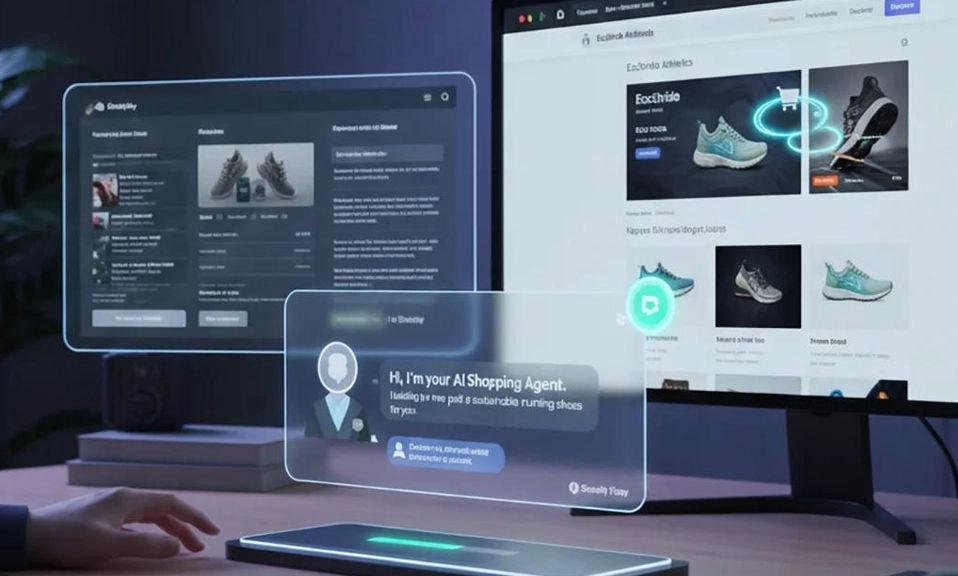
The online shopping experience has barely changed in two decades. You open an app, type a search, scroll through dozens of listings, compare prices across tabs, read reviews, add to cart, and check out. It is a process designed for human attention—and it is exhausting. In 2026, a new class of AI shopping agents is promising to do all of that for you: research products, compare prices, hunt for deals, and even complete the purchase. The question is no longer whether these agents work. It is whether they will replace the act of browsing altogether—and what we lose if they do.
The shift is visible across the tech landscape. Amazon’s Rufus has evolved from a product Q&A bot into an agent that can compare items, track prices, and make recommendations based on conversational prompts. Google’s Gemini now integrates with Shopping Graph to surface deals and even complete purchases through Agentic Checkout. OpenAI has partnered with retailers to let ChatGPT handle product research and transactions. Startups like Deft and Daydream are building AI shopping assistants that learn your preferences and automatically find what you need. The infrastructure for agentic commerce—the technical plumbing that lets an AI agent browse, negotiate, and pay on your behalf—is being built by Visa, Mastercard, and major banks.
The adoption is real. A 2026 survey by the Baymard Institute found that 42% of online shoppers have used an AI assistant to help with a purchase decision, and 18% have let an AI agent complete a transaction on their behalf. Among Gen Z and millennials, those figures rise to 57% and 29% respectively. The direction of travel is clear.
What AI Shopping Agents Actually Do
The term “shopping agent” covers a spectrum of capabilities, from assistive to fully autonomous.
At the assistive end, an agent acts as a research assistant. You describe what you are looking for in natural language—“a lightweight rain jacket for hiking, under $150, that packs into its own pocket”—and the agent searches across retailers, filters by your criteria, summarizes reviews, and presents a shortlist. You still make the final decision and complete the purchase.
In the middle, an agent negotiates and optimizes. It monitors prices over time, alerts you when something drops, applies available coupons automatically, and suggests alternatives that offer better value. Some agents can even haggle with sellers on your behalf—a feature that is particularly popular on resale platforms and in markets where bargaining is customary.
At the autonomous end, an agent completes the entire transaction. You give it a goal and a budget, and it finds the product, places the order, and arranges delivery. This is where the most significant—and most controversial—developments are happening.
The Benefits: Time, Money, and Decision Fatigue
The case for shopping agents is straightforward and compelling.
They save time. The average online shopper spends over four hours per month browsing and researching purchases, according to a 2025 Statista report. An agent that can handle the research and comparison in seconds reclaims that time for things people actually enjoy.
They find better deals. Agents can monitor prices across dozens of retailers simultaneously, apply discounts that humans might miss, and identify the optimal moment to buy. Early data from Amazon’s Rufus suggests that users who engage with the agent are 15% more likely to find a lower-priced alternative than those who search manually.
They reduce decision fatigue. Choice overload is a real psychological burden. A 2026 study in the Journal of Consumer Research found that shoppers presented with more than 24 options were significantly more likely to delay or abandon a purchase. An agent that curates a shortlist based on your stated preferences removes that friction.
They democratize access. For people with disabilities, the elderly, or those who find navigating e-commerce interfaces challenging, an agent that can handle the entire process is a genuine accessibility breakthrough.
The Concerns: Privacy, Serendipity, and Control
The case against shopping agents is equally serious, and it goes beyond the usual privacy worries.
The data trade-off is immense. To work well, an agent needs to know your sizes, your budget, your past purchases, your style preferences, and your schedule. That is a detailed profile of your life, shared with a company that may have its own commercial interests. The agent is not a neutral advisor; it is a product of a platform that may prioritize certain retailers, brands, or sponsored listings.
The loss of serendipity is real. Browsing is not just a means to an end. It is a form of discovery. You stumble on a brand you have never heard of, a product you did not know existed, a style you had not considered. An agent optimized for efficiency will never show you something you did not ask for—and that means fewer happy accidents, fewer new tastes, and a narrower, more predictable consumer experience.
Control and trust remain unresolved. If an agent makes a purchase decision on your behalf, who is responsible when it goes wrong? If it is manipulated by a retailer’s sponsored placement, how would you know? If it develops a bias toward certain brands or price points, who audits it? The regulatory framework for agentic commerce is still being written, and the answers are not yet clear.
Will You Still Browse Stores Yourself?
The honest answer is: sometimes, but less often, and for different reasons.
The tasks that agents will take over are the ones that are transactional, repetitive, and well-defined. Reordering household supplies. Finding the cheapest flight for a specific date. Comparing specifications for a new laptop. Buying a replacement for a worn-out pair of shoes. These are chores, not pleasures. Handing them to an agent is a clear win.
The tasks that will remain human are the ones that are experiential, discovery-driven, and emotionally significant. Browsing a bookstore for a gift. Trying on clothes in a store. Wandering through a market on holiday. Exploring a new brand because a friend recommended it. These are not optimization problems. They are experiences, and the friction is part of the point.
The hybrid future is already taking shape. Agents will handle the research and logistics—the price comparison, the review summary, the availability check—while humans retain the final decision and the moment of discovery. You might tell your agent to find three options for a new sofa, but you will still want to sit on it before you buy. You might let it reorder your groceries, but you will still want to browse the farmers’ market on a Saturday morning.
AI shopping agents
are not going to eliminate browsing. They are going to redefine what browsing is for. The transactional, time-consuming, decision-fatiguing parts of online shopping will increasingly be handled by machines. The experiential, serendipitous, and emotionally meaningful parts will remain human.
The question is not whether you will still browse stores yourself. It is whether you will still want to. For the things that matter—the gift for a loved one, the outfit for a special occasion, the book you will remember for years—the answer is almost certainly yes. For the things that do not—the toothpaste, the phone charger, the replacement lightbulb—the answer is increasingly no.
The agent will handle the chores. You will keep the pleasures. That is not a loss. It is a reallocation of your most precious resource: attention.