For nearly a decade, the folding steering wheel has been the ultimate auto-show party trick—a slick concept car flourish that every major automaker and supplier has paraded on a stand, and absolutely no one has put into a car you could actually buy. Hyundai Mobis has been showing one for years. BYD’s own Denza brand had one on a concept in 2025. Autoliv and Tensor unveiled what they called the “world’s first foldable steering wheel” at CES in January 2026, for a robotaxi that was still months away from volume production.
Then, on November 19, 2026, BYD quietly did what the entire industry had been promising and failing to do for a decade. It put a folding steering wheel into a mass-produced SUV and gave it a price tag.
The car is the Fang Cheng Bao Tai 9, a six-seat plug-in hybrid from BYD’s off-road sub-brand. The folding wheel comes only on the range-topping “Folding Smart Cabin” trim, which sells for 329,900 yuan—about $49,000—in China. It is not a concept. It is not a limited-run homologation special. It is a button you can press, on a car you can order, and it changes the front cabin in a way that feels genuinely new.
How It Works: Ten Seconds, No Steering Column
The magic is made possible by a technology that only became legal in China months ago. The Tai 9 has no mechanical steering column—no metal shaft connecting the wheel to the road wheels. It is entirely steer-by-wire. Turn the wheel, and electronic sensors read the movement and send a signal to motors that turn the tires. Without a physical column in the way, the wheel is free to go wherever the designers want it to go.
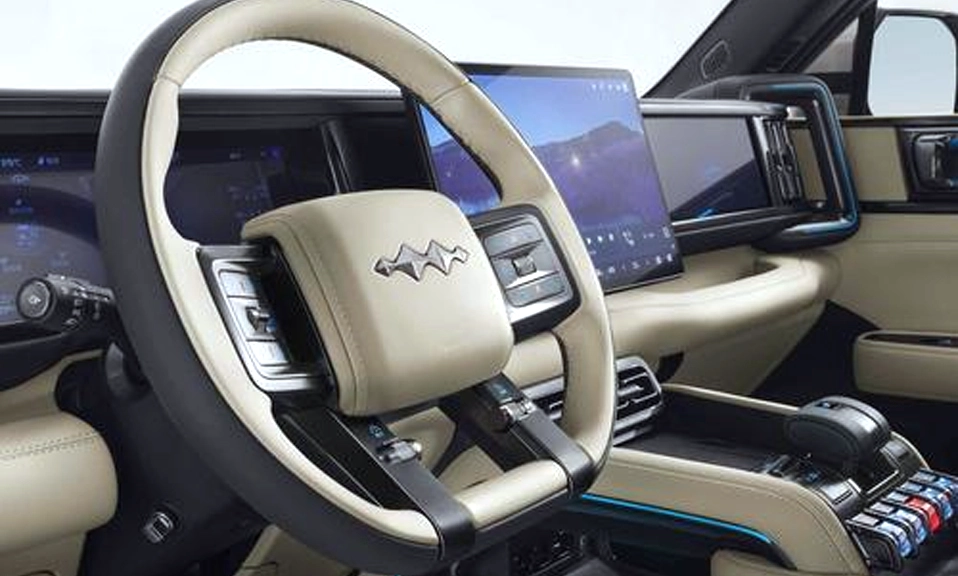
On the Tai 9, that means a hidden hinge and a motorized mechanism that swings the wheel through 180 degrees and drops it into a compartment in the dashboard in about 10 seconds. A panel closes over the opening, leaving a clean, flat surface where the wheel used to be. The airbag stays outside the compartment, so it remains functional whether the wheel is deployed or stowed. And when the wheel is out, it is a regular D-shaped wheel with a full rim and physical buttons—not a yoke.
The mechanism is rated for 80,000 operating cycles. As Fang Cheng Bao’s general manager Xiong Tianbo put it, that is enough to fold it four times a day for more than half a century. The motor that moves the wheel is borrowed from the same technology BYD develops for humanoid robots, a first for one of its cars.
The folding wheel is only half of the transformation. The driver’s seat reclines to 165 degrees, the base rises by about 3.5 inches, and the whole process takes roughly 20 seconds. A small tray table folds out where the wheel used to be. The pitch is simple: fold the wheel, lie back, and eat, nap, work, or watch something while the car charges or waits. BYD claims that 80% of the driver’s area becomes usable space once the wheel is stowed.
The Safety Interlock: It Only Folds When Parked
The most important detail is what the folding wheel does not do. It is not a step toward hands-free driving. The wheel only folds when the vehicle is stopped—or, according to Fang Cheng Bao, while the car is parking itself. It will not retract while you are driving, and it cannot be used to clear the driver’s area for Level 2 or Level 3 driver-assistance functions. BYD has built in five layers of redundancy covering sensing, control, actuation, communications, and power supply, and the system carries an ASIL D rating—the highest automotive safety integrity level.
This is a deliberate design choice, and it matters. A folding wheel that disappears while the car is moving would raise profound questions about emergency control, airbag deployment, and regulatory approval. A folding wheel that disappears only when the car is parked is a comfort and packaging feature, not an autonomy feature. It is a way to make the driver’s seat a better place to spend time when you are not driving—which, for an EV or plug-in hybrid, is increasingly often.
The Regulatory Catalyst: China Opened the Door
The Tai 9 could not have existed a year earlier. China’s new national standard for steering systems, GB 17675-2025, took effect on July 1, 2026. It dropped the long-standing requirement for a mechanical link between the steering wheel and the road wheels, provided the system meets redundancy and fail-safe rules. Before that, steer-by-wire required special approval, and only a handful of cars—Nio’s ET9 in China, Tesla’s Cybertruck in the US—had been granted it.
The regulatory change did not just legalize steer-by-wire at scale. It unlocked the design space. As Xiong Tianbo explained, “a mechanical steering column connects the steering wheel and the wheels,” and “that one column limits the imagination for the entire driver’s space”. Remove the column, and the wheel becomes just another input device—one that can be placed, shaped, and stored however the designer sees fit. The folding wheel is the first mass-production expression of that new freedom.
The Bigger Picture: A Bridge to Autonomous Driving
The Tai 9’s folding wheel is not an autonomous driving feature. The car cannot drive itself. But it is a bridge to the interior layouts that autonomous vehicles will require. When a car reaches Level 4 autonomy—where it can handle all driving tasks within defined conditions without human intervention—the driver’s area no longer needs to be a driving position. It can become a lounge, an office, or a bedroom. The steering wheel becomes optional, and the space it occupied becomes valuable.
Autoliv and Tensor’s CES concept was built for exactly that future: a wheel that folds away when the car switches into Level 4 mode, with safety systems that automatically reconfigure airbag deployment and restraint strategies. The Tai 9 is not that car. It is a production-ready proof of concept for the mechanical and regulatory infrastructure that will make that car possible. It demonstrates that a folding wheel can be built, validated, and sold to the public—not just shown on a stand. And it does so years before the robotaxis and Level 4 passenger cars that will ultimately justify the feature at scale.
There is also a competitive dimension. Tesla went the other way with the Cybercab: no steering wheel at all. But the prototypes testing on public roads have a Cybertruck wheel bolted onto an exposed column, because a human still has to be able to drive. The Tai 9’s approach—a conventional wheel that folds away when it is not needed—is a more pragmatic transition. It gives drivers the familiarity of a normal wheel when they are in control, and the space of an autonomous cabin when they are not.
The Caveats: A $49,000 Party Trick?
The folding wheel is not cheap, and it is not for everyone. It is available only on the top trim of the Tai 9, which starts at 279,900 yuan for the base model and rises to 329,900 yuan for the Folding Smart Cabin version. The rest of the Tai 9 is a serious vehicle—a 5,270 mm long, six-seat SUV with a 1.5-liter turbo engine and dual electric motors producing a combined 536 hp, a 66.48 kWh Blade battery with 310 km of electric-only range, and a 0–62 mph time of 4.8 seconds. But the folding wheel is the headline, and it is the reason the top trim exists.
For driving enthusiasts, the proliferation of steer-by-wire is a trade-off. The Tai 9 is a three-ton, three-row plug-in hybrid SUV; it was never going to feel like a sports car. But the loss of mechanical steering feel is real, and the folding wheel is a symbol of a broader shift away from the tactile, mechanical relationship between driver and road that defined the last century of motoring. Whether that shift is a loss or a liberation depends on what you value in a car.
The Tai 9 is also China-only for now, and there is no confirmed timeline for a European or American launch. The regulatory environment outside China is different, and steer-by-wire approval is still piecemeal. But the technology is proven, the safety case is built, and the manufacturing process is running. The question is not whether folding steering wheels will spread beyond China. It is how quickly the rest of the world will catch up.
A Strange Design That Points to a Real Future
The folding steering wheel is strange. It is the kind of feature that invites jokes about Batmobiles and party tricks, and it is easy to dismiss as a gimmick. But the Tai 9 is not a gimmick. It is the first production car to solve the engineering, safety, and regulatory problems that kept folding wheels on show stands for a decade. It turns the driver’s seat into a genuinely flexible space, and it does so with a conventional wheel that behaves normally when you need it to.
More importantly, it is a glimpse of the interior architecture that autonomous driving will demand. The cars that drive themselves will not need permanent steering wheels. The Tai 9 is not one of those cars, but it is the first step toward making their cabins possible—and it is a step that customers can take today, for the price of a well-equipped family SUV. The future of driving may not have a steering wheel at all. But the transition to that future will run through cars like this one, where the wheel is still there when you want it, and gone when you don’t.