For the past few years, the entire world has been trained to interact with artificial intelligence in one specific way: typing a prompt into a text box and waiting for a response.
We’ve called them chatbots, copilots, and assistants. We’ve marveled at their ability to write emails, summarize documents, and generate code. But as we look toward the late 2020s, a quiet consensus is forming among top AI researchers: The chat interface is a bottleneck, not the endgame.
Treating a superintelligent system like a glorified search engine or a text-based vending machine is like using a supercomputer to play Pong. The chatbot era is simply the “command line” phase of AI.
The real revolution is already brewing beneath the surface. It’s not about talking to machines; it’s about machines understanding, acting, and reshaping the world around us. Here are the 5 paradigm shifts that will define the next era of AI.
1. Ambient and “Invisible” AI 👻
The Shift: From Explicit Prompting to Implicit Anticipation.
Right now, AI requires you to initiate the interaction. The next generation of AI will be ambient. It will live in the background of your operating system, your home, and your car, observing context and acting proactively.
Right now, AI requires you to initiate the interaction. The next generation of AI will be ambient. It will live in the background of your operating system, your home, and your car, observing context and acting proactively.
Instead of typing, “Draft an email to Sarah rescheduling our meeting to 3 PM because my flight is delayed,” your AI will notice your flight status change, check Sarah’s calendar, draft the email, and present it to you with a single “Approve” button. The best AI of the future won’t have a chat window at all. It will just be a seamless, invisible layer of intelligence that removes friction from your life.
2. Embodied AI and General-Purpose Robotics 🤖
The Shift: From Generating Bits to Manipulating Atoms.
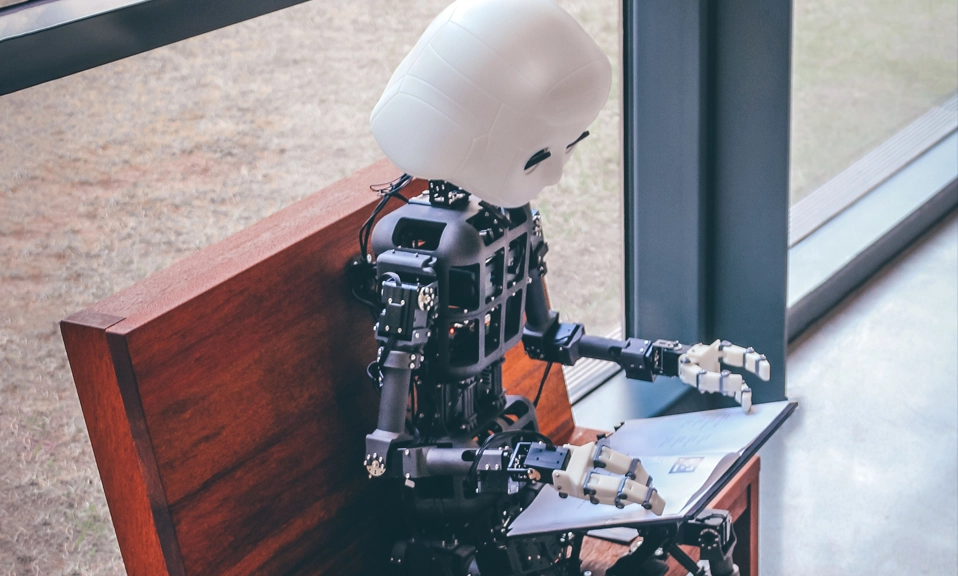
Large Language Models (LLMs) gave AI a “brain,” but it was trapped in a server rack. The next frontier is giving that brain a body. Thanks to “Vision-Language-Action” (VLA) models, robots are no longer hard-coded to perform a single repetitive task on an assembly line.
Large Language Models (LLMs) gave AI a “brain,” but it was trapped in a server rack. The next frontier is giving that brain a body. Thanks to “Vision-Language-Action” (VLA) models, robots are no longer hard-coded to perform a single repetitive task on an assembly line.
They are learning to understand the physical world. By 2026 and beyond, we are seeing the rapid deployment of general-purpose humanoid and adaptive robots that can navigate unstructured environments, fold laundry, sort complex recycling, or assist in elderly care. The AI revolution is literally getting up and walking around.
3. Generative Science and the “Atoms” Revolution 🔬
The Shift: From Content Creation to Discovery.
The most valuable application of AI isn’t writing marketing copy; it’s solving the hardest problems in physics, biology, and chemistry.
The most valuable application of AI isn’t writing marketing copy; it’s solving the hardest problems in physics, biology, and chemistry.
We are entering the era of “Generative Science.” AI models are now being used to:
- Design novel proteins and enzymes to cure previously untreatable diseases.
- Discover new battery materials that could double EV range and halve charging times.
- Optimize nuclear fusion reactions in real-time. While chatbots argue about grammar, AI scientists are quietly rewriting the foundational rules of the physical world.
4. Neuro-Symbolic and Causal AI 🧠
The Shift: From Pattern Matching to Actual Reasoning.
Current LLMs are “stochastic parrots”—they predict the next statistically likely word based on patterns in their training data. They don’t actually understand cause and effect, which is why they hallucinate.
Current LLMs are “stochastic parrots”—they predict the next statistically likely word based on patterns in their training data. They don’t actually understand cause and effect, which is why they hallucinate.
The next breakthrough is Neuro-Symbolic AI, which combines the pattern-recognition power of neural networks with the rigid, logical rule-based systems of classical computer science. These systems build internal “world models.” They don’t just guess what comes next; they reason through a problem step-by-step, verify their own logic, and understand why something is true. This is the key to making AI truly reliable for high-stakes fields like law, medicine, and aerospace.
5. Autonomous Multi-Agent Swarms 🐝
The Shift: From Single-Tool Users to Digital Organizations.
Today, you use one AI tool to write, another to code, and another to analyze data. Tomorrow, you will manage a “swarm” of specialized AI agents.
Today, you use one AI tool to write, another to code, and another to analyze data. Tomorrow, you will manage a “swarm” of specialized AI agents.
You will give a high-level goal: “Launch a new e-commerce store for sustainable coffee.”
- Agent A researches the market and writes the business plan.
- Agent B writes the code for the website.
- Agent C generates the product photography and marketing copy.
- Agent D negotiates with supplier APIs. These agents will communicate with each other, critique each other’s work, and present you with a finished product. Your job won’t be to do the work; it will be to act as the CEO, setting the vision and approving the final output.
The Interface Is Disappearing
The chatbot was a necessary stepping stone. It helped us build trust with AI, understand its capabilities, and train the foundational models. But it is inherently limited by human typing speed and our own imagination.
The next big AI revolution won’t feel like using a new piece of software. It will feel like the world itself has become smarter, more responsive, and more capable.
We are moving from an era where we command computers, to an era where computers collaborate with us—and eventually, act on our behalf. The chat window is closing. The real work is just beginning.
Which of these post-chatbot AI revolutions are you most excited (or nervous) about? Do you think embodied robots or generative science will have a bigger impact on your lifetime?