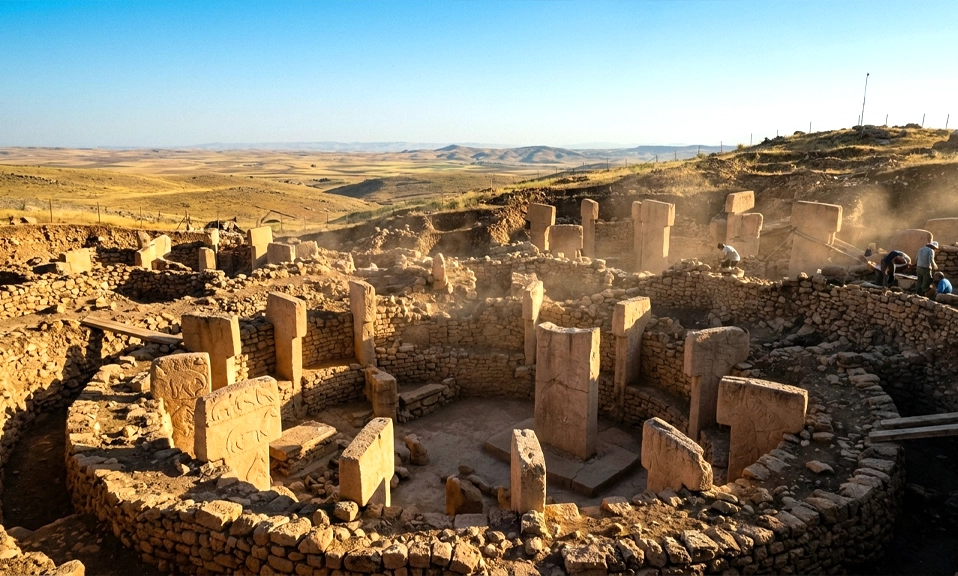
For decades, Göbekli Tepe has been framed as the world’s first temple — a monumental sanctuary built by hunter-gatherers who had no business being that sophisticated. But a wave of discoveries in 2026 is dismantling that narrative. Beneath the famous stone circles, archaeologists have found something far more human: homes, graves, and a statue hidden in a wall for over 12,000 years.
The story of Göbekli Tepe is no longer just about ritual. It’s about people who lived, died, and buried their dead beneath the very structures that were supposed to be their monuments.
The Mystery Beneath the Surface
For more than 30 years, archaeologists excavating Göbekli Tepe have faced a bewildering spectacle: hundreds of fragmented human bones scattered among the ruins of the monumental stone buildings. The site, which dates back roughly 11,600 years, is famous for its massive T-shaped limestone pillars, carved with snakes, foxes, and vultures. Yet despite its extraordinary preservation, researchers had never found a single clearly identifiable burial that could explain where those bones came from.
That changed in September 2026. A study published in PLOS ONE by Julia Gresky and Lee Clare announced the discovery of the first two intact burials at Göbekli Tepe, dating to the Pre-Pottery Neolithic B period (8700–8000 BCE).
The first tomb was found beneath the floor of a rectangular building. It contained the remains of at least three individuals — an adult woman, a young man, and an adolescent. The arrangement of the bones suggests the burial was reused over time, with earlier remains moved aside to make room for new interments. The second burial, likely belonging to a young woman, was located next to one of the site’s famous monumental structures.
The implications are profound. Taphonomic analysis of the bones showed that fragmentation could occur naturally over time due to soil pressure, mineral deposits, and animal activity. The researchers propose that many of the 928 scattered bone fragments recovered since 1995 may have originated from tombs located beneath buildings that have since eroded. Over millennia, ground movements and erosive processes would have transported human remains and debris toward the monumental structures, creating the enigmatic accumulation that had puzzled archaeologists for decades.
But the mystery isn’t entirely solved. Some skulls found at Göbekli Tepe show deep intentional incisions — evidence of possible skull cult rituals, documented at other sites in the Neolithic Taş Tepeler complex. The new discovery reinforces the idea that Göbekli Tepe was not just a ceremonial center, but a place where daily life, worship, and funerary practices were deeply intertwined.
The Dwellings: A Settlement, Not Just a Sanctuary
The second major discovery came in August 2026, when Turkish archaeologists opened a new 80-by-70-meter excavation area on the northern part of the mound.
Surface surveys and geomagnetic measurements had indicated the presence of large communal buildings, rectangular structures, and huts. When the team began digging, they found exactly that: rectangular buildings dating to the site’s second occupational phase, lying just beneath the surface.
Professor Necmi Karul, head of the Göbeklitepe excavations, told Anadolu Agency that the structures may have been used for residential purposes. “Looking at the interior arrangement of the spaces, they may have been used more for residential purposes,” he said. “But, of course, it is not enough to say this simply by exposing the walls.”
Soil samples collected from inside the structures will provide further information about their function, particularly once excavation reaches floor levels. But the first impression is clear: these were dwellings. The discovery adds to a growing body of evidence that Göbekli Tepe was not only a center for ritual activities but also a settlement where people lived. Similar settlement patterns have been identified at other excavation sites within the Stone Hills project.
The Statue Hidden in the Wall
The third discovery is perhaps the most haunting. In October 2026, archaeologists announced the discovery of a rare anthropomorphic statue — a human figure carved in stone — that had been hidden inside a wall for more than 12,000 years.
The statue was found inserted horizontally into a cavity carved into the masonry of a structure. According to archaeologists, its placement appears intentional and may be linked to a ritual practice or an offering. The object has not yet been presented in a scientific publication, and conservation analyses are still ongoing.
The discovery is particularly significant because anthropomorphic depictions are rare at Göbekli Tepe. The site is famous primarily for its imposing animal representations — snakes, foxes, boars, and vultures, carved on the great T-shaped limestone pillars. Complete human figures are much less frequent. An example integrated into the architecture of a ritual space could therefore offer new elements for understanding the symbolic world of the people who built Göbekli Tepe.
The announcement was made by the mission led by Professor Necmi Karul of Istanbul University, as part of the Taş Tepeler (“Stone Hills”) project — a vast research initiative involving 36 scientific institutions and more than 220 scholars working across ten Neolithic sites in southeastern Anatolia.
The Architectural Plan: The World’s Oldest Blueprint?
In September 2026, a Turkish architect named Bora Uluurgun proposed that three carved motifs on top of Pillar 43 — the famous “Vulture Stone” in Enclosure D — may be the oldest known architectural drawings in the world, dating back 11,500 years.
The motifs are shaped like handbags: a rectangular base topped with an arch, each accompanied by a small animal. Uluurgun argues that the arch depicts the profile of a domed roof, the vertical lines represent walls or a row of pillars, and the animal marks the entrance or identity of each building. The three motifs would thus represent three distinct monumental spaces at the site — elevations drawn before construction even began.
The idea of a pre-existing plan is supported by earlier research. In 2020, Gil Haklay and Avi Gopher of Tel Aviv University applied an algorithm to the site’s layout and found that the midpoints between the central pillars of Enclosures B, C, and D form an almost equilateral triangle, with an axis perpendicular to one of its sides passing through the center of Enclosure D. The geometry is too regular to be accidental. The builders of Göbekli Tepe, it seems, conceived their enclosures before they raised them.
What This All Means
The discoveries of 2026 are reshaping our understanding of Göbekli Tepe. The site is no longer just a temple on a hill, built by mysterious hunter-gatherers for reasons we can’t fathom. It is a settlement — a place where people lived, worked, buried their dead, and carved images of themselves into the walls.
The scattered bones that puzzled archaeologists for three decades may finally have an explanation: they came from tombs beneath the floors of buildings that have long since eroded. The skull cult, with its deep incisions, may reflect a complex set of funerary rituals that were part of everyday life. The dwellings suggest that the people who built the monumental circles were not just passing through — they were staying.
And the statue, hidden in a wall for 12,000 years, is a reminder that beneath the grandeur of Göbekli Tepe’s animal carvings, there were human faces too. People who wanted to be remembered. People who buried their dead with care. People who, even in the depths of prehistory, were trying to make sense of their world.
The mystery of Göbekli Tepe is far from solved. But for the first time in decades, we’re not just looking at a temple. We’re looking at a home.