A 210-million-year-old dinosaur is revealing a lost world scientists never fully understood — and it was hiding in plain sight on the shores of Lake Kariba.
For decades, palaeontologists assumed that the dinosaurs roaming southern Africa during the Late Triassic were a fairly homogenous bunch. The same species, or close relatives, turned up across what is now Zimbabwe and South Africa. The fossil record seemed to tell a simple story of widely distributed animals moving freely across a connected landscape.
Musango matusadonaensis has shattered that assumption.
Described in the Journal of Systematic Palaeontology, this newly identified species is based on a skeleton excavated in 2018 on the shores of Lake Kariba in northern Zimbabwe. It lived roughly 210 million years ago, during the Late Triassic — a pivotal moment when dinosaurs were just beginning to spread across the planet, long before they became the dominant land animals. It is only the fifth dinosaur species ever named from Zimbabwe.
But the real story isn’t about the dinosaur itself. It’s about what it represents: a prehistoric world that was far more diverse, fragmented, and complex than anyone had imagined.
Meet Musango: A Lightweight Relative of Giants
Musango matusadonaensis was not a giant. Unlike the long-necked sauropods that would evolve millions of years later — the Brachiosaurus and Diplodocus that dominate our imagination of the dinosaur age — Musango was lightly built, about 4.5 metres long and weighing an estimated 220 to 390 kilograms, roughly the weight of a fully grown pig or a small horse. It stood about 1.5 metres tall at the hip and walked on its hind legs alone.
Its name honours two things: Musango, from the local Shona word meaning “living in the bush,” and matusadonaensis, after the Matusadona National Park where the fossil was found.
The skeleton is among the most complete dinosaur fossils of its age ever found in Zimbabwe, with bones from the spine, ribs, arms, legs, and feet preserved. Growth marks in the bones suggest the individual was a subadult, around eight years old, when it died. The bones also show signs of a serious injury or infection that the animal had recovered from — a small but poignant detail that speaks to a life lived, not just a fossil preserved.
No skull was found, so its diet remains uncertain. Its closest relatives were largely plant-eaters, but researchers haven’t ruled out an omnivorous lifestyle, feeding on plants along the ancient riverbanks where it lived.
A Dinosaur With No Neighbours
What makes Musango matusadonaensis truly significant isn’t its size or its age. It’s its isolation.
The fossil site sits geographically and chronologically close to well-studied South African fossil beds. By all expectations, the dinosaurs found in Zimbabwe should have been the same as, or closely related to, those found next door. They weren’t.
Musango shares no close relatives with any dinosaur found in South Africa. Evolutionary analyses suggest it may have been more closely related to dinosaurs previously found in Argentina — thousands of kilometres away across what was then the supercontinent of Gondwana — than to its geographical neighbours.
And Musango is not an anomaly. Every fossil animal collected from the Kariba sites so far has turned out to be unique to Zimbabwe. That includes Musankwa, another dinosaur described from the same rock beds in 2024, which also has no close relatives in South Africa despite the similar age and proximity of the fossil sites.
The distinctiveness extends beyond dinosaurs. Researchers also found lungfish and phytosaurs — aquatic reptiles that are rare or absent in comparable South African deposits.
The Lost World: Climate, Rivers, and Separation
Why was Zimbabwe’s Late Triassic ecosystem so different from South Africa’s?
The answer, researchers believe, lies in ancient climate differences. The Kariba sites preserve fossils from a dry landscape of scattered conifer groves, laid down in brick-red mudstones that were once ancient riverbeds. South Africa’s contemporaneous fossil beds tell a different story — wetter, more lush, with a different mix of plants and animals.
These environmental differences may have been enough to separate dinosaur populations across southern Africa, allowing distinct species to evolve in isolation even within the same broader region. Rivers, aridity, and vegetation acted as barriers that fragmented the landscape into distinct ecosystems, each home to its own unique fauna.
“Until recently, it was assumed that the dinosaurs living across southern Africa were largely the same,” said Professor Paul Barrett of the Natural History Museum in London, lead author of the study. “The discovery suggests the region was instead made up of several distinct ecosystems, each home to different dinosaur species”.
And the implications go further. “It suggests that what we’ve found so far is only the tip of the iceberg”.
The Accidental Discovery That Changed the Picture
The story of how Musango was found is almost as remarkable as the dinosaur itself.
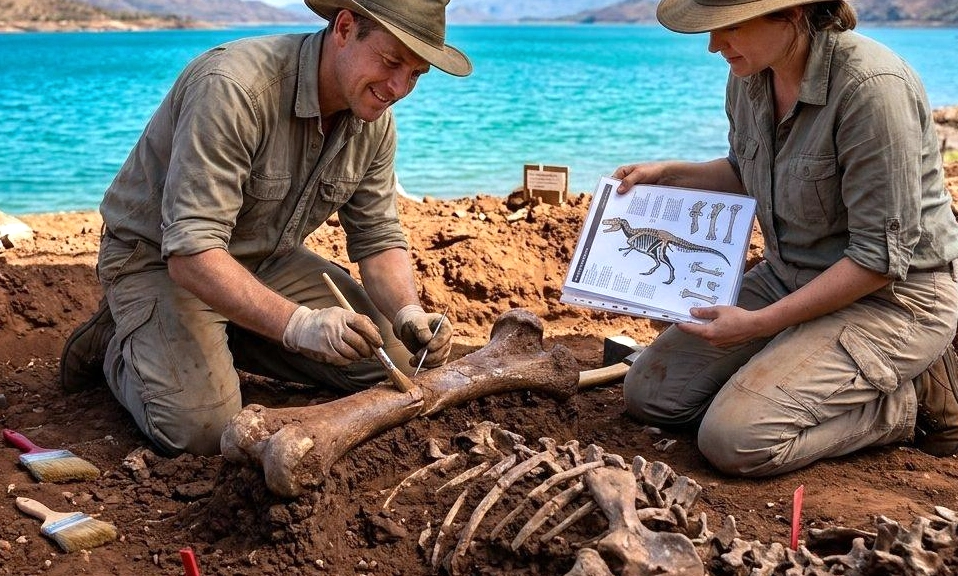
In 2018, an international team from Zimbabwe, South Africa, and the UK was prospecting the shoreline of Lake Kariba, deep inside Matusadona National Park. With no road access, the team used a houseboat as a floating base and mobile laboratory.
Barrett was walking along the shoreline when he noticed leg bones eroding out of the ground — a thigh, shin, and ankle that proved distinct enough to represent an entirely new species.
“I’ve named many species in my career, but this is the first time I’ve described a dinosaur that I found myself,” Barrett said.
The discovery also highlights a deeper problem in palaeontology. Africa’s fossil record is vastly undersampled compared to North America, Europe, and Asia. As co-author Dr. Kimberley Chapelle put it: “The main reason for the underrepresentation of African dinosaur fossils is ‘undersampling.’ Put simply, there have been fewer people looking for and unearthing dinosaurs in comparison with other regions of the world”.
Musango matusadonaensis, she added, “highlights the potential of the region for further paleontological discoveries”.
Musango matusadonaensis
is not just a new species. It is a window into a lost world — a Late Triassic Africa that was not a single, uniform landscape, but a patchwork of distinct ecosystems, each with its own unique dinosaurs, its own climate, its own story.
The discovery challenges the assumption that early dinosaurs roamed freely across connected continents. It suggests that even 210 million years ago, geography and climate were powerful forces shaping the diversity of life. And it reminds us that the fossil record is not a complete book. It is a scattered collection of pages, many of them still buried in the red mudstones of places like Lake Kariba, waiting for someone to notice a bone eroding out of the ground.
“What we’ve found so far is only the tip of the iceberg,” Barrett said.
The lost world beneath Zimbabwe is just beginning to reveal itself. And Musango matusadonaensis is the first of its inhabitants to step into the light.