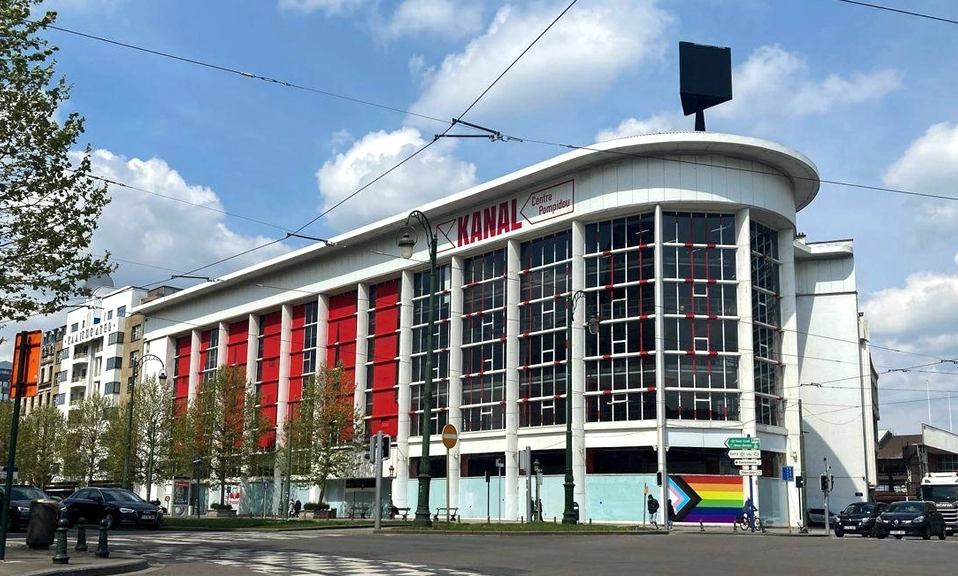
After nearly a decade of construction, delays, and political turbulence, Brussels is finally about to unveil the cultural institution it has long lacked. On 28 November 2026, the Kanal-Centre Pompidou will open its doors in a vast former Citroën factory on the banks of the city’s canal, transforming a derelict industrial landmark into one of Europe’s largest museums of modern and contemporary art.
It is a project that has been described as Europe’s largest museum development, a €230 million gamble on the belief that Brussels—a city rich in artists but poor in major contemporary art spaces—is ready for an institution of international scale. With five floors of galleries, a rooftop restaurant, a library, an architecture centre, a 700-square-metre playground, and even a bakery, Kanal is not just a museum. It is a new piece of the city.
The Building: From Citroën Factory to Art Hub
The Kanal-Centre Pompidou is housed in the former Citroën car assembly plant, an Art Deco landmark built in the mid-1930s and acquired by the Brussels-Capital Region in 2015. The 40,000-square-metre complex—roughly one and a half times the size of the Guggenheim Bilbao—has been reimagined by a team of architects including noAarchitecten (Brussels), EM2N (Zurich), and Sergison Bates (London).
The building’s industrial bones have been retained, but its interior has been radically opened up. An 18-metre-high “street” in the shape of a cross cuts through the structure, connecting entrances on all four facades and creating a free, unprogrammed public space that is intended as a meeting place and an accessible gateway to the art. Almost half of the building’s area is dedicated to unprogrammed public space—a deliberate choice to ensure the museum feels open and welcoming rather than exclusive.
The former showroom, a 24-metre-high glass-and-steel structure, faces the city centre and serves as Kanal’s public face, with large sections of its façade able to open onto the redesigned Sainctelette Square. At the top, there is a restaurant and a freely accessible rooftop terrace with panoramic views over Brussels.
The Opening Programme: Ten Exhibitions, 350 Works
Kanal is not opening quietly. The inaugural season features ten exhibitions across fourteen spaces, bringing together works by more than 250 artists—a statement of intent for an institution that aims to position itself “between permanence and experimentation, inherited histories and imagined futures”.
The centrepiece is “A Truly Immense Journey” , a sprawling exhibition running from 28 November 2026 to 10 January 2028, featuring over 350 works drawn from the collection of the Centre Pompidou in Paris. The show explores themes of movement, migration, trade, and the exchange of ideas—a thematic choice that Kanal’s artistic director, Kasia Redzisz, describes as deeply representative of Brussels, a city shaped by centuries of migration and cultural confluence. Artists on display include Henri Matisse, Alberto Giacometti, Sonia Delaunay, Lygia Clark, and Wolfgang Tillmans.
Other exhibitions in the opening programme include:
“An Infinite Woman: Black Archives in Two Acts” (28 November 2026 – 26 April 2027), which revisits the colonial circulation of images of Mangbetu women and their reappropriation by Afro-descendant artists.
“No Show” (28 November 2026 – 18 January 2027), an immersive, ironic exhibition by Deborah Bowmann and Maoupa Mazzocchetti that asks whether a museum can entertain, blending art, light, sound, and live performance.
“Whispering Pleas of the Eternal Echoes” by Joshua Serafin, an immersive film installation exploring questions of origin and identity.
“La Première Fois” by Joëlle Tuerlinckx, a personal reflection on the artist’s first encounter with the museum’s underground gallery space.
“Blindsight” by Manon de Boer, a meditative installation offering a moment of respite amid the museum’s bustle.
Kanal Architecture: A New Home for CIVA
A significant part of the Kanal project is the relocation of CIVA, Brussels’ architecture museum, which will become Kanal Architecture. The new space will house three exhibition halls, 2,000 square metres of archive rooms, a research centre, a library, a study room, and a bookshop, bringing CIVA’s vast collections to a much larger audience.
Its first special exhibition, “The Right to the City – Right to the Future” , positions Brussels as a pioneering laboratory for new spatial practices, pushing back against the tendency to blame the city for its problems.
The Partnership: A Pompidou in Brussels
Kanal’s relationship with the Centre Pompidou in Paris is at the heart of its identity. A partnership agreement signed in 2017 grants Kanal access to the Pompidou’s 150,000-strong collection of works dating from 1905 to the present, as well as advice on development and programming. The arrangement, which runs until at least 2031, costs Kanal €2 million annually.
The timing is fortuitous. The Centre Pompidou’s iconic Paris home is currently closed for a five-year refurbishment, meaning the Brussels outpost will be the primary showcase for its collection during that period. As managing director Yves Goldstein put it, the partnership is not intended to be permanent: “We will assess it by 2029 or 2030 and think about what we’ll do afterwards”.
Free Spaces and Accessibility
One of Kanal’s most distinctive features is its commitment to free public space. While the ten exhibitions will be ticketed (with a single ticket covering everything), the library, reading room, rooftop terrace, and the 18-metre internal street will be free to access. A Brussels subscription will be available for the first six months, making access very cheap for local residents, and the museum has stated that making the institution accessible to young people is a policy priority.
This emphasis on free, open space reflects a broader ambition: to create a museum that belongs to the city, not just to the art world. As Goldstein said, “Brussels has never lacked artists, but it does lack a contemporary art museum to give them a place. Kanal is the answer to that”.
A Turbulent Journey
The road to opening has not been smooth. The project was due to be completed three years ago, but was hit by financial and political problems, including government formation paralysis in Brussels that threatened its launch over budgetary issues. A fire in July 2026 also caused damage, though the museum confirmed it would open as planned. The final construction bill is expected to reach €230 million, of which the Brussels Region has committed €185 million, and the annual operating budget is around €30-35 million.
Goldstein has been adamant that there is no turning back. “This time, there is no way back,” he said. “This project will be done. This place can only be the museum that we have built for nine years now”.
Brussels has waited
a long time for a cultural institution of this scale. The Kanal-Centre Pompidou is not just a museum; it is a statement that the city—home to Magritte, the Belgian surrealists, and a thriving contemporary art scene—deserves a place among Europe’s great art capitals. With its vast industrial spaces, its partnership with the Pompidou, its commitment to free public access, and its ambition to tell stories that have been overlooked, it is poised to become one of the continent’s most significant cultural destinations.
The doors open on 28 November 2026. The first weekend is free, but reservations are required. For anyone planning a visit to Brussels, it is a date worth marking.
Will you be visiting the Kanal-Centre Pompidou when it opens—and what exhibition are you most looking forward to?