Cerebras has done something remarkable in 2026: it has turned a decade-old architectural gamble into a credible business, a blockbuster IPO, and a set of hyperscaler partnerships that no other Nvidia challenger has managed. But the question of whether it can become a serious threat to Nvidia’s dominance depends entirely on which battlefield you are looking at. In the niche of ultra-low-latency inference, Cerebras is already a genuine rival. In the broader war for AI infrastructure, it remains a specialist with a revenue base that is less than one per cent the size of Nvidia’s.
The distinction matters because the AI chip market is no longer a single monolithic contest. It is splitting into layers—training, general-purpose inference, and latency-critical inference—and each layer has different technical requirements and different winners. Cerebras is not trying to beat Nvidia at everything. It is trying to own the layer where its wafer-scale architecture has an insurmountable advantage.
The Technological Bet: One Wafer to Rule Them All
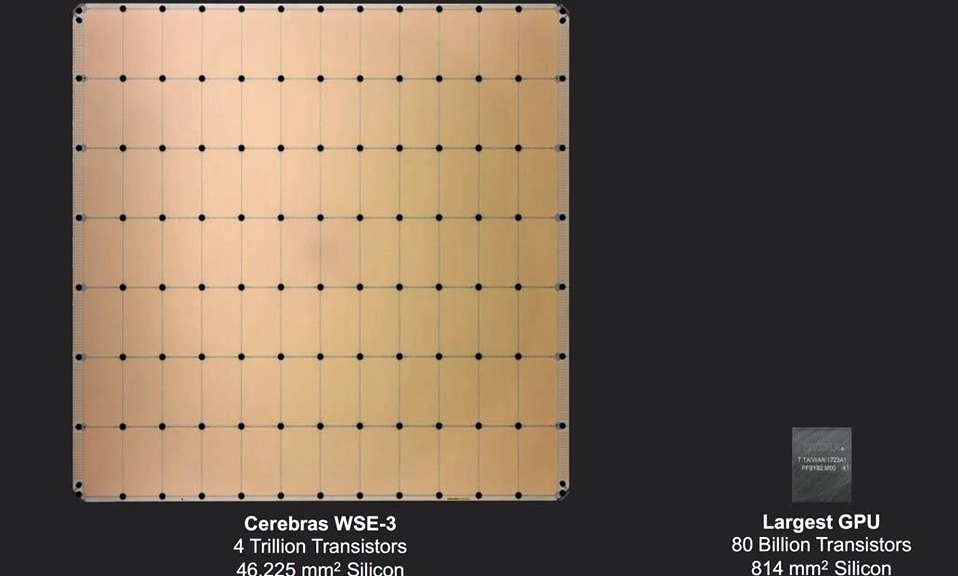
Cerebras’ core innovation is deceptively simple to describe and extraordinarily difficult to execute. Instead of cutting a silicon wafer into dozens of individual chips and packaging them separately, Cerebras keeps the entire wafer as one massive processor. The WSE-3 Turbo (WSE-3T) measures 46,225 mm², contains 4 trillion transistors, and packs 900,000 AI-optimized cores with 44GB of on-chip SRAM.
The performance implications are dramatic. The WSE-3T delivers 250 petaflops of AI compute—which Cerebras claims is 56× more compute than Nvidia’s B300—and a rack-scale CS-4 system powered by three WSE-3T processors promises up to 30× faster inference than GPU systems. The secret sauce is memory bandwidth: the WSE-3’s on-chip SRAM delivers 21 PB/s, compared with 3.35 TB/s for an Nvidia H100’s HBM. That is roughly 2,600× the per-chip bandwidth, and it is why Cerebras can generate tokens at speeds that GPU clusters cannot match.
The real-world validation came from OpenAI. In August 2026, OpenAI launched GPT-5.6 Sol Ultrafast mode, powered exclusively by Cerebras, delivering up to 750 output tokens per second. On the Humanity’s Last Exam benchmark, Ultrafast answered all 2,500 graduate-level questions in 11 hours and 11 minutes; Claude Fable 5 needed 78 hours and 27 minutes to reach comparable accuracy—nearly 7× slower. Independent testing by Artificial Analysis found Cerebras running Llama 4 Maverick at 2,400 tokens/s, compared with 1,040 tokens/s on Nvidia Blackwell—more than double the throughput.
This is not a marginal improvement. It is a different category of performance for a specific, commercially valuable workload: latency-sensitive, low-batch inference, where a single user or agent needs a response as fast as possible.
The Business Momentum: From Curiosity to Contender
For years, Cerebras was a science project with a impressive demo and no scalable business. In 2026, that changed.
The company went public in May 2026 in the largest US tech IPO since Uber, raising $5.55 billion** at a fully diluted valuation of **$56.43 billion. Its Q3 2026 results showed 70% year-over-year revenue growth to $230.9 million**, with cloud and services revenue surging **265%** to **$141.9 million. More importantly, it signed Microsoft as its third hyperscaler customer, following Amazon Web Services and Oracle. The Microsoft deal was signed in October 2026, with revenue expected to begin in Q1 2027.
The biggest prize, however, is OpenAI. Cerebras’ remaining performance obligations stood at $26.1 billion** as of September 30, 2026, and much of that is tied to OpenAI’s **750MW commitment**—a multi-year deal valued at more than **$20 billion. Cerebras also counts Cognition, Lovable, Figma, Block, AlphaSense, GSK, and CrowdStrike among its enterprise customers, using its fast inference for AI coding, agentic workflows, and inline security inspection.
The customer diversification matters. A year ago, Cerebras was a one-customer story. Today, it has three hyperscalers, a frontier lab, and a growing roster of enterprises. That is the profile of a company that is building a real business, not just a demo.
The Reality Check: The Gap Is Still Enormous
For all its momentum, Cerebras is not close to challenging Nvidia’s dominance in any meaningful market-share sense.
Nvidia held 63% of AI chip supply in Q2 2026, measured in H100-equivalents, and an estimated 75% of AI accelerator revenue for the full year. Its projected 2027 annualized run rate is $432 billion**. Cerebras’ 2027 revenue target is **$2.85 billion—approximately 0.6% of Nvidia’s run rate. Even if Cerebras triples revenue in 2027, as it has guided, it will remain a rounding error in the broader AI infrastructure market.
The technological comparison is also more nuanced than Cerebras’ headline claims suggest. The WSE-3’s 44GB of on-chip SRAM is tiny compared with Nvidia’s 288GB of HBM3e on a B300 or 288GB of HBM4 on Rubin. For large models, Cerebras must stream weights from external memory or link multiple wafers, which introduces complexity and limits the size of models it can serve efficiently on a single system. Nvidia’s Rubin, meanwhile, offers 50 petaflops of NVFP4 inference per GPU, 22 TB/s of memory bandwidth, and 3.6 TB/s of NVLink—specifications that are designed for training and inference at massive scale, not just latency-critical serving.
And then there is the software moat. CUDA is the default language of AI development, and the entire open-source LLM ecosystem—PyTorch, Hugging Face, vLLM, TensorRT-LLM—is optimized for it. Cerebras supports PyTorch, but workloads written for CUDA typically require porting, and its compiler and SDK are proprietary. Cerebras has chosen not to submit to MLPerf Inference, the industry’s most widely cited benchmark, relying instead on its own measurements and third-party numbers from Artificial Analysis. For enterprise buyers, that absence is a procurement obstacle: it makes direct comparisons with Nvidia, AMD, and Intel difficult.
The Threat Assessment: Where Cerebras Can Win
The honest assessment is that Cerebras is a serious threat in a narrow but growing segment, and a peripheral player in the broader market.
Where Cerebras is a genuine threat: The market for ultra-low-latency inference is real and expanding. As AI agents move onto the critical path of business operations—handling customer service, detecting security threats, executing trades, responding to production outages—the speed of inference becomes a competitive differentiator. OpenAI’s decision to serve its fastest GPT-5.6 mode exclusively on Cerebras is a proof point that cannot be dismissed. The company’s disaggregated inference strategy, pairing AMD GPUs for prefill with Cerebras systems for decoding, is a clever way to expand its reach without needing to replace the entire data center. And its CS-5 chip, expected in production in summer 2027, will further extend its performance lead.
Where Cerebras is not yet a threat: Training. The WSE-3 is designed for inference, and while it can train models, Nvidia’s GPUs remain the default for large-scale training because of their memory capacity, software ecosystem, and the maturity of distributed training frameworks. Nvidia’s Rubin CPX, a specialized accelerator for the compute-bound prefill stage of inference, is a direct response to the disaggregated inference trend that Cerebras is helping to create—a sign that Nvidia is watching, but not yet losing sleep.
Where the threat could grow: If Cerebras can prove that its architecture scales beyond inference into fine-tuning and smaller-scale training, and if it can build a software ecosystem that reduces the porting burden for CUDA-native workloads, it could expand its addressable market significantly. The Microsoft, Amazon, and Oracle partnerships give it the distribution to reach enterprise customers who would never buy a Cerebras system directly. The OpenAI deal gives it the credibility to win more frontier-lab business. And the IPO gives it the capital to keep investing in capacity—700MW of data center capacity is contracted for delivery by the end of 2027, with more than 75% outside the US in Canada, France, and Norway.
A Specialist, Not a Usurper
Cerebras is not going to dethrone Nvidia. The gap in revenue, market share, software ecosystem, and breadth of capability is too wide, and Nvidia is not standing still. But that is the wrong question. The right question is whether Cerebras can build a durable, profitable business by owning a segment of the market that Nvidia cannot serve as well—and on that front, the evidence is increasingly compelling.
The company has a genuine technological advantage in latency-critical inference, validated by OpenAI and adopted by three hyperscalers. It has a growing customer base beyond the hyperscalers, a massive order book, and the capital to scale. Its 2027 revenue target of $2.85 billion is small relative to Nvidia, but it would represent a tripling of revenue in a single year—the kind of growth trajectory that turns a specialist into a serious player.
The AI chip market of 2027 is not a single kingdom. It is a collection of duchies, and Cerebras is carving out one of the most valuable. It may never rule the entire realm. But it does not need to.