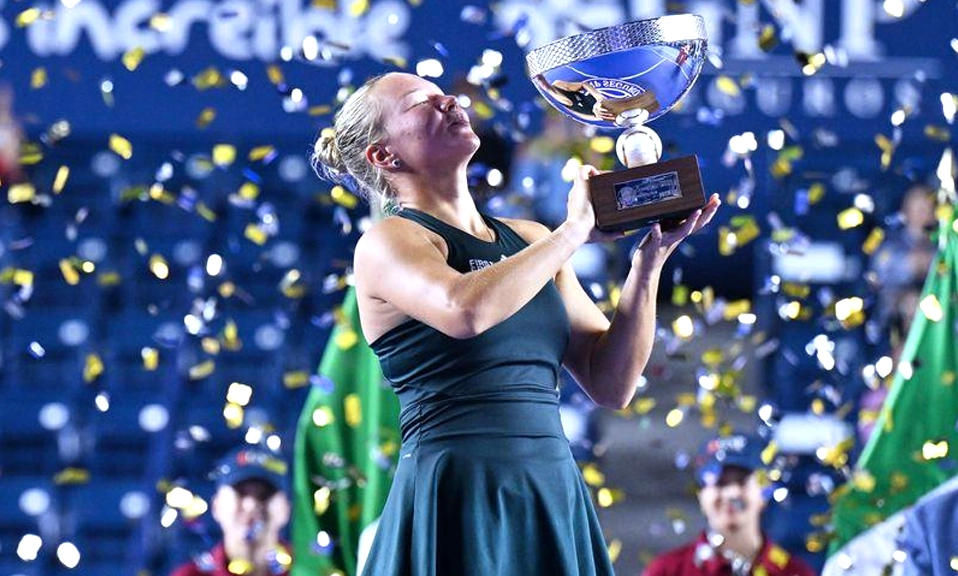
Diana Shnaider doesn’t do quiet victories. She does statement wins. And on Sunday at the Ariake Coliseum, the 22-year-old delivered the kind of performance that separates contenders from champions—a 6-4, 5-7, 6-2 victory over Canada’s Leylah Fernandez in the Pan Pacific Open final that was equal parts brilliance, resilience, and nerve.
It was her first title of the season, her sixth career WTA singles crown, and the culmination of a week in Tokyo that saw her dismantle a series of quality opponents—including a quarterfinal thriller against Alexandra Eala and a semifinal win over Mia Pohankova—before surviving a second-set collapse in the final that would have broken a lesser player.
Here’s why this title matters, what it says about Shnaider’s trajectory, and why the rest of the tour should be paying attention.
The Final: A Match That Almost Got Away
For a set and a half, Shnaider was in complete control. She took the opener 6-4, then raced to a 4-0 lead in the second set. Fernandez, the world No. 23, looked beaten.
Then the match turned.
Fernandez, who had won 16 of her previous 20 matches coming into the final, found another gear. She won seven of the next eight games to take the second set 7-5, forcing a decider. In the third set, she earned three break points on Shnaider’s serve at 1-1. The momentum was entirely with the Canadian.
Shnaider saved all three.
She held serve, broke Fernandez in the fifth game, and won three of the next four games to close out the match in 2 hours and 18 minutes. On match point, she celebrated with a calm pump of her fist—not a scream, not a collapse to the court, just the quiet satisfaction of a job done.
“It means definitely a lot,” Shnaider said on court after receiving the trophy. “It’s a great achievement and a great finish to the season”.
The Numbers Behind the Win
The stat sheet tells the story of a player who was more clinical when it mattered most.
Shnaider: 6 break points converted from 8, zero double faults, two aces.
Fernandez: 4 break points converted from 12, five double faults, and only half of her first serves landing in the opening set.
The difference in the final set was composure. Fernandez had done the hard work to force a decider, but Shnaider refused to let the momentum carry her away. She broke when it counted, held when she needed to, and closed out the match with the kind of authority that has been building all season.
The Season That Led Here
This title didn’t come out of nowhere. It was the product of a year of consistent, high-level tennis that had too often ended in frustration.
Shnaider had reached four semifinals in 2026 before Tokyo—each time falling short of the final. Her best Grand Slam result of the year was a run to the semifinals of the French Open in June. She had been knocking on the door for months.
Tokyo was the breakthrough. And it came against a field that was far from weak. Her quarterfinal against Eala was a three-set thriller (6-2, 6-7, 4-6) that tested her resilience. Her semifinal against Pohankova was a 6-4, 7-6(7) grind that required her to save set points. By the time she reached the final, she had already proven she could win in different ways.
The victory also maintained an extraordinary record in finals: Shnaider is now 6-1 in career WTA singles finals, and she has won her last six finals in a row. That is not luck. That is a player who knows how to close.
The Ranking Jump: Back to a Career High
The title will lift Shnaider from world No. 13 to world No. 11 when the rankings update on Monday—matching the career-high ranking she first achieved in 2025.
That’s a significant milestone, but it also underscores the narrow margins at the top of the women’s game. Shnaider has been a fixture in the top 15 for two seasons, but she has yet to break into the top 10. The players ahead of her—the likes of Iga Świątek, Aryna Sabalenka, Coco Gauff, and Elena Rybakina—have been consistently excellent at the majors and in the WTA 1000 events.
Tokyo was a WTA 500. The next step is converting this level of performance into deep runs at the biggest tournaments. Shnaider’s French Open semifinal showed she can do it on the Grand Slam stage. The question is whether she can do it consistently.
The Context: A Russian Star in a Complicated Era
Shnaider, like all Russian players, competes under a neutral status at international tournaments—a consequence of the IOC’s 2022 recommendations following the invasion of Ukraine. She does not represent her country on the WTA Tour, and Russian flags are absent from her player profile.
That context is worth acknowledging, not because it defines her tennis, but because it shapes the environment in which she competes. Shnaider has spoken about the situation with grace and focus, insisting that her job is to play tennis and let others handle the politics. Her results have done the talking.
She also has a doubles pedigree that speaks to her all-court game: she won silver in women’s doubles at the 2024 Paris Olympics alongside Mirra Andreeva, and she has three WTA doubles titles to her name. That doubles experience—the reflex volleys, the court awareness, the ability to problem-solve in real time—has clearly informed her singles development.
What Comes Next: The Off-Season and 2027
The Tokyo title is Shnaider’s first since Monterrey in August 2025, and it ensures she will finish the 2026 season on a high note. She is now a lock for the year-end top 15, and she has given herself a platform to build on heading into 2027.
The off-season will be crucial. Shnaider’s game has few obvious weaknesses—she hits a heavy ball, moves well, competes fiercely, and has a serve that can dictate points. But the gap between “top 15” and “top 5” is measured in consistency, in the ability to bring her best tennis to the biggest stages, and in the small tactical adjustments that separate the very best from the very good.
At 22, she has time. But time is also a luxury in a tour defined by ruthless competition. The next 12 months will tell us whether Tokyo was a breakthrough or a high point.
Diana Shnaider won her
sixth WTA title on Sunday, and she did it the hard way—by dominating, by nearly losing, and by refusing to let the match slip away. She saved three break points in the third set, broke when it mattered, and closed out a final against a player who had been in excellent form.
It was her first title of the year, her third WTA 500 crown, and a reminder that she is one of the most compelling young players on the women’s tour. She is 22 years old, ranked No. 11 in the world, and she is getting better.
The rest of the tour has been warned.
Diana Shnaider is coming. And she’s not finished yet.