On November 8, 2026, more than a billion people across the globe will pause to light a lamp against the darkness. It is a gesture so simple that a child can perform it, and so profound that it has endured for more than 2,500 years. Diwali—the Festival of Lights—is not just a holiday. It is a shared human declaration that light will always find a way.
In 2026, Diwali is celebrated over five days, from November 6 to November 10, with the main day of celebration falling on Sunday, November 8. The date shifts each year because it follows the Hindu lunar calendar, falling on the darkest night of the month, the new moon. And that is the point: the festival is at its most radiant precisely when the world is at its darkest.
What Is Diwali?
The name comes from the Sanskrit dipavali, meaning “row of lights”—a reference to the countless oil lamps, called diyas, that decorate homes, temples, and public spaces during the festival. For Hindus, Diwali commemorates the return of Lord Rama to Ayodhya after 14 years of exile and his defeat of the demon king Ravana. Residents welcomed him home with lit lamps, and the tradition has continued ever since.
But Diwali is not observed by Hindus alone. Jains, Sikhs, and some Buddhists also celebrate the festival, each with their own stories and traditions. What unites them is a common theme that transcends religious boundaries: the victory of light over darkness, knowledge over ignorance, and good over evil. It is a festival that belongs to anyone who has ever hoped for a brighter tomorrow.
The five-day celebration is also a time of renewal. Homes are deep-cleaned to prepare for the arrival of the goddess Lakshmi, who is associated with prosperity and abundance. It marks the beginning of the new year in the Hindu calendar and celebrates the year’s last rice harvest. It is, in every sense, a festival of new beginnings.
The Spectacle: A World Lit by a Billion Flames
The visual scale of Diwali is difficult to comprehend until you see it.
In Ayodhya, the northern Indian city believed to be the birthplace of Lord Rama, millions of earthen oil lamps are lit at dusk on the banks of the Saryu River—a ceremony that has become one of the defining images of the festival. In Jaipur, the Swaminarayan Akshardham temple is illuminated with thousands of lights, drawing visitors from across the country. In Srinagar, in Indian-controlled Kashmir, Hindus and paramilitary soldiers alike light oil lamps to celebrate the festival, a small but poignant symbol of shared community in a region often defined by division.
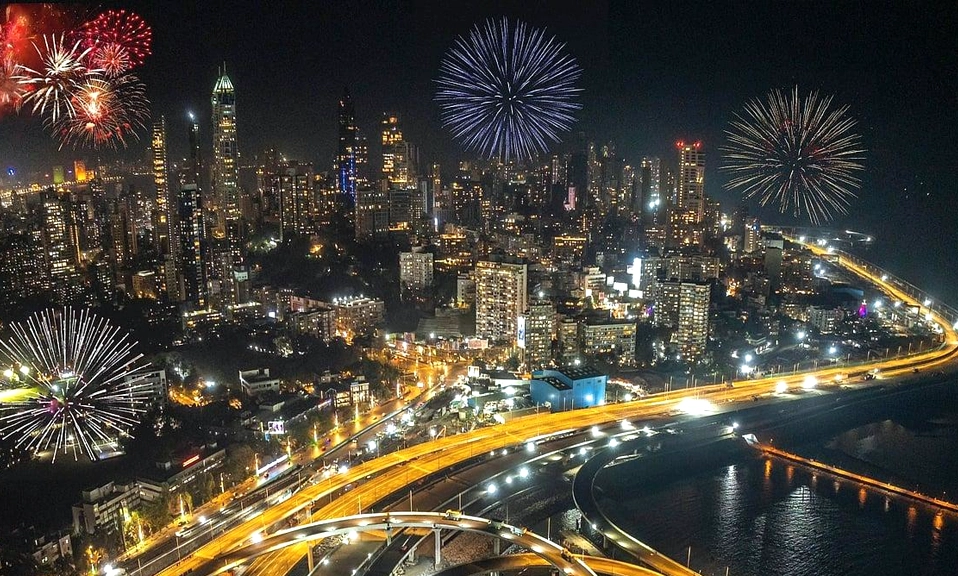
Across India, the night sky is filled with fireworks—a tradition that has become as synonymous with Diwali as the lamps themselves. And in homes from Mumbai to Manipur, thresholds are decorated with rangoli, intricate floor designs made from colored powders, flower petals, rice, or chalk, intended to invite prosperity and good luck into the home.
A Global Festival
Diwali is no longer confined to the Indian subcontinent. It is a global celebration, observed by the Indian diaspora and embraced by communities around the world.
In New York, Diwali was celebrated at Times Square with performances and gatherings, and Governor Kathy Hochul formally signed a proclamation designating November 8 as Diwali, recognizing the contributions of South Asian communities. In Toronto, Mayor Olivia Chow did the same. At the White House, President Donald Trump participated in a diya-lighting ceremony with India’s Ambassador to the US and members of the Indian-American community.
World leaders from across the political spectrum extended greetings. French President Emmanuel Macron wrote: “Wishing all my Indian friends in India, France, and around the world a very happy Diwali! May its light inspire us to ever uphold unity, peace, and hope!”. Australian Prime Minister Anthony Albanese described Deepavali as “a celebration of the victory of light” that unites communities across religious and cultural boundaries. UAE Vice President and Prime Minister Sheikh Mohammed bin Rashid Al Maktoum offered “warmest wishes and greetings to all those celebrating Diwali” and wished them “peace, hope, and goodness”.
The outpouring of messages from leaders across continents illustrated, as one report put it, “Diwali’s power to bridge borders and cultures, uniting people in a shared hope that light, goodness, and prosperity will prevail”.
The Meaning: Why Light Matters
Diwali’s spectacular visuals are not an end in themselves. They are a language—a way of expressing something that words struggle to capture.
“The light from these lamps symbolizes the illumination within all of us, which can overcome ignorance, represented by darkness,” the Hindu American Foundation explains. The diya is not just a decoration. It is a reminder that every person carries a light within them, and that this light is capable of dispelling the darkness of fear, hatred, and ignorance.
In a world that often feels defined by division—political, religious, cultural—Diwali offers a different story. It is a festival that celebrates the triumph of hope over despair, and it invites everyone, regardless of faith or background, to share in that hope. It is a reminder that the darkest night is always followed by the dawn, and that the smallest flame can hold back the greatest shadow.
Diwali 2026 is a celebration
of light in all its forms: the physical light of a billion diyas, the spiritual light of knowledge and compassion, and the collective light of a global community that refuses to let darkness have the final word. It is a festival of spectacular beauty and profound meaning, of ancient tradition and modern relevance.
On November 8, as the sun sets and the first lamps are lit, more than a billion people will participate in a ritual that has endured for millennia. They will light a flame against the dark, and they will declare—in a language older than any scripture, simpler than any prayer—that light will always find a way.