If you travel the world, you’ll see a lot of familiar faces. Pigeons in Paris, raccoons in New York, stray cats in Rome, and sparrows in Tokyo. Thanks to human expansion and adaptable biology, many species have gone global.
But there is a rare and magical category of animals that defy this trend. They are called endemic species—creatures that are native to and found in only one specific geographic location on the entire planet.
Usually, this happens because of extreme geographic isolation. An island breaks away from a continent, a mountain range creates an impenetrable barrier, or a unique microclimate evolves over millions of years. Cut off from the rest of the world, these animals evolve in their own private evolutionary sandbox, becoming utterly unique.
If you want to see these creatures, you have only one choice: you must go to their specific country. Here are 5 of the most fascinating endemic animals on Earth, and the single countries that call them home.
🦎 1. The Komodo Dragon 🇮🇩
Exclusive Country: Indonesia
The Quirk: The world’s largest, most prehistoric living lizard.
The Quirk: The world’s largest, most prehistoric living lizard.
If you want to see a Komodo dragon in the wild, you must travel to Indonesia. Specifically, to a handful of islands in the Lesser Sunda archipelago, including Komodo, Rinca, Flores, and Gili Motang.
Growing up to 10 feet long and weighing over 150 pounds, these apex predators look like they walked straight out of the Jurassic period. For years, scientists believed their mouths were deadly simply because of rotting bacteria. We now know the truth is much more fascinating: they possess specialized venom glands in their lower jaws that prevent blood from clotting, sending their prey into shock. They are the ultimate example of island gigantism, evolving to fill the apex predator role in an ecosystem devoid of large mammalian carnivores.
🦜 2. The Kākāpō 🇳🇿
Exclusive Country: New Zealand
The Quirk: The world’s only flightless, nocturnal, and overweight parrot.
The Quirk: The world’s only flightless, nocturnal, and overweight parrot.
Before humans arrived, New Zealand was a bird’s paradise with almost no land mammals. Without the need to fly away from predators, birds evolved to fill every ecological niche. The Kākāpō (Māori for “night parrot”) is the most bizarre result of this isolation.
It is the heaviest parrot in the world, flightless, and active only at night. It smells faintly of honey and old books, and it has a bizarre, booming mating call that can be heard from miles away. By the 1990s, habitat loss and introduced predators (like cats and stoats) brought the Kākāpō to the brink of extinction, with fewer than 50 individuals left. Today, thanks to one of the most intensive, country-wide conservation efforts in history, every single living Kākāpō is named, tracked, and protected on predator-free offshore islands. Their population is slowly, beautifully bouncing back.
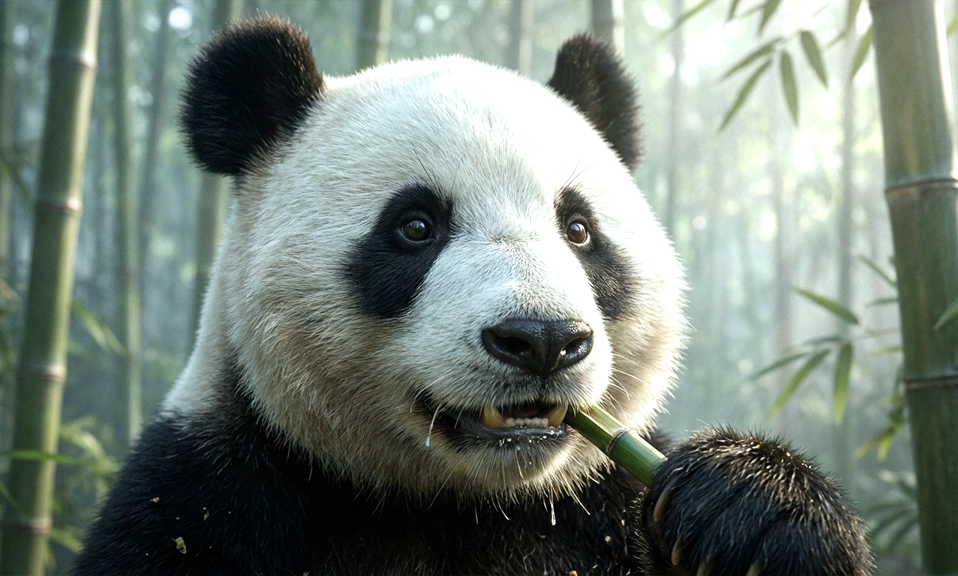
🐼 3. The Giant Panda 🇨🇳
Exclusive Country: China
The Quirk: A carnivore’s digestive system running entirely on bamboo.
The Quirk: A carnivore’s digestive system running entirely on bamboo.
The Giant Panda is the ultimate symbol of wildlife conservation, and for good reason: it is found nowhere in the wild except in the remote, misty mountain ranges of central China (primarily Sichuan, Shaanxi, and Gansu provinces).
Pandas are biologically fascinating. They belong to the order Carnivora and have the digestive tract of a meat-eater, yet 99% of their diet consists of bamboo. To survive on such a low-nutrient food source, they have evolved a “false thumb” (an enlarged wrist bone) to grip bamboo stalks, and they must spend up to 14 hours a day eating. While they were recently downgraded from “Endangered” to “Vulnerable” thanks to massive Chinese reforestation and anti-poaching efforts, they remain strictly bound to their native bamboo forests.
🦎 4. The Marine Iguana 🇪🇨
Exclusive Country: Ecuador
The Quirk: The only ocean-going lizard in the world.
The Quirk: The only ocean-going lizard in the world.
To find a Marine Iguana, you must travel to Ecuador—specifically, to the remote volcanic archipelago of the Galápagos Islands.
When Charles Darwin first saw them, he famously called them “imps of darkness.” These spiky, charcoal-colored reptiles are the only lizards on Earth that forage in the sea. They dive up to 30 feet deep into the freezing, nutrient-rich Pacific currents to scrape algae off underwater rocks. To survive the cold, they are masters of thermoregulation: they bask on black volcanic rocks to absorb heat, and they have specialized glands connected to their nostrils that allow them to “sneeze” out excess salt from the seawater they ingest. They are a masterclass in extreme evolutionary adaptation.
🐒 5. The Ring-Tailed Lemur 🇲🇬
Exclusive Country: Madagascar
The Quirk: The charismatic face of an entire island’s evolutionary isolation.
The Quirk: The charismatic face of an entire island’s evolutionary isolation.
Technically, all lemur species (over 100 of them) are endemic to Madagascar, but the Ring-Tailed Lemur is the most iconic.
Madagascar split from the African continent about 160 million years ago, and from India about 88 million years ago. This extreme, prolonged isolation allowed the animals that rafted over or were already there to evolve without competition from monkeys or apes. Lemurs filled the ecological niches that primates fill elsewhere. The Ring-Tailed Lemur, with its iconic black-and-white striped tail and sunbathing habits (sitting in a “yoga” pose to warm up in the morning), is found only in the spiny forests and scrublands of southern and southwestern Madagascar.
⚠️ The Fragility of Being “One of a Kind”
There is a dark side to being endemic. When a species is found in only one country, or one specific ecosystem, it is incredibly vulnerable.
If a disease, invasive species, natural disaster, or human development impacts that single location, the entire global population of that species is at risk. The Kākāpō nearly vanished because of this. The Marine Iguana is highly vulnerable to oil spills and climate change (like El Niño warming the ocean and killing their algae food source).
This is why endemic species are the highest priority for global conservation efforts. Protecting them doesn’t just save an animal; it protects an entire, irreplaceable evolutionary lineage.
The Magic of Geographic Isolation
The existence of these animals is a reminder of how wonderfully weird and diverse life on Earth can be when left to its own devices.
The Komodo Dragon, the Kākāpō, the Giant Panda, the Marine Iguana, and the Ring-Tailed Lemur are not just animals; they are living, breathing testaments to the power of time, isolation, and evolution. They belong to their countries, and in a way, those countries are the sole guardians of a piece of the planet’s biological magic.