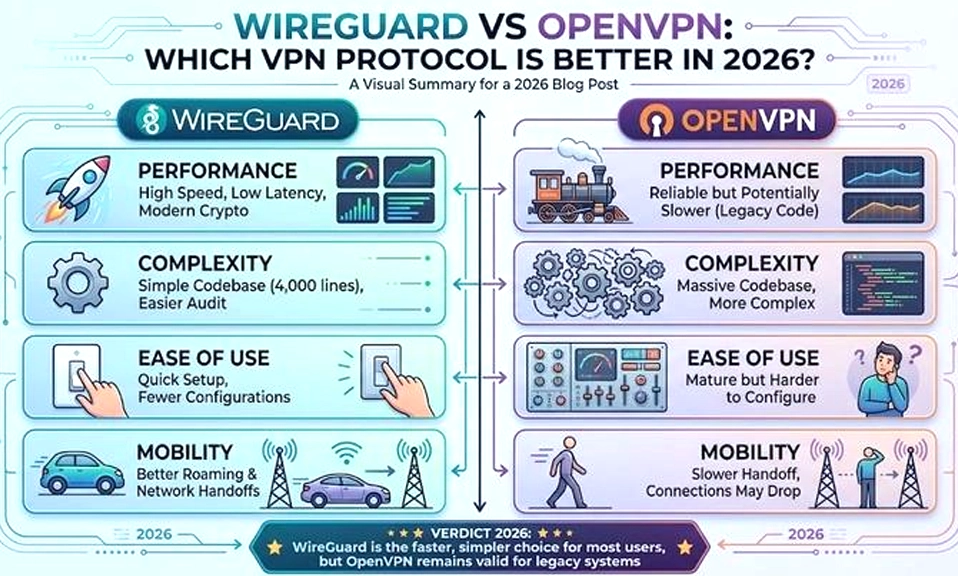
The VPN protocol landscape has a clear frontrunner for most people in 2026: WireGuard is the faster, lighter, and more modern default. However, OpenVPN is far from obsolete, and thanks to a major performance update in 2026, it remains the essential tool for anyone facing restrictive firewalls or censorship. The choice is not about which is better overall, but which is better for your specific situation.
Here is the definitive breakdown of how WireGuard and OpenVPN compare in 2026.
⚡ Speed and Performance: The Gap Has Narrowed
For years, WireGuard was the undisputed speed king, and for most use cases, it still is. Its code is integrated directly into the Linux kernel, allowing it to process data with remarkable efficiency. Independent tests have consistently shown WireGuard delivering 1.5x to 4x the throughput of legacy OpenVPN implementations on the same hardware. It also establishes a connection almost instantly, often in around 100 milliseconds, compared to the 1 to 2 seconds OpenVPN can take. In real-world use, this means faster browsing, quicker file transfers, and a more seamless experience, especially on mobile devices.
The critical development in 2026 is OpenVPN’s Data Channel Offload (DCO) . Historically, OpenVPN’s data encryption ran in “user space,” a slower method. DCO moves this process into the kernel, dramatically improving performance. Vendor benchmarks now show OpenVPN with DCO achieving 700 Mbps, surpassing WireGuard’s 600 Mbps in the same router tests. Other reports show IPVanish achieving download speed increases of up to 196% with DCO enabled.
The Verdict on Speed: For the vast majority of consumer VPN apps, which do not yet widely deploy DCO, WireGuard remains the faster and more efficient choice. For enterprise or self-hosted setups where DCO can be fully leveraged, OpenVPN can achieve parity or even a slight edge in raw throughput, but WireGuard’s near-instant connection times still give it a practical advantage.
🛡️ Security and Privacy: Two Paths to Trust
Both protocols are considered highly secure, with no known cryptographic weaknesses, but they achieve this through different philosophies.
WireGuard follows a “do one thing and do it well” approach. It uses a fixed, modern cryptographic suite (ChaCha20 for encryption, Curve25519 for key exchange, BLAKE2s for hashing). This lack of configurability is a security feature: it eliminates the risk of a user or provider choosing a weak cipher or falling victim to a downgrade attack. Its codebase is roughly 4,000 lines, making it far easier for security researchers to audit and less likely to contain hidden bugs. This simplicity is its greatest security asset.
OpenVPN is the veteran, with over two decades of scrutiny. It offers configurable cryptography, allowing it to use a wide range of ciphers via the OpenSSL library, including AES-256-GCM and ChaCha20-Poly1305. This flexibility allows it to adapt to different security standards. Its larger, more complex codebase (often cited as 70,000 to 400,000 lines) has been extensively audited, but its size presents a larger theoretical attack surface.
The Verdict on Security: Both are excellent and trustworthy. If you prefer a minimalist, opinionated design with a smaller attack surface, WireGuard is the safer default. If you require specific, configurable cryptographic options or need to integrate with existing PKI (Public Key Infrastructure) systems, OpenVPN offers more flexibility.
📱 Battery and Data Efficiency: WireGuard’s Clear Win
This is one of WireGuard’s most significant practical advantages, particularly for mobile users. WireGuard is designed to be “silent” when idle, consuming minimal resources. OpenVPN maintains a persistent connection by sending heavier “keepalive” packets every 10 seconds, which uses more CPU and battery.
The impact is substantial: on iOS and Android, WireGuard tunnels typically use 40-60% less battery than OpenVPN. WireGuard also has much lower data overhead—roughly 5% compared to OpenVPN’s 20%—meaning less of your mobile data is consumed by the protocol itself. It is also far more resilient when switching between Wi-Fi and cellular networks, reconnecting almost instantly.
The Verdict on Efficiency: WireGuard is the clear winner for mobile devices, laptops on battery, and anyone on a limited data plan.
🧱 Censorship Resistance and Compatibility: OpenVPN’s Domain
This is the one area where OpenVPN retains a decisive and often irreplaceable advantage.
WireGuard operates only over UDP on a single port. Its “silent” nature, which is a security benefit, also makes it easy for firewalls to identify and block. In countries with sophisticated internet censorship (like China, Iran, or Russia) or on restrictive corporate networks, WireGuard traffic is often simply dropped.
OpenVPN, by contrast, can run over TCP on port 443—the same port used by secure HTTPS web traffic. To a deep-packet inspection system, an OpenVPN TCP connection on port 443 is nearly indistinguishable from a normal, encrypted web browsing session. This allows it to “punch through” firewalls that would block almost any other VPN. OpenVPN also supports Layer 2 bridging (TAP mode), which is necessary for certain types of network applications that WireGuard’s Layer 3-only design cannot handle.
The Verdict on Censorship Resistance: OpenVPN is the clear winner and is often the only viable option in highly restricted network environments.
🔮 Post-Quantum Readiness: A Work in Progress for Both
Both protocols rely on classical public-key cryptography, which is theoretically vulnerable to future quantum computers. Neither is post-quantum secure “out of the box”.
However, the ecosystem is adapting. There are active research efforts to integrate post-quantum key exchange mechanisms (like ML-KEM) into WireGuard. Some VPN providers, like Surfshark, have already deployed a fully post-quantum secure version of WireGuard. OpenVPN’s path to post-quantum security is likely to involve layered solutions, such as using TLS 1.3 with post-quantum cipher suites for the control channel.
The Verdict on Post-Quantum Readiness: It is currently a tie, with both protocols on a path to integration. The practical difference will come down to how quickly individual VPN providers implement and deploy these upgrades.
💎Which Protocol Should You Choose?
The choice is simpler than it might seem, as the “better” protocol depends entirely on your needs.
Choose WireGuard as your default if:
You want the fastest speeds and lowest latency for everyday browsing and streaming.
You use a VPN on a mobile device or laptop and care about battery life.
You value a modern, minimalist design with a small, easily auditable codebase.
You are not behind a restrictive firewall that blocks UDP traffic.
Choose OpenVPN if:
You are in a censored country or on a restrictive corporate or school network where other VPNs fail. Its ability to disguise itself as HTTPS traffic is unmatched.
You need maximum compatibility with older routers, devices, or network setups.
Your use case requires Layer 2 (TAP) bridging or specific, configurable cryptographic options.
You are running a large-scale, multi-user network where a certificate-based PKI is essential for authentication and revocation.
For the average person using a commercial VPN, the app will (and should) default to WireGuard. For the network administrator, the security researcher, or the user in a hostile network environment, OpenVPN remains an indispensable and, at times, irreplaceable tool. The good news is that you rarely have to choose one or the other—most premium VPN services offer both, allowing you to switch based on the network you are on.