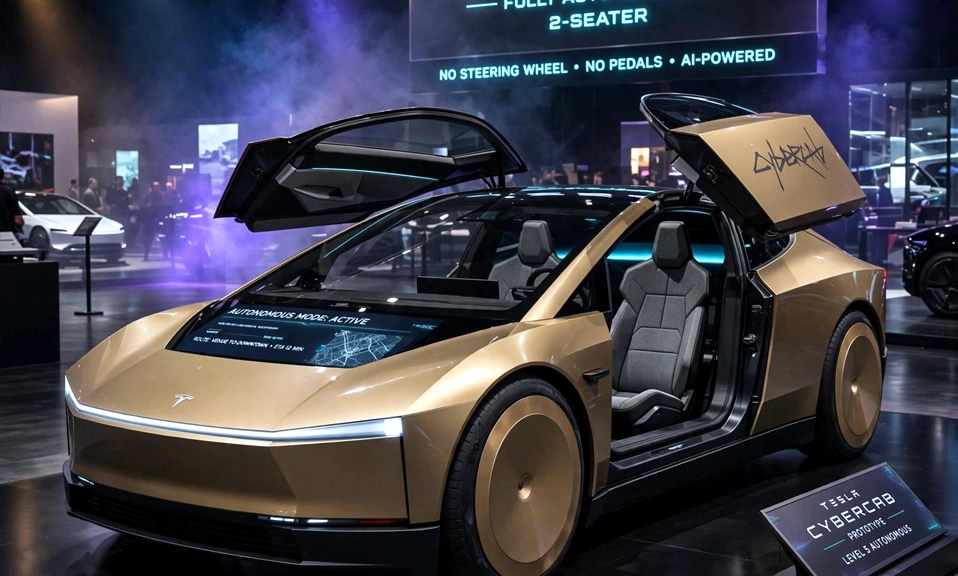
Tesla says you can buy a car with no steering wheel by the end of this year. The US government’s top auto-safety regulator says it’s still investigating how that car was ever certified for the road in the first place. Both statements are true at the same time. That contradiction is the entire story of the Cybercab.
On October 21, 2026, during Tesla’s third-quarter earnings call, VP of Engineering Lars Moravy said the company is “trying to get Cybercabs to customers by the end of this year, 2026”. It was a small-scale pilot, he stressed—a way to “learn about delivery and ownership and fleet management of autonomous vehicles in customer hands”.
But Elon Musk immediately clarified what “customer hands” actually means. The Cybercab, he said, is “primarily” a transport-as-a-service product. The “vast majority” of them will be “essentially Tesla-owned”. Tesla isn’t selling you a car. It’s selling you a ride—and occasionally letting a few people buy the vehicle that provides it.
The Regulatory Wall: Self-Certification Under a Microscope
The Cybercab has no steering wheel, no pedals, and no mirrors. America’s Federal Motor Vehicle Safety Standards (FMVSS) were written for human-driven vehicles and explicitly require those controls.
There is a legal path for a car like this: a Part 555 exemption from NHTSA, which allows manufacturers to deploy vehicles that don’t meet every standard. Amazon’s Zoox took that path and received the first federal exemption for a robotaxi without manual controls, capped at 2,500 vehicles per year.
Tesla didn’t take that path. It self-certified the Cybercab, claiming it meets applicable federal standards without needing an exemption.
On September 4, 2026—the same day Cybercabs began carrying paying passengers in Austin—NHTSA opened an Audit Query (AQ26002) to examine the basis and procedures behind Tesla’s self-certification, covering up to 1,000 vehicles. The agency has asked Tesla to explain which standards it determined were “not applicable” to a vehicle without manual controls, and why. Tesla’s deadline to respond was October 30, 2026.
NHTSA has proposed updating the FMVSS to accommodate driverless vehicles, but those changes are not yet in force. Until they are, the existing standards—including requirements for steering wheels and brake pedals—“remain in force,” the agency has said.
The Software Gap: A Car You Can’t Drive and That Can’t Drive Itself
Here is the detail that makes the Cybercab’s consumer rollout genuinely strange.
Tesla’s current Full Self-Driving system is a Level 2 driver-assistance product. It requires an attentive human driver who is ready to take control at any time. Unsupervised, Level 4 or 5 autonomy—the kind that would actually allow a steering-wheel-less car to operate—is not expected in customer vehicles until the second quarter of 2027, according to Tesla’s AI chief Ashok Elluswamy.
Put those timelines together. If Tesla delivers a Cybercab to a customer by the end of 2026, that customer will own a vehicle that has no steering wheel and no pedals, but also does not yet have the software to drive itself without supervision. As Electrek put it: “This would leave a half-year where these Cybercabs… are completely inoperable. You couldn’t even push them into your driveway, because you’d have no steering wheel to help you do so”.
The only way this makes sense is if the “consumer” Cybercab is not really a consumer product at all. It is a fleet vehicle—owned by a customer, perhaps, but operated by Tesla, dispatched by Tesla, and managed by Tesla. Elluswamy said customer-owned vehicles could join Tesla’s robotaxi fleet around Q2 2027, once integration into Tesla’s service areas and fleet management system is complete.
Will We Soon Own Cars Without Steering Wheels?
Not in any meaningful sense—not yet.
The Cybercab is not the beginning of a wave of steering-wheel-less personal cars. It is the beginning of a new kind of vehicle ownership: one where the manufacturer retains operational control, the “owner” is more of a fleet investor than a driver, and the car’s primary purpose is to generate ride-hailing revenue when it’s not being used.
That model may eventually spread. If Tesla proves that a steering-wheel-less robotaxi can operate safely and profitably at scale, other manufacturers will follow. NHTSA is already moving toward a regulatory framework that would make it easier to deploy vehicles designed without human controls. The Zoox exemption has established a precedent. The rules are being rewritten in real time.
But the personal car—the one you drive, the one that sits in your driveway, the one you control—is not disappearing. The Cybercab is a different category of object. It’s a robotaxi that happens to be sold to individuals, not a car that happens to drive itself.
Musk was remarkably candid about this on the earnings call. The Cybercab is “primarily” a ride service. The “vast majority” will be Tesla-owned. The few that reach customers will be part of a pilot program to figure out how ownership works when the owner isn’t the operator.
So: will we soon own cars without steering wheels? No. We may soon subscribe to cars without steering wheels. We may soon invest in cars without steering wheels. But owning one—in the sense that you own a Model 3, with the keys in your pocket and the wheel in your hands—is not what the Cybercab is selling. It’s selling the end of that kind of ownership, one small pilot delivery at a time.