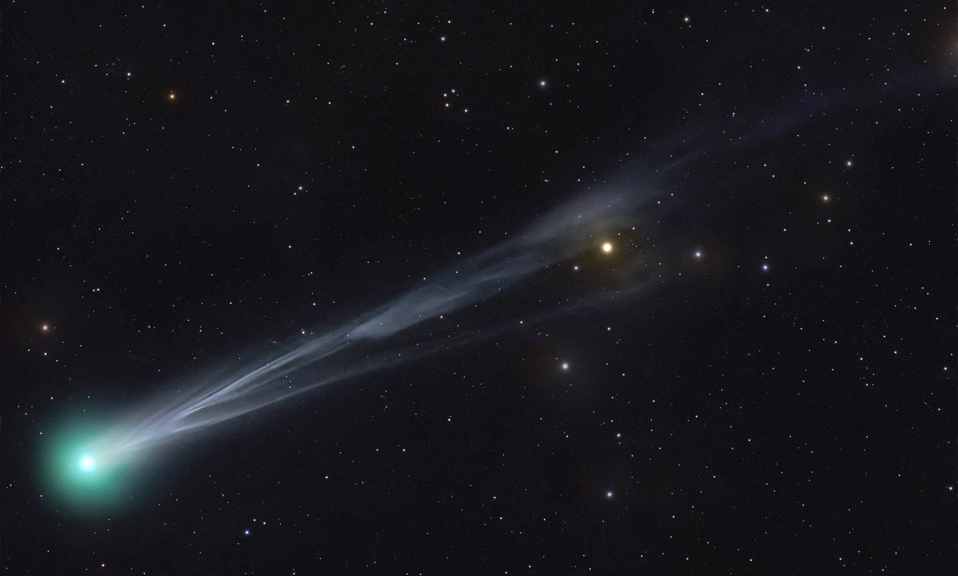
Euclid wasn’t looking for comets. At all.
The European Space Agency’s Euclid space telescope was built to do one job: map the dark universe. 10 billion galaxies, dark matter, dark energy — the biggest, oldest, farthest things in existence.
Last month, it found something small, close, and moving fast — and nobody had ever seen it before.
The Accidental Discovery
The European Space Agency’s Euclid space telescope has discovered a comet that appears in no catalogue. The images were taken between 16 and 24 September 2026.
Spotted in images taken between 16 and 24 September 2026, the object is now officially designated C/2026 S1 (Euclid), and it marks the first previously unknown comet ever found by the dark-matter-hunting observatory. Euclid had photographed comets before, but every one of those was already catalogued.
On September 17, 2026, at 00:41:07, 00:58:53 and 01:16:39 UTC, Euclid’s VIS camera was staring at the same patch of sky for its Euclid Deep Field North survey — a deep, steady look at distant galaxies.
In three images, each a 560.52 second exposure, something moved.
In this image sequence it moves against background stars and galaxies in three of Euclid’s VIS camera exposures. Each image is a 560.52 second exposure, so the comet appears like a streak because it moves across the sky during the long exposure.
Background galaxies stayed perfectly still. This one little smudge crept across the frame like a bug on a windshield.
Software flagged it. Astronomer M. Pöntinen and team checked. It wasn’t in any database.
The Minor Planet Center confirmed the discovery on 8 October, and the object now carries the designation C/2026 S1 (Euclid).
Announcement went public October 19, 2026.
Where Is It? How Far?
The object is designated C/2026 S1 (Euclid) and sits about 1.3 billion kilometers from Earth, roughly the distance from the Sun to a point somewhere between the orbits of Jupiter and Saturn.
That’s 800 million miles away. 807 million miles if you want to be precise.
At that distance, it’s not bright. It’s not tail-y. It’s just a faint, fuzzy streak. No dramatic tail yet — it’s still too far from the Sun for its ice to boil.
The comet, located at a distance of around 1.3 billion kilometers (800 million miles) from Earth, is the first previously unknown comet ever found by the telescope and traverses an orbit that will take thousands of years to complete.
Early orbital calculations say C/2026 S1 (Euclid) is a long-period comet — one that comes from the Oort Cloud, the icy shell at the edge of the solar system, and takes thousands of years to orbit the Sun. This is likely its first trip into the inner solar system in human history. Maybe ever.
Why This Is Wild For Euclid
Euclid was mapping the universe. Then it found a comet. The Euclid space telescope made an accidental comet discovery as it searched the universe for evidence of dark matter and dark energy.
Euclid discovers its first comet. That’s quite impressive for a Dark Universe detective meant to take deep, steady images of distant galaxies, not fast-moving tiny objects.
Think about it: Euclid is designed to NOT see moving things. It stares at the same galaxies for 10 minutes at a time to get perfect sharpness. Fast-moving asteroids and comets are a problem for Euclid — they ruin images. The team built advanced software to detect moving objects in astronomical data and remove them.
This time, instead of deleting it, they kept it. Utilizing advanced software designed to detect moving objects in astronomical data, Pöntinen identified a distinct light trail.
And it paid off.
In a surprising achievement for a telescope designed to peer into the universe’s deepest reaches, the European Space Agency’s (ESA) Euclid spacecraft has discovered its very first previously unknown comet. This celestial interloper was spotted demonstrating Euclid’s unexpected prowess in tracking fast-moving objects within our own Solar System.
ESA’s Euclid Telescope Finds New Comet in October 2026. ESA’s Euclid space telescope has discovered its first previously unknown comet, officially designated C/2026 S1 (Euclid), with the announcement made on 19 October 2026.
What Happens Next?
C/2026 S1 (Euclid) is now on every telescope’s watchlist.
Right now it’s between Jupiter and Saturn, cold and dim. As it falls toward the Sun over the next few years, it will heat up, its ice will sublimate, and it should grow a coma and tail. If it survives perihelion (closest approach), it could become bright enough for amateur telescopes in 2028-2029.
Astronomers will watch it to figure out:
- What it’s made of (pristine ice from 4.6 billion years ago)
- Where it came from (Oort Cloud dynamics)
- How big it is (maybe 1-5 km)
But the coolest part is what it says about Euclid itself.
Euclid was built to look out — to the edge of the universe. In doing so, it accidentally looked in — and found something in our own backyard that all the asteroid-hunting telescopes on Earth missed.
There are likely thousands more like it, hiding in Euclid’s data. The dark universe telescope just became a comet hunter.
Next time Euclid sends back a picture of 10,000 galaxies, remember: there might be a tiny, icy intruder streaking through the corner, uncatalogued, unknown, 800 million miles away — and we only saw it because we were looking at everything else.
That’s how discovery works. You look for dark matter, you find a comet.
Welcome to the family, C/2026 S1 (Euclid).