Every year, an estimated 95,000 diving seabirds drown in gillnets around Europe’s coasts. They dive for fish, become tangled in the mesh, and never resurface. It’s a conservation crisis that has resisted easy solutions for decades. But a new study off the coast of Cornwall suggests that something almost absurdly simple — a buoy with a pair of spinning googly eyes — could cut that death toll by more than half.
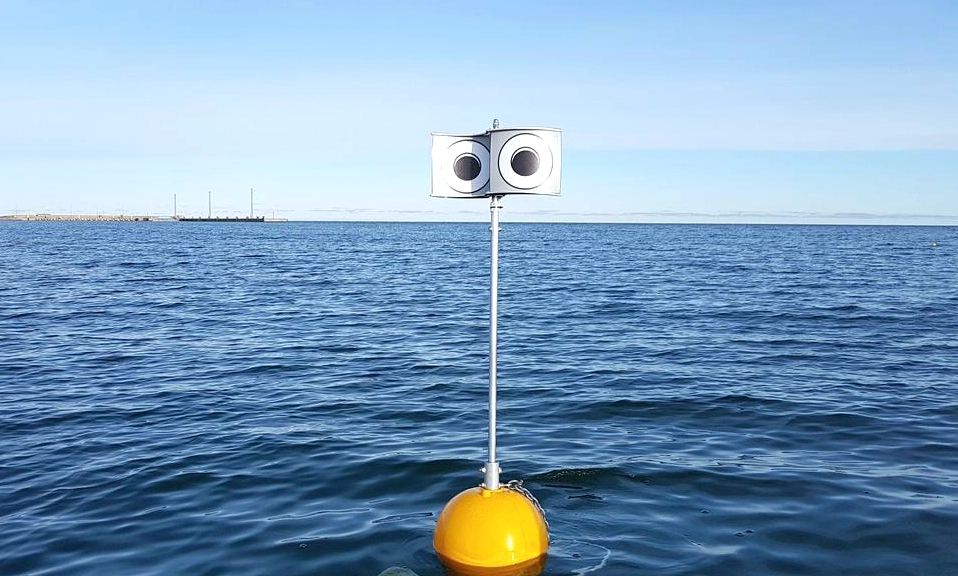
The device is called the Looming Eye Buoy (LEB). It looks like a scarecrow that wandered out to sea: a bright yellow fishing buoy with a pole rising from it, topped by a spinning head displaying large, animated black-and-white eyes. As the ocean moves and the wind blows, the eyes bob and loom, creating the impression of a predator approaching. The idea is to scare diving birds away before they plunge into the net below.
It sounds comical. The results are anything but.
The Scale of the Problem: A Hidden Catastrophe
Gillnets are walls of mesh set in the water to catch fish. They’re effective, relatively cheap, and widely used. They’re also lethal to diving seabirds — auks like guillemots and razorbills, which forage underwater and can’t see the fine mesh until it’s too late.
The numbers are staggering. A 2024 review estimated that gillnets in the Baltic Sea and Northeast Atlantic alone kill more than 95,000 seabirds a year. Across all European fisheries, around 31,000 common guillemots die as bycatch annually. Globally, the estimate for gillnet bycatch is around 400,000 seabirds per year.
“Gillnets have proved a real challenge to develop mitigation methods for and pose a significant threat to seabirds in the UK,” says Yann Rouxel, bycatch programme manager at the RSPB, who co-authored the new study.
Fixes have been hard to find. An earlier trial of eye-pattern deterrents in Iceland’s lumpfish fishery found they didn’t reduce bycatch at all. The problem seemed intractable.
The Breakthrough: 59% Fewer Deaths
The new study, published in Conservation Letters, was led by researchers at the University of Exeter and conducted with 10 Cornish fishers over nearly two years. The fishers set nets in pairs — one with a deterrent, one without — at least 200 metres apart. Cameras and GPS units on their boats recorded every haul.
In total, they set 1,057 nets with a combined length of about 129 kilometres (80 miles). The nets caught 191 non-fish animals: 153 birds, 25 seals, and 13 cetaceans. Guillemots and razorbills made up nearly three-quarters of the total.
The results were clear and consistent.
Nets fitted with the Looming Eye Buoys had 59% lower odds of catching an auk. Nets fitted with a bird-of-prey-shaped kite — the “scarybird” — had 71% lower odds. When birds were caught, the number caught per unit effort dropped by 68% with the buoys and 62% with the kites.
“The biggest surprise was how clear and consistent the results were,” says lead author Tom Horton of the University of Exeter. “Conservation interventions often show mixed results when they’re tested under real-world commercial conditions, so seeing both deterrent types perform well across such a large-scale trial was genuinely encouraging.”
How a Pair of Googly Eyes Fools a Seabird
The Looming Eye Buoy isn’t magic. It’s applied evolutionary biology.
Seabirds are wired to respond to the visual signature of a predator. A large, forward-facing pair of eyes — the kind that belongs to a hawk, an eagle, or a seal — triggers an instinctive avoidance response. The LEB exploits that wiring.
The buoy’s head spins with the wind and waves, creating what researchers call an “animated eye effect.” The eyes appear to loom — growing larger and more threatening as the head rotates — mimicking the approach of a predator. It’s the maritime equivalent of a scarecrow, but with better engineering.
The device was developed over eight years by Fishtek Marine, a Devon-based conservation engineering firm, in collaboration with the RSPB. The design has evolved through multiple prototypes, informed by seabird diving behaviour and visual perception research.
“It’s essentially a rotating head with an eye, which gives the impression of an animated, or looming eye, which deters the birds from going near the fishing nets,” explains Tom Hooper, senior fisheries scientist at Fishtek Marine.
The Kites: A Stronger Deterrent, With Drawbacks
The “scarybird” kite — a commercially available kite shaped like a bird of prey — actually outperformed the buoy in the Cornwall trial, cutting bycatch odds by 71%. Within 30 metres of the device, the kites were clearly superior.
But kites come with practical problems. Fishers reported that they performed poorly in very light winds and were harder to handle in strong winds. The buoys, by contrast, were easier to handle and store — and they were moderately effective over a wider range.
The authors suggest that improved kites, spaced every 60–80 metres, could be a practical option for coastal gillnet fisheries. But the buoy’s simplicity may make it the more scalable solution.
The Caveats: What the Buoys Can’t Do
The study is a breakthrough, but it’s not a silver bullet. The researchers are candid about the limitations.
Birds may learn to ignore the buoys. A separate 2026 study in Denmark tested the LEB at a pound net and found that it initially reduced bird numbers — but after about 23 days, the birds figured out it was harmless. Cormorants were soon perching right next to it. “They couldn’t care less about the eye turning next to them,” says fisheries scientist Gildas Glemarec.
The buoys may attract seals. In the Cornwall trial, 15 seals were caught in buoy nets, compared with six in control nets and four in kite nets. The authors say more testing is needed to confirm whether this is a real pattern, but it’s a warning sign.
An earlier trial in Iceland failed entirely. The LEBs did not reduce bycatch in Iceland’s lumpfish fishery, suggesting that effectiveness may be species-specific or context-dependent.
The effect may fade over time. The Cornwall team didn’t test for habituation, but they note that birds getting used to deterrents can weaken them over time.
The Smartest Part: Targeting the Worst Months
Perhaps the most practical finding from the study is about timing.
Bycatch in Cornwall peaked in January and February, and was highest in nets targeting sea bass and mackerel with mesh sizes of 100–110 millimetres. That means deterrents don’t need to be deployed year-round. They can be used strategically, during the months when birds are most at risk.
“This means that deterrent efforts can be directed and efficient,” says Hooper.
It’s a model that could be replicated elsewhere: identify the bycatch hotspots, deploy the deterrents when they matter most, and avoid burdening fishers with unnecessary gear the rest of the year.
The Fishers: Partners, Not Bystanders
The study wasn’t just done to fishers. It was done with them.
The 10 Cornish fishers who participated weren’t just providing boats and access. They were actively involved in testing, feedback, and design refinement. “They were actively helping to test ideas, providing feedback on what worked in practice, and suggesting ways the devices could be improved,” Horton says.
Micky Bacon, a fisherman from Mousehole, joined the trial because “the sea is my workplace.”
“It is also a good opportunity to publicise to people outside the industry that fishermen don’t just want to go and catch fish, we also want to be part and parcel of improving the environment,” he said.
That collaborative approach is essential. Any technology used at sea must be simple and robust — and the only way to ensure that is to work with the people who will actually use it.
The Looming Eye Buoy is not
a perfect solution. It doesn’t work everywhere. Birds can learn to ignore it. It may attract seals. And its effect may fade over time.
But in the waters off Cornwall, in the hands of fishers who helped design it, it cut seabird bycatch by 59%. That’s not a rounding error. That’s tens of thousands of birds that might otherwise have drowned.
The study’s most important message, Horton says, is simple: “bycatch is not an inevitable consequence of fishing.”
A pair of googly eyes on a buoy won’t save every seabird. But it might save enough to make a difference. And in a world where conservation news is often grim, that’s something worth celebrating.